
How to store your tyres correctly (summer, winter, all-season): the complete guide

Good storage extends the life of your tyres, prevents deformation and preserves grip. Here's how
reliable for storing summer, winter and all-season tyres, with or without rims.
Reading time: 6–8 min
Why storing your tyres properly is essential
The tyres are made of rubber and sensitive components light, to the heat,
to the’Damp and to the Chemical substances. Inadequate storage can lead to:
- Deformations (flats, ovalisation), sources of vibration and irregular wear.
- Premature ageing (microcracks), reducing adhesion and safety.
- Alteration of the compound (hardening), particularly critical for winter tyres.
Properly storing your tyres, therefore, is preserve performance, reduce costs and
to maintain safe road behaviour.
Before storing: cleaning, marking, checking
Properly clean (without harsh products)
Rinse with clear water, then clean with mild soap (like washing-up liquid). Avoid solvents, strong degreasers,
tyre shine products and hydrocarbons.
Important: let dry completely Prior to storage (otherwise moisture + mould).
2) Locate the position of the tyres
Mark on the side with a marker: Android Virtual Device, AVG, Ard, ARG.
This makes it easier to swap them at the next service and helps to balance wear.
3) Check status (safety + compliance)
- Carving depth Check that it remains suitable for your use.
- Uneven wear Interior/exterior, facets (can indicate parallelism/dampers).
- Cuts, hernias, fissures When in doubt, ask a professional for advice.
- DOT (tyre age): the date is shown on the sidewall (week/year). A very old tyre
may perform less well, even if it appears to be little used.
Ideal storage conditions
Aim for an environment stable, second and sheltered :
- Temperature: Cool and constant (avoid strong variations and heat sources).
- Light: out of the sun and UV rays (which accelerate ageing).
- Humidity: low, without condensation (risk of corrosion on wheel rims and deterioration).
- Ozone Keep tyres away from electric motors, compressors, and welding sets (ozone attacks rubber).
- Chemicals away from solvents, fuels, paints, oils, greases.
Covers: useful, but not “waterproof”
Tyre covers protect from dust and light. Prefer a cover or a bag clean and
opaque, without trapping moisture. If you use a plastic bag, ensure the tyre is
perfectly dry and avoid storage in damp areas.
Tyre pressure on rims
If you are storing complete wheels (tyre + rim), maintain a pressure of close to the working pressure.
This limits the risks of deformation.
Storage with rims vs rims off: the correct position
If your tyres are on alloys (complete wheels)
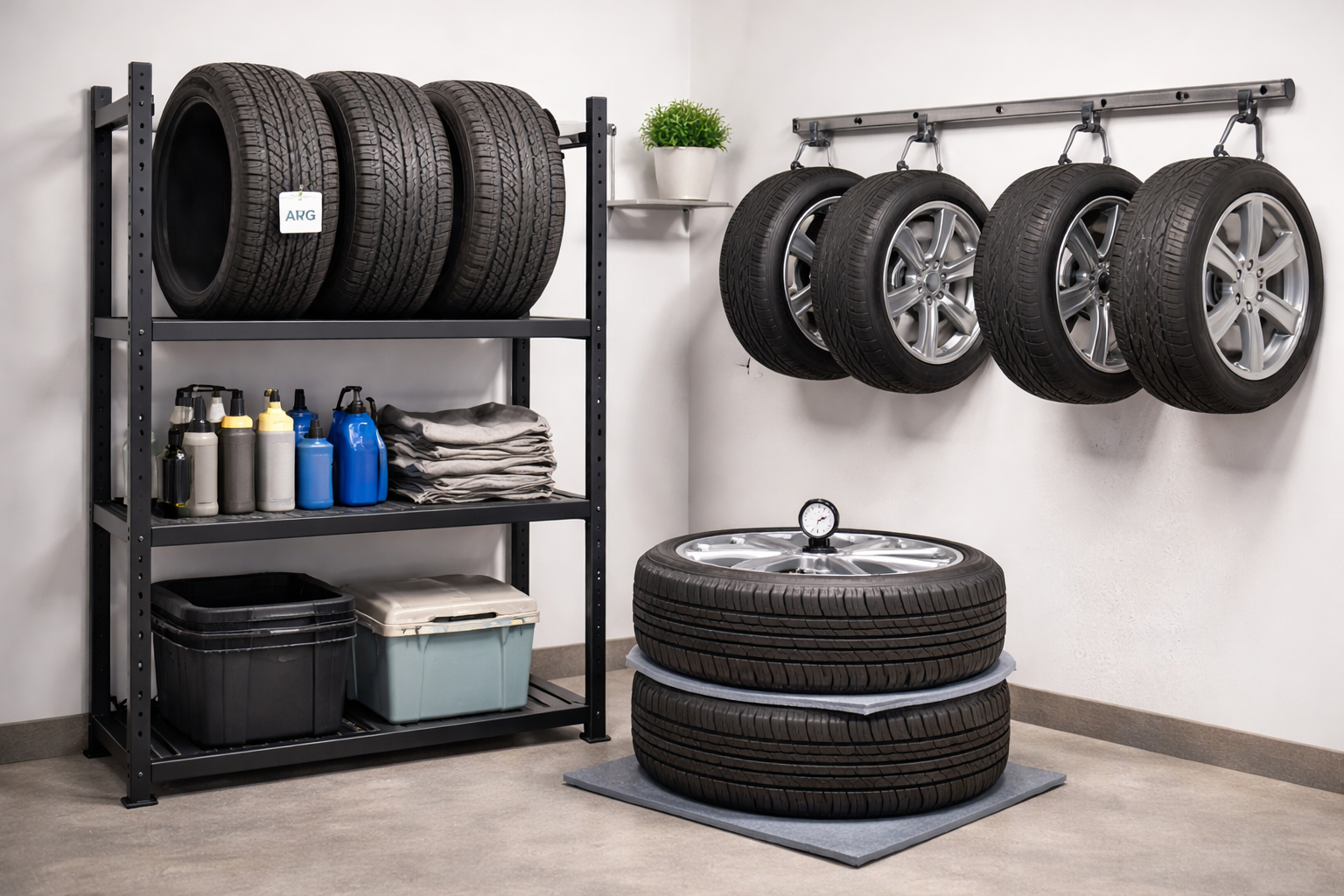
- Best option Stacked flat (on a “stack”) or hung on a suitable wall mount.
- Advice: If stacking, place the heaviest wheel at the bottom and do not make the stack too high.
If your tyres are without alloy wheels
- Best option Upright (vertical), on a clean floor, ideally on a shelf.
- Tip: Turn them slightly (a quarter turn) every month to limit flat spots.
- To avoid: Stacking bare tyres for a long time (risk of sidewall deformation).
Summer, winter, and all-season tyre specificities
Summer tyres
The compound is designed to perform at moderate to high temperatures. Storage should avoid excessive heat
(attic, near a boiler) in order to limit hardening.
Winter tyres
They are more sensitive to heat-related ageing. Store them cool and protected from UV rays
to preserve the more “flexible” mixture that makes them effective in cold weather.
All-season tyres
They combine summer/winter compromises: apply the same general rules. Pay particular attention to wear and
homogeneity, as they often run all year round.
Common point: regardless of the type (summer/winter/all seasons), the winning trio remains:
secure + dark + stable.
Where to store: garage, cellar, balcony, storage unit…
Garage
Often practical, but be careful: keep the tyres away from hot areas (water heaters, radiators) and products
Chemicals (petrol, solvents). Ideally on a shelf or stand.
Cave
Fine if it's dry. If it's damp (condensation), opt for a well-ventilated area raised off the ground.
Avoid direct contact with cold, damp ground.
Balcony / outdoor
To avoid if possible: UV rays, temperature variations, and humidity accelerate ageing.
If you have no other choice: opaque cover + rain protection + elevated + far from direct sunlight.
Box / local
Good option if the location is dry and stable. Check for ozone and volatile product sources.
Common mistakes to avoid
- Store in direct sunlight Or near a window: UV = accelerated ageing.
- Proximity of hydrocarbons (essence/oil) or solvents: attacks rubber.
- Leave dirty tyres (salt, mud): retained moisture + wheel rim corrosion.
- Stacking bare tyres Too long: risk of deformation.
- Store next to an electric motor ozone = microcracks.
- Forget labelling loss of reference points and less uniform wear on the next assembly.
Quick checklist: perfect storage in 8 points
- Clean with water and mild soap (no solvents), then dry.
- Locate the position (front right/front left/rear right/rear left).
- Check wear, damage, DOT and tread.
- Choose a dry, dark, cool, stable place.
- Far from hydrocarbons, solvents, paints, oils.
- Away from ozone sources (electric motors/compressors).
- With rims: stack flat or hang. Without rims: store upright.
- Option: opaque cover, without trapping moisture.
FAQ: Tyre Storage
How long can I store tyres?
Several months without worry if conditions are good (dry, dark, stable). Over a long period, monitor the condition.
(cracks, hardening) and tyre age (DOT).
Should I deflate my tyres before storage?
No For complete wheels (tyre + rim), maintain pressure close to usage. For bare tyres,
There's no question about it.
Can tyres be stored in a plastic bag?
Yes, but only if the tyre is perfectly dry and stored in a dry place. Otherwise,
You risk trapping moisture.
How to avoid “flat spots” and deformations?
Stock Standing tyres without rims and turn them slightly from time to time. Store
flat Or hanged the complete wheels.
Is it different for winter tyres?
winter tyres particularly like the fee and the absence of UV. Avoid hot rooms and
the wide temperature variations.
Want to know more about storing your tyres? Visit the specialist, Pneus-Online.fr: https://www.tyres-pneus-online.co.uk/fitting-and-storage-advice.html
You might be interested in these articles:
 Pneumatic Innovations 2025: The Future of the Smart, Sustainable, and Connected Tyre
 Chinese vs European tyres: what are the real differences in 2025?
 What tyres to drive on snow safely? The ultimate 2025 guide
 Continental ContiSportAttack 5: The new supersport motorcycle tyre that redefines performance