What pressure for my tyres? Complete guide by vehicle type
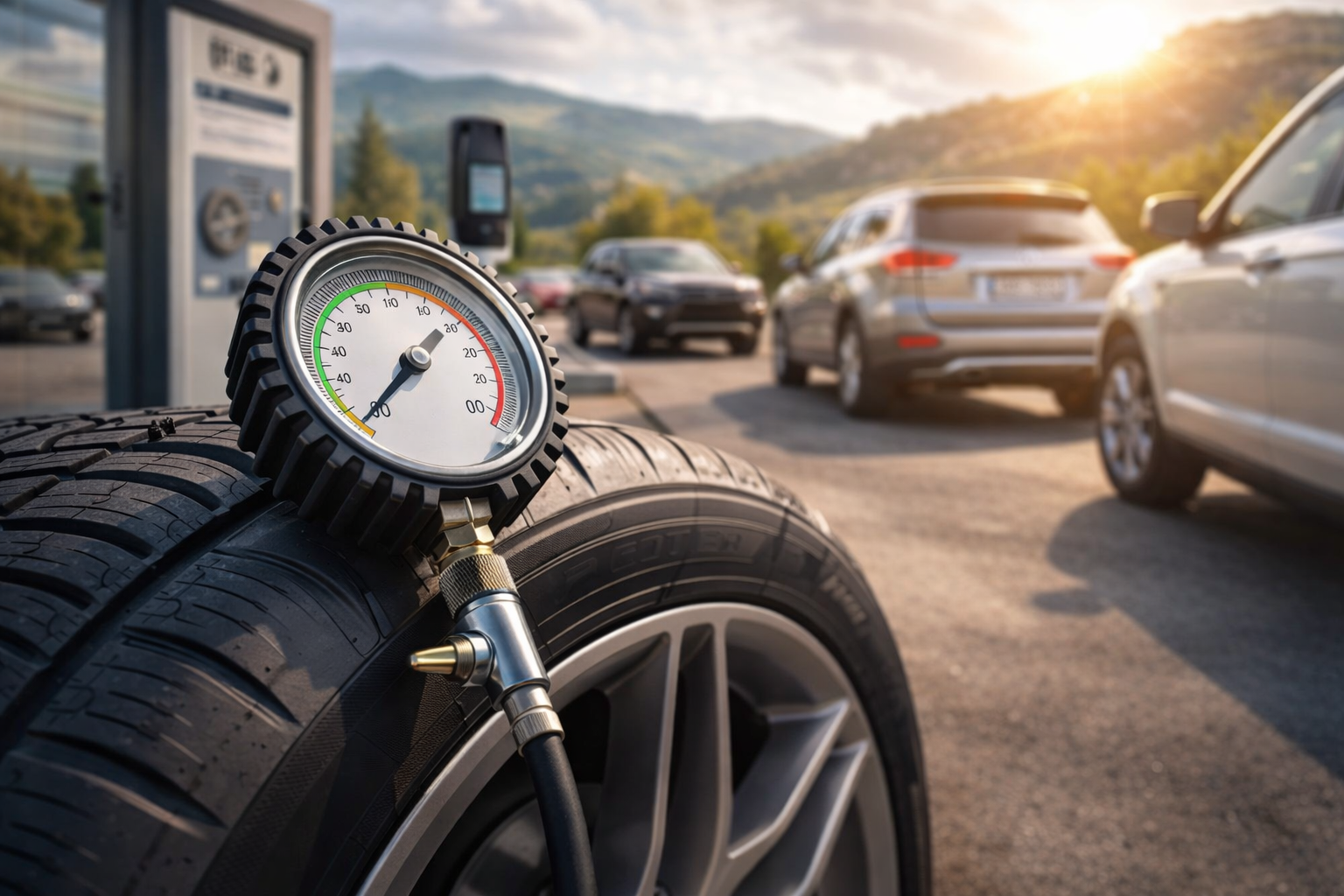
The key takeaways
- The correct pressure is not written “at random” on the sidewall of the tyre: it is defined by the Vehicle manufacturer.
- Good information is usually found on the driver's door sticker, in the Fuel trap or in the Manufacturer's manual.
- You must always check the pressure cold.
- An under-inflated tyre wears out faster, overheats and increases fuel consumption.
- An overinflated tyre can reduce comfort and grip, and cause uneven wear in the centre.
- When in doubt, always follow the Official vehicle recommendation, especially if you are carrying a load or driving on the motorway.
Why tyre pressure is so important
Tyre pressure directly influences the vehicle's behaviour. A correctly inflated tyre operates under optimal conditions: the contact patch with the road remains ideal, the casing does not overheat, and wear is more regular.
Conversely, incorrect pressure can have several consequences:
- Extended braking distance
- Nicer road holding
- Premature tyre wear
- Excessive fuel consumption
- Increased risk of rupture in case of significant under-inflation
In other words, checking tyre pressure is among the simplest, yet most cost-effective maintenance tasks for your safety.
Where to find the correct pressure for your vehicle
The only reliable reference value is the one recommended by the car manufacturer. It varies according to:
- the exact model of the vehicle; ;
- the engine ;
- tyre size ;
- the charge ;
- normal or loaded/motorway use.
You will generally find this information in one of the following places:
- on the Driver's door amount ;
- inside the Fuel trap ;
- in the Vehicle handbook.
The values are often stated in bar and sometimes in Powers. You will sometimes see two settings:
- Normal use lightly loaded vehicle ;
- Full throttle / Motorway Passengers + luggage, or long, fast journeys.
Important: The maximum pressure indicated on the tyre sidewall is not Pass the pressure to use on a daily basis. This is a technical limit of the tyre, not a recommended inflation pressure for your vehicle.
When and how to check tyre pressure
How often?
It is advised to check the pressure:
- at least once a month ;
- before Long journey ;
- before leaving On holiday ;
- in case of significant temperature variation; ;
- if the TPMS warning light comes on.
Why cold?
The pressure must be measured cold tyres, that is to say, before driving or after a prolonged stop. When driving, the air heats up and the pressure naturally increases. If you measure when hot, you risk getting a misleading value.
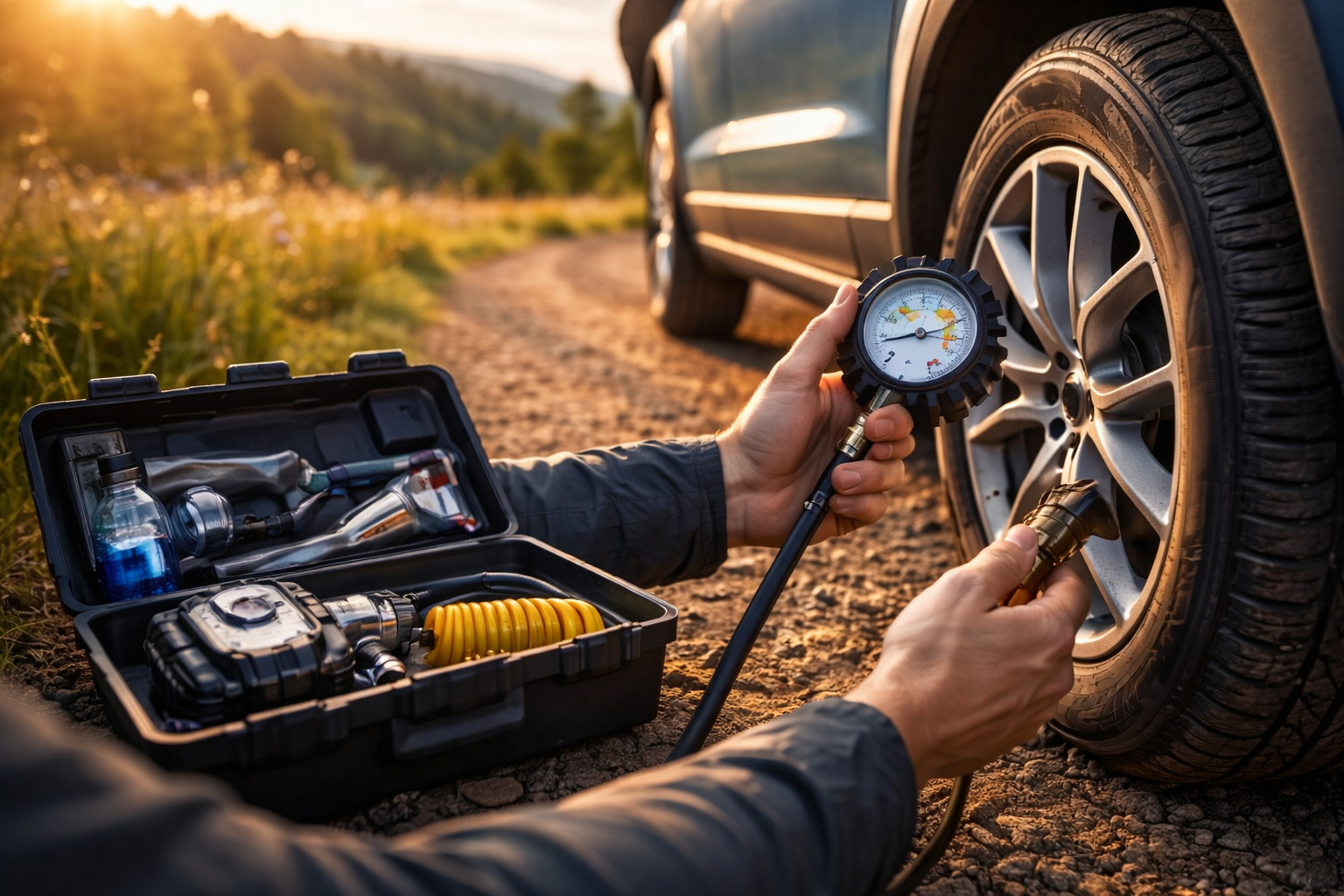
How do I do it?
- Consult the manufacturer's recommended pressure.
- Check the tyres when cold.
- Measure each tyre, including the spare tyre if you have one.
- Adjust the pressure according to use: normal or loaded.
- Screw the valve caps on tightly.
Tyre pressure by vehicle type
The forks below are indicatives. They never replace the manufacturer's pressure, but they allow for a better understanding of trends according to the type of vehicle.
Urban
Small cars often display moderate pressure, generally around 2.0 to 2.4 bar depending on the axles and the load. These light vehicles require precise adjustment to maintain a good balance between comfort, braking and tyre longevity.
Compact and family saloon
On compact and family cars, you'll frequently find pressures around 2.2 to 2.6 bar. The rear axle may require a slightly higher value, especially when the vehicle is loaded.
3. SUV and crossover
SUVs often run with slightly higher pressure, usually between 2.3 and 2.8 bar. Their greater weight justifies this level of inflation, particularly to preserve stability and limit tyre shoulder wear.
4x4 and all-terrain
4x4s use varying pressures depending on their use. On the road, the values are often in a range close to 2.2 to 2.8 bar. For specific off-road use, some drivers reduce tyre pressure to gain traction, but this should only be done with experience, at low speed, and by reinflating the tyres afterwards before returning to the road.
5. Light commercial vehicle
Utilities often ask for higher pressure, especially at the back. In practice, the values can range from 2.5 to 3.5 bar, or even more depending on the payload. This is a crucial point, as an under-inflated utility vehicle wears out very quickly and can become unstable.
6. Monospace or 7-seater vehicle
These vehicles often provide two very distinct configurations: common usage and Full charge. In the presence of several passengers and luggage, rear pressure often needs to be increased considerably.
7. Electric vehicle
Electric cars are heavier and have high instant torque. The recommended pressure may therefore be a little firmer than on an equivalent internal combustion engine model. Adhering to the manufacturer's specified value is particularly important here for range and wear.
| Vehicle type | Indicative pressure | Note |
|---|---|---|
| City car | 2.0 to 2.4 bar | To be confirmed according to dimensions and load |
| Compact / Saloon | 2.2 to 2.6 bar | Rear sometimes higher |
| SUV / crossover | 2.3 to 2.8 bar | Weight above a saloon car |
| 4×4 | 2.2 to 2.8 bar on the road | Off-road use to be managed separately |
| Light utility vehicle | 2.5 to 3.5 bar | Highly dependent on the load carried |
| Electric vehicle | Varies by model | Strictly follow the manufacturer's value |
Should the pressure be increased with load or prior to going on holiday?
Yes, often. When the vehicle is carrying multiple passengers, luggage, equipment, or towing a trailer, the manufacturer may recommend a higher pressure, particularly at the rear.
This increase allows:
- to better bear the load; ;
- limit the warm-up; ;
- to stabilise the vehicle; ;
- to preserve tyres on motorways.
Before going on holiday, check if your manufacturer's label indicates a specific value “Loaded vehicle” Or “high-speed”.
Under-inflation and over-inflation: the risks
Underinflated tyre
- overheating ;
- accelerated wear on the edges; ;
- higher consumption; ;
- Less precise direction ;
- risk of internal tyre degradation.
Overinflated tyre
- reduced comfort ;
- reduced adhesion on certain surfaces ;
- more marked wear in the centre; ;
- behaviour sometimes drier on poor roads.
The right reflex, therefore, is neither to “inflate a bit more for safety” nor to drive slightly under the recommendation for comfort. You should aim for exact value suited to your use.
Tyre pressure in winter and summer
The external temperature naturally influences pressure. When it's cold, the measured pressure decreases. Conversely, it increases when the air warms up.
In winter
Temperature drops can cause pressure to fall, sometimes enough to trigger a warning light. You should therefore check your tyres more regularly during the cold season, especially after a sudden change in weather.
In summer
During hot periods and on long motorway journeys, tyres heat up more. This does not mean that they should be deflated when hot. The correct method remains to check and adjust them. cold.
Mistakes to avoid
- Refer to the maximum pressure indicated on the tyre.
- Control only a single tyre.
- Forget the spare wheel.
- Measure straight after rolling.
- Ignore the difference between normal use and full load.
- To think that an absent witness means everything is perfect.
- To forget that the front and back can have different pressures.
Conclusion
The answer to the question “What pressure for my tyres?” It looks simple, but is precise in practice: The correct pressure is the one indicated by your vehicle manufacturer.. It depends on the type of car, the load, the tyre size and the operating conditions.
A monthly check, carried out when the vehicle is cold, helps to improve safety, reduce wear and tear, and ensure better driving conditions. Regardless of whether you drive a city car, an SUV, a van or an electric car, tyre pressure remains an essential maintenance point.
FAQ – Tyre Pressure
What is the correct tyre pressure for my tyres?
The correct pressure is that recommended by the vehicle manufacturer. It is generally found on the driver's door pillar, in the fuel filler flap, or in the manual.
Can I trust the pressure marked on the tyre's sidewall?
No. This marking indicates a technical limit of the tyre and not the recommended operating pressure for your vehicle.
Do you need to check tyre pressure when hot or cold?
You should always check the pressure when the tyres are cold. After driving, the pressure naturally increases with temperature.
Should I increase the pressure before a long journey?
Yes, if your vehicle is loaded and the manufacturer specifies a particular pressure for full load or motorway driving. You should then follow those instructions.
What pressure for an SUV?
As a guide, many SUVs run between 2.3 and 2.8 bar, but the exact value depends on the model, tyres and load.
Is an underinflated tyre dangerous?
Yes. It can overheat more, wear out faster, consume more, and degrade road-holding and braking.
Does the pressure change in winter?
Yes. The cold can cause pressure loss. It is therefore advisable to check your tyres more regularly in winter.