
How to choose your tyres: the complete method explained
The key takeaways
- The right tyre depends first on the approved dimensions for your vehicle.
- Then you need to choose according to the season Summer, winter or all seasons.
- The Vehicle type and the Driving style strongly influence the choice.
- The load and speed indices must always be compatible with the vehicle.
- A good choice of tyres improves the Security, the Braking, the road holding and sometimes the consumption.
- The best tyre isn't necessarily the most expensive, but the one that truly matches your intended use.
Why choosing your tyres well is essential
The tyres play a central role in the vehicle's handling. They influence grip, braking, stability, comfort, steering precision and fuel consumption. Choosing unsuitable tyres can degrade road holding, accelerate wear or reduce safety, particularly on wet roads, in cold weather or on long journeys.
Conversely, well-chosen tyres allow:
- better grip on dry and wet surfaces ;
- more consistent braking distances; ;
- more even wear ;
- improved driving comfort ;
- a response more suited to your vehicle and your environment.
The complete guide to choosing your tyres
To choose your tyres correctly, you need to follow a logical order. The most reliable method involves successively analysing:
- the Allowed dimension ;
- the Season of use ;
- a Vehicle type ;
- your Actual usage ;
- socks Technical indices ;
- socks Performances sought ;
- your budget.
This approach avoids a “random” choice or one based solely on price.
Step 1: Choose the right tyre size
The first rule is simple: you must respect the Tyre size compatible with your vehicle. This information is usually found on the sidewall of the fitted tyre, on the vehicle's sticker or in the manufacturer's manual.
How to read a dimension?
Let's take the example 205/55 R16 :
- 205 tyre width in millimetres ;
- 55 Aspect ratio; ;
- R Radial structure ;
- 16 Rim diameter in inches.
Changing dimensions cannot be improvised. Even when possible equivalents exist, it is necessary to confirm that they are permitted for the vehicle. An incorrect dimension can disrupt handling, comfort, the speedometer, and compatibility with the wheels.
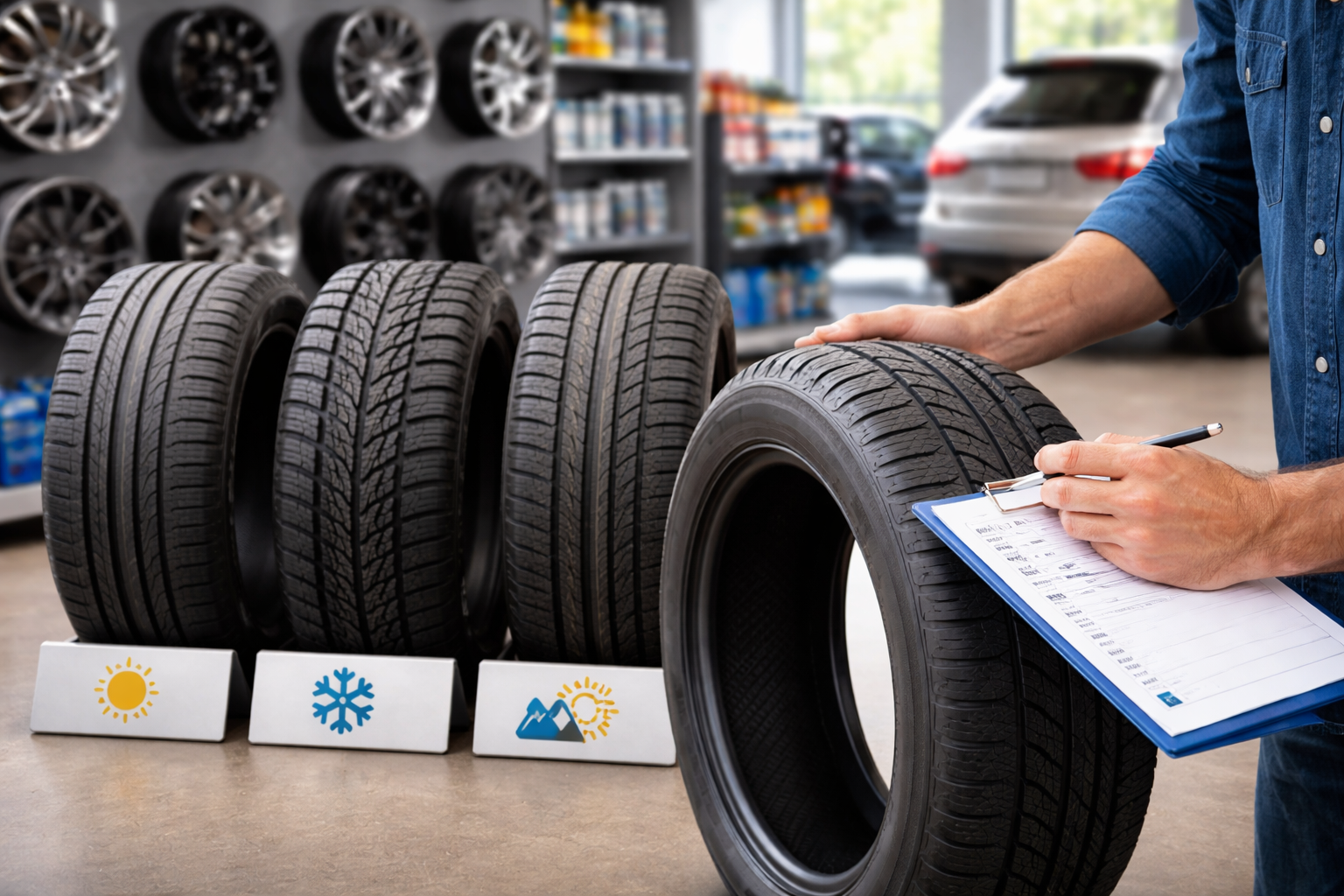
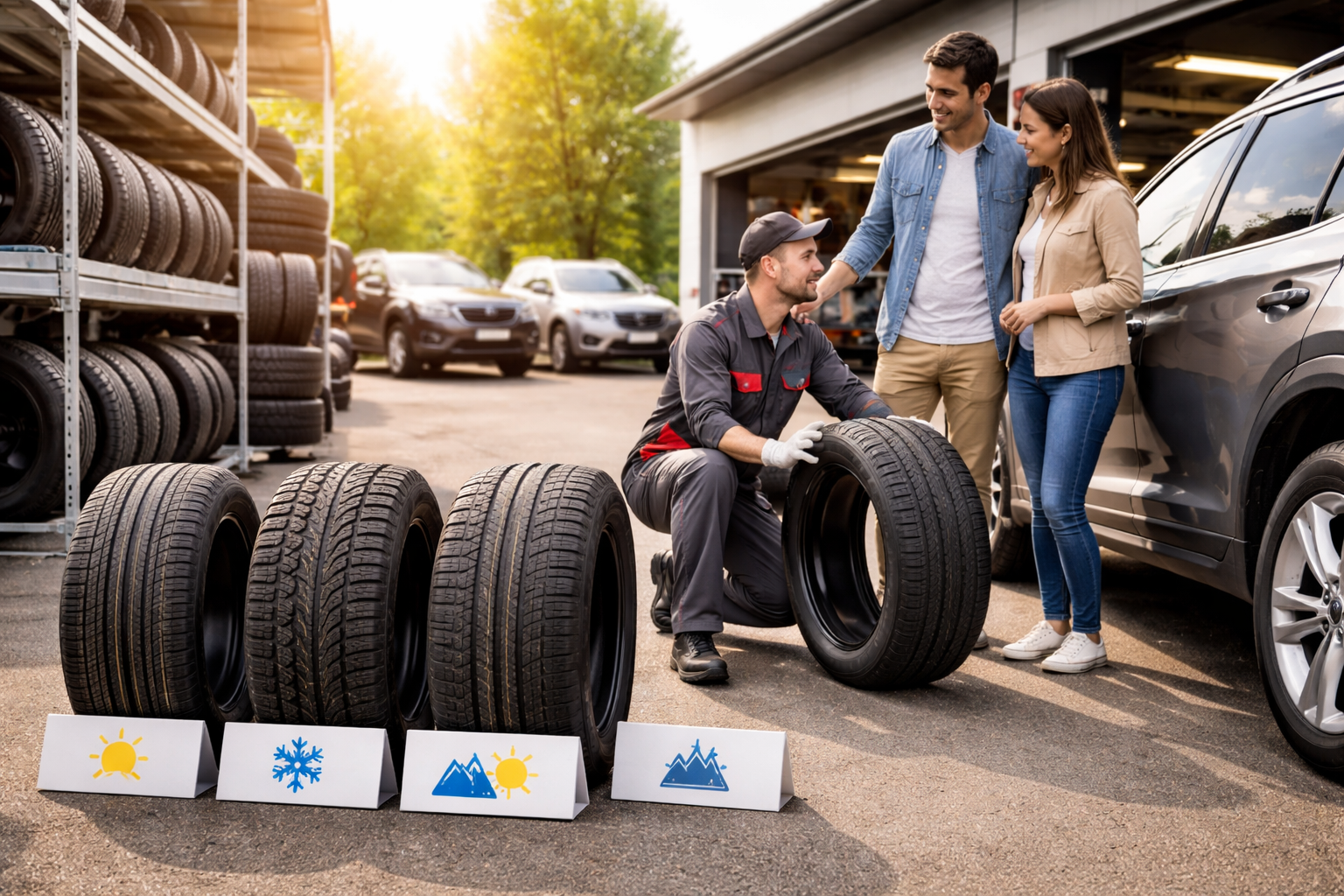
Step 2: Choose between summer, winter, and all-season tyres
The second fundamental criterion is the season. Not all tyres perform the same way depending on the temperature and road conditions.
Summer tyres
The summer tyres are designed to offer good performance in mild or high temperatures. They are perfectly suited for driving mainly on dry or wet roads outside of the winter period.
Winter tyres
The winter tyres They are designed for cold, wet, snowy or icy conditions. Their rubber compound and tread patterns are optimised to remain effective when temperatures drop significantly.
All-season tyres
The all-season tyres represent an interesting compromise for drivers who drive all year round in moderate conditions and wish to avoid two separate sets of tyres.
| Tyre type | Ideal for | Driver profile |
|---|---|---|
| Summer tyre | Mild to warm temperatures, common use | Driver primarily operating outside of winter |
| Winter tyre | Cold, snow, winter roads | Driver exposed to a real winter |
| All-season tyre | Moderate conditions all year round | Driver seeking versatility |
Step 3: Consider the vehicle type
You don't choose the same tyres for a city car, a sedan, an SUV, a van or an electric car. The weight, ride height, power, torque and type of use significantly change the requirements.
City car
A city car often prioritises comfort, manoeuvrability, fuel economy and good urban handling.
Saloon and hatchback
For these vehicles, a good balance is generally sought between comfort, driving precision, braking, and longevity.
SUV and crossover
The higher weight of an SUV requires tyres capable of carrying more load while maintaining good stability.
Utility
A utility vehicle requires tyres suitable for high loads and intensive use, often with particular attention paid to durability.
Electric car
Electric vehicles place significant strain on tyres due to their weight and instant torque. The choice must therefore take into account wear resistance, acoustic comfort, and energy efficiency.
Step 4: Adapt the tyres to your actual use
The right tyre also depends on how you use your car every day. Two drivers with the same vehicle might need different tyres.
Urban use
If you primarily drive in the city, you can opt for comfortable, quiet tyres that are resistant to frequent braking.
Road and motorway usage
For long journeys, it is important to aim for tyres that are stable at sustained speeds, reassuring in wet conditions, and capable of managing wear well over time.
Dynamic driving
More sustained driving requires tyres that offer greater precision, grip and responsiveness.
Mountain routes or difficult conditions
In hilly regions or those subject to rapid weather changes, manoeuvrability, braking and versatility become priorities.
Step 5: check the load and speed ratings
Once the dimension has been chosen, it is necessary to check the load and speed indices. They appear after the dimension on the tyre.
Example: 205/55 R16 91V
- 91 load index ;
- V Speed rating.
These indicators must be compatible with the vehicle. They are not decorative: they guarantee that the tyre is capable of supporting the intended load and speed under normal operating conditions.
Choosing a tyre based solely on its size, without checking these ratings, is a common mistake.
Step 6: Compare performance criteria
When several tyres are compatible, you must differentiate them according to the performance that is actually useful for you.
Wet road grip
It is one of the most important criteria for everyday safety. A tyre that performs well in the wet can improve braking and vehicle control in the rain.
Longevity
Certain tyres are designed to last longer. This is an interesting criterion for high-mileage drivers or those looking for good value for money.
Comfort and noise
On regular journeys, noise level and ride comfort are very important, especially for saloons, family SUVs, or electric cars.
Rolling resistance
This criterion can influence a vehicle's fuel consumption or an electric vehicle's range.
Driving precision
For more dynamic driving, certain tyres offer sharper steering and better responsiveness.
Step 7: Choose according to your budget without neglecting safety
The budget remains a real criterion, but it should never be the only one. A cheaper tyre can be suitable in certain cases, provided it is adapted to the correct size, the correct usage and the correct technical specifications.
To reason intelligently, one must compare:
- the purchase price ;
- The estimated lifespan ;
- wet performance ;
- comfort ;
- consistency with your driving style.
The best choice is often the one that offers the best balance between Security, durability and budget.
Example of a simple method for choosing your tyres well
- I'll take the exact size of my current tyres or the fitment foreseen by the vehicle.
- I'm determining if I need summer, winter, or all-season tyres.
- I am taking my vehicle into account: city car, SUV, electric, commercial vehicle, saloon.
- I'm thinking about my main use: city, motorway, mountains, long journeys.
- I am checking the load and speed indices.
- I am comparing compatible tyres according to my priorities: wet grip, comfort, longevity, noise, and fuel consumption.
- I make my final choice based on the best overall compromise.
Mistakes to avoid
- Choosing tyres solely based on price.
- Forgetting to check the exact dimension.
- To neglect the load and speed indexes.
- Fitting unseasonal tyres.
- Choosing a tyre that is too sporty for purely urban use, or the opposite.
- Forgetting that the vehicle type strongly influences the choice.
- Confusing versatility and maximum performance in all areas.
Conclusion
To know How to choose your tyres, a structured method must be followed and it is necessary to start with the right criteria: Dimension, season, vehicle, usage, Technical indices and Performances sought. It is this approach that allows you to find truly suitable tyres, rather than relying on a single commercial or price-based argument.
A well-chosen tyre improves safety, comfort, longevity and driving pleasure. The right choice is therefore not just a matter of brand or price, but of matching the tyre to the car and the reality of your journeys.
FAQ – How to choose your tyres?
How to know which tyre size to choose?
You must check the recommended size for your vehicle, which can be found on the current tyre, the vehicle's sticker, or the manufacturer's manual. This is always the first criterion to check.
Should you choose summer, winter, or all-season tyres?
The choice depends on your climate, your journeys, and the level of winter you are exposed to. Summer tyres are suitable for mild periods, winter tyres for cold conditions, and all-season tyres for moderate all-round use.
How to choose tyres for an SUV?
When choosing, you need to take into account the vehicle's weight, the appropriate load and speed ratings, stability, comfort, and the actual intended use, for example, urban, long-distance, or mixed driving.
Are load and speed ratings important?
Yes. They are essential to ensure the tyre correctly supports the intended load and speed for the vehicle.
Can you choose your tyres based solely on price?
No. Price matters, but you also need to consider wet grip, durability, comfort, season, and technical compatibility.
How to choose tyres for an electric car?
The higher weight, immediate torque, potential wear, acoustic comfort, and rolling resistance must be taken into account.
Quel est le meilleur pneu pour tous les conducteurs ?
There is no perfect universal tyre for everyone. The best tyre is one that suits your vehicle, your environment, your driving style, and your priorities.