
Connected cars: when vehicles talk to each other to avoid accidents
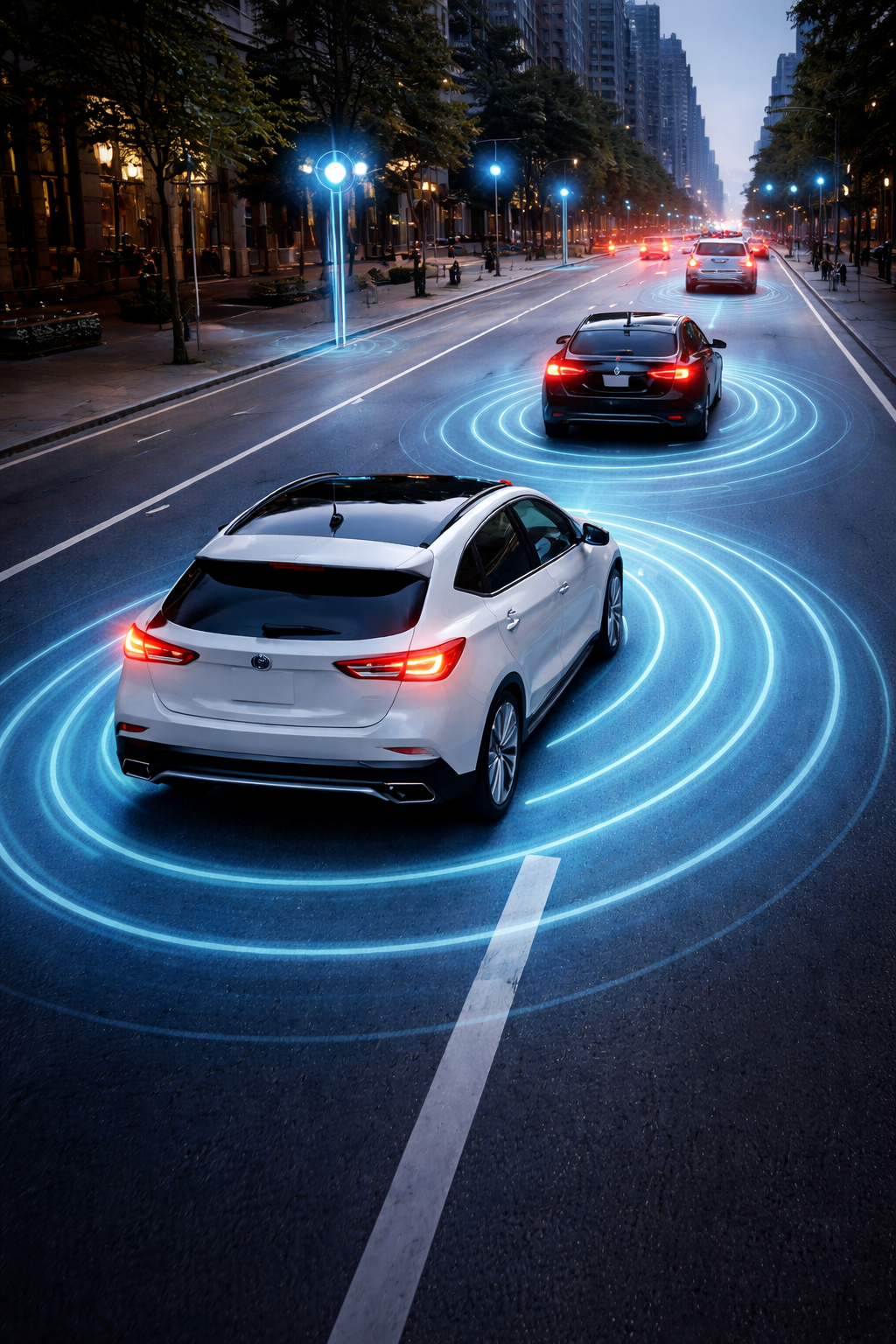
The Connected cars are no longer a science fiction concept: they are already in the testing phase and could become the norm in the coming years. Thanks to technologies Vehicle-to-Vehicle (V2V) and C-V2X (Cellular Vehicle-to-Everything), vehicles can now communicate with each other and with their surroundings to avoid collisions, improve traffic flow, and enhance the safety of the most vulnerable road users.
In this article, we explore in depth this mobility revolution, its advantages, its challenges, and its future.
🚗 A new era for road safety
Imagine you're driving and suddenly your car alerts you that a vehicle is braking sharply 200 metres ahead.
You haven't yet seen the danger, but your car has already anticipated it. This is precisely what the systems allow V2V and C-V2X.
This technology promises to save thousands of lives each year, by drastically reducing accidents caused by a lack of information or visibility.
✅ Concrete benefits for drivers
1. Fewer accidents
Early warnings make it possible to react before an accident becomes unavoidable.
According to several studies, the widespread adoption of V2V could reduce 80 %: collisions involving several vehicles.
2. Greater fluidity
Connected vehicles can automatically adapt their speed, thus avoiding slowdowns and chain traffic jams.
3. Enhanced safety for vulnerable road users
Pedestrians and cyclists equipped with sensors or connected smartphones are detected even when outside the driver's field of vision.
This reduces the risk of urban accidents.
4. More relaxed driving
With more anticipation and fewer surprises, driving becomes less stressful. This also improves comfort on long journeys.
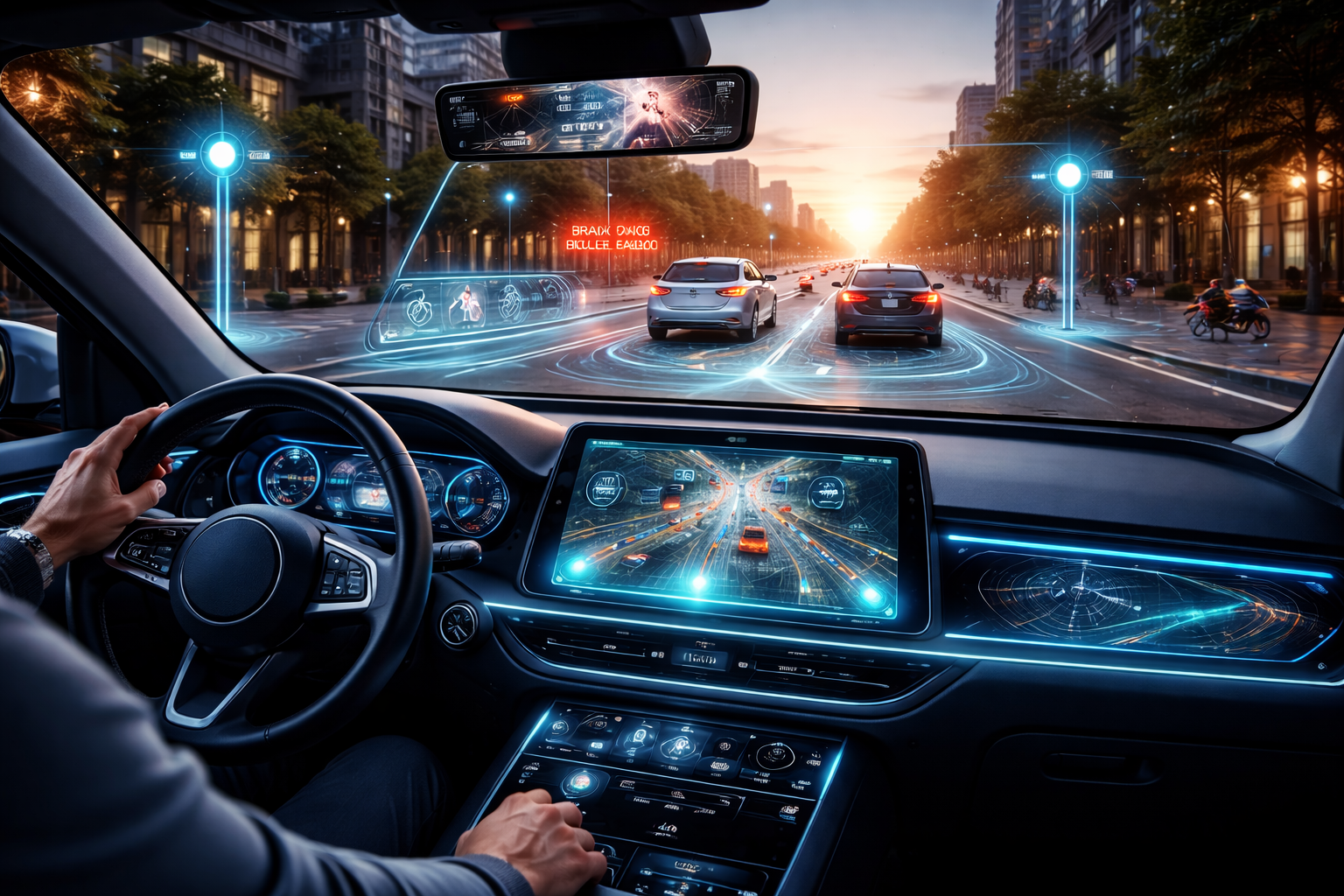
Europe could make this technology mandatory
In the United States, the NHTSA is already working on regulations mandating V2V for new vehicles.
In Europe, the idea is gaining ground: it's possible that in a few years, every new car will integrate a module C-V2X de série.
Cela placerait l’Europe à l’avant-garde mondiale de la sécurité routière, avec un objectif clair : atteindre le zéro accident.
🚧 Les défis à relever
- Standardisation : tous les constructeurs doivent utiliser un langage commun pour que les véhicules se comprennent.
- Protection des données : les informations doivent être sécurisées pour éviter piratage ou exploitation abusive.
- Infrastructures adaptées : routes, feux et panneaux devront être connectés pour interagir efficacement.
- Adoption massive : plus il y a de véhicules équipés, plus le système est efficace.
Pneus Online supports this development
Chez Pneus Online, nous considérons que la technologie C-V2X est une étape majeure vers l’objectif « zéro accident ».
Nous suivons de près son développement et accompagnerons nos clients dans cette transition vers une mobilité plus sûre et plus connectée.
Notre mission : fournir non seulement des pneus performants, mais aussi une expertise adaptée à cette nouvelle ère de la route intelligente.
📌 À retenir
- La communication entre véhicules est déjà testée et pourrait devenir obligatoire dans les prochaines années.
- Elle permet de sauver des vies, réduire les embouteillages et protéger les piétons et cyclistes.
- Son succès dépendra de la standardisation, de la sécurité des données et de son adoption massive.
Et si demain, votre voiture devenait votre meilleur allié pour éviter les dangers ?
❓ FAQ – Voitures connectées et sécurité routière
What is V2V?
The V2V est une technologie de communication directe entre véhicules, permettant l’échange instantané d’informations
comme la vitesse, la direction ou un freinage d’urgence.
Quelle est la différence entre V2V et C-V2X ?
The V2V relie uniquement les véhicules entre eux, tandis que le C-V2X inclut aussi les infrastructures,
les piétons et les systèmes de gestion du trafic grâce aux réseaux 4G/5G.
Will this technology be mandatory?
In the United States, the NHTSA is already considering a mandate. In Europe, the idea is being seriously considered for the coming years.
What are the main benefits for drivers?
Fewer accidents, more fluidity, better protection for pedestrians and cyclists, more relaxed driving.
What are the current limitations?
Standardisation, cybersecurity, and mass adoption remain major challenges before full widespread adoption.
Are connected cars already a reality?
Yes, several manufacturers are already testing these systems, and some high-end cars already incorporate advanced communication modules.
What role does 5G play in this revolution?
The 5G est essentielle pour permettre des échanges ultra-rapides et fiables, nécessaires à la sécurité en temps réel.
✅ Conclusion
Les technologies V2V and C-V2X transforment la sécurité routière en faisant circuler l’information plus vite que l’œil humain : freinage d’urgence, danger hors champ de vision, usagers vulnérables, trafic.
Pour que cette promesse devienne réalité à grande échelle, il faudra avancer sur la standardisation, the cybersécurité and the’équipement massif des véhicules et des infrastructures.
D’ici là, comprendre ces systèmes permet déjà de mieux choisir son véhicule… et d’anticiper la mobilité de demain.
You might be interested in these articles:
 Pneumatic Innovations 2025: The Future of the Smart, Sustainable, and Connected Tyre
 Chinese vs European tyres: what are the real differences in 2025?
 What tyres to drive on snow safely? The ultimate 2025 guide
 Continental ContiSportAttack 5: The new supersport motorcycle tyre that redefines performance
How does it work?
V2V technology
The V2V relies on direct data exchange between vehicles, via a short-range connection.
Imagine ultra-fast Wi-Fi, but specifically designed for automobiles. Each vehicle emits real-time information such as its speed, trajectory, or intentions (braking, lane changes).
C-V2X technology
The C-V2X it goes further: it relies on 4G and 5G cellular networks to extend its reach and connect:
The information exchanged includes: