Can you mix tyres from different manufacturers? What the regulations say
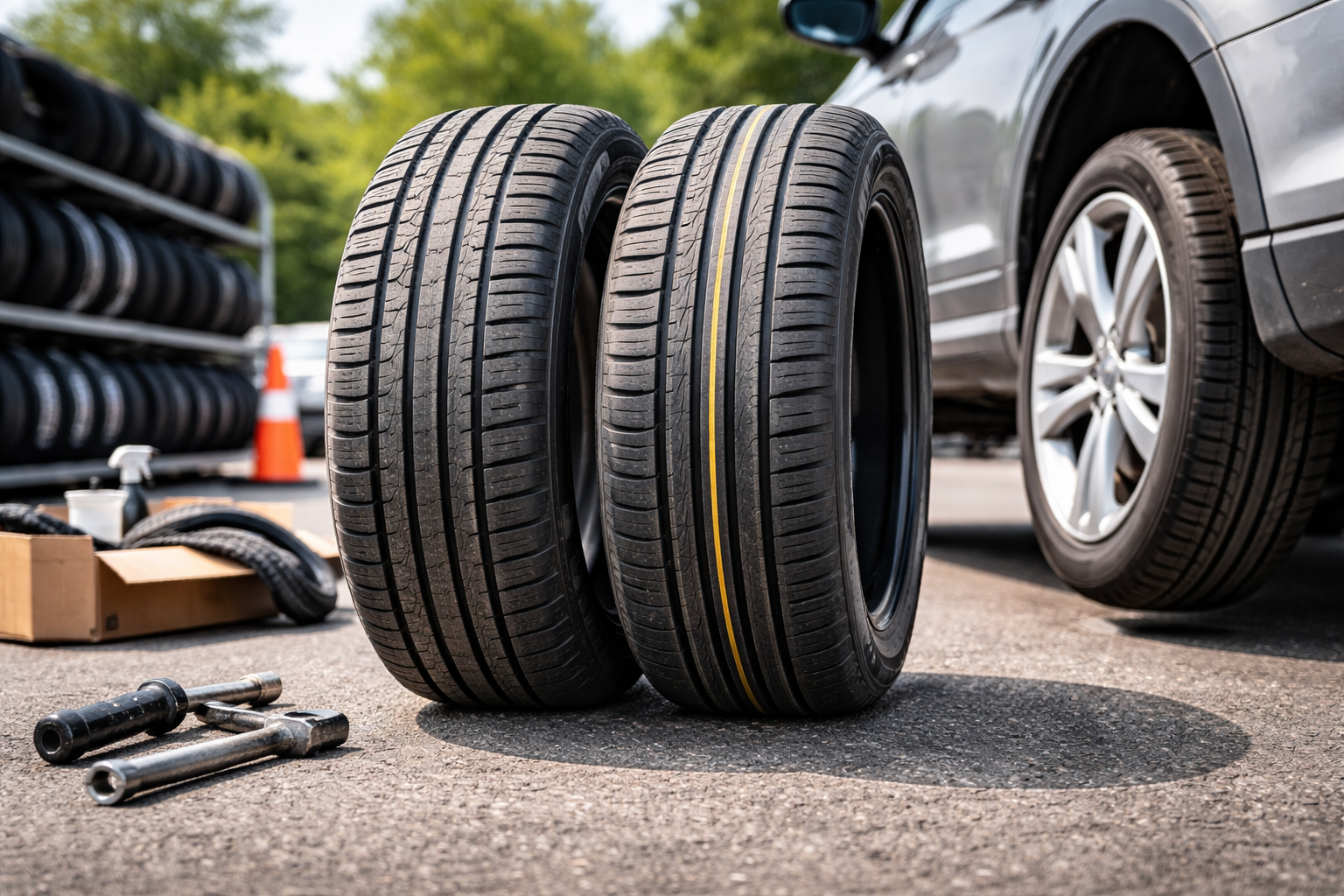
When a tyre is worn or damaged, many motorists ask themselves the same question: can you mix different brands of tyres on a car? The answer is nuanced. From a regulatory perspective, it is not always forbidden, but that doesn't mean it's a good idea in all situations.
Between regulation, safety, driving behaviour and wear and tear, it is essential to understand what is permitted and what is recommended before Replace one or more tyres.
Can you mix tyres of different brands?
Yes, it is possible in certain cases to have different makes of tyres on the same vehicle. However, this must never be done haphazardly. Several essential criteria must be respected: same size, same construction, compatible load index, compatible speed rating, and coherent fitting per axle.
To check these characteristics, it is important to know Read the markings on the sidewall of the tyres and to control the load and speed indices.
In practice, even if the brand isn't always the stumbling block, two tyres from different manufacturers can behave very differently in terms of grip, stiffness, braking, comfort, or resistance to aquaplaning.
You can find out about the features of the different Car tyre brands in order to better understand their specificities. Professionals generally recommend fitting two identical tyres on the same axle.
What the regulations say
The Regulations applicable to tyres It's not just about the tyre brand. What matters most is the technical compliance of the fitting. To be legal, tyres must, in particular, comply with the specifications approved for the vehicle.
The essential points to observe
- the same dimension on the same axle; ;
- the same tyre structure, for example radial; ;
- a load index at least equal to that specified; ;
- a speed rating suitable for the vehicle and its use; ;
- a general condition that ensures safety and proper wear.
A different dimension must not be chosen randomly. It must correspond to the manufacturer's recommendations or comply with the rules of’Tyre dimension equivalence.
In other words, the regulation is primarily concerned with technical compatibility and safety. Two tyres from different brands may sometimes be tolerated if they meet these criteria, but an uneven fit is often less homogeneous than a strictly identical fit.
Why it's better to keep the same tyres on the same axle
On the same axle, the two tyres work together during every braking, cornering, acceleration, and on wet surfaces. If they do not have the same reaction, the vehicle can become less predictable.
This is why it is highly recommended to have on the same axle:
- the same brand ;
- the same model ;
- the same dimension; ;
- a wear level as close as possible; ;
- comparable performance characteristics.
Even if two tyres have the same size marked on their sidewall, their rubber compound, tread pattern or stiffness can differ. On wet roads or during emergency braking, these discrepancies can be quickly felt.
What are the risks of mixing different tyres?
Mixing tyres of different makes or models may seem harmless, especially if the dimensions are identical. However, this can alter the vehicle's behaviour, particularly in emergency situations.
The main risks
- less uniform braking between right and left; ;
- unbalanced handling on dry or wet road surfaces; ;
- Different reactions in bends; ;
- increased risk of aquaplaning if a tyre evacuates water less effectively; ;
- Irregular and sometimes faster pulse; ;
- loss of comfort and stability at high speed.
The greater the difference between the tyres, the higher the risk. It’s not just a question of brand, but also of the overall design of the tyre.
In which cases is this possible?
In certain situations, mixing tyre brands can be considered, provided you remain consistent. This is often the case when a driver needs to quickly replace a worn pair of tyres, without changing all four.
Examples where this might be acceptable
- two tyres of one brand on the front and two others of another brand on the rear; ;
- replacement of a full pair on an axle, with identical tyres between them; ;
- Assembly strictly respecting the planned dimensions, indices and structure.
However, it is best to avoid mixing tyres from very different ranges on the same axle, for example a premium tyre and an entry-level tyre, or a very new tyre with a significantly more worn tyre.
Should one tyre or two tyres be changed?
When only one tyre is damaged, the temptation is great to replace only that one. However, in many cases, it is preferable to replace two tyres on the same axle. This solution helps to maintain:
- a balanced grip ;
- uniform wear ;
- improved stability ;
- more predictable vehicle behaviour.
Replacing a single tyre can create differences in tread, grip, or braking response. The more worn the other tyre is, the more problematic the discrepancy becomes.
Pair replacement therefore remains the most coherent solution in many cases. Also find Pneus Online's tips on how to When and how to change your tyres.
Good practices for staying safe
To avoid assembly errors and keep a vehicle safe, a few simple rules help you make the right choice:
- respect the dimensions approved by the manufacturer; ;
- fit two identical tyres to the same axle ;
- avoid excessive wear discrepancies; ;
- Do not mix summer and winter tyres without a logical reason for their use; ;
- Check the pressure after replacement ;
- check wheel alignment and balance if necessary; ;
- Seek advice from a professional if in doubt.
Before making your choice, consult the guide dedicated to different types of summer, winter and all-season tyres.
After the replacement, also consider check tyre pressure. The correct tyre pressure helps to maintain grip, stability and even tread wear.
The fitting, balancing, and geometry must be carried out with care. Find the recommendations relating to Tyre fitting and storage You are looking directly for a Pneus Online fitting centre partner.
The objective is not only to be compliant, but also to ensure stable and safe driving on a daily basis.
Conclusion
Yes, in some cases, provided that technical regulations are respected and a coherent assembly is maintained. However, from a safety perspective, the best solution is to fit two identical tyres on the same axle, or even four matching tyres where possible.
Regulation isn't limited to the name inscribed on the tyre's sidewall. What really matters is the compatibility of dimensions, ratings and road behaviour. To avoid any loss of grip, balance or comfort, it's better to prioritise uniformity and replace tyres thoughtfully.
FAQ : Mixing different tyre brands
Can you fit tyres of different brands on a car?
Yes, this can be permitted if the tyres comply with the specified dimensions, structure, load index and speed rating. However, it is still recommended to have identical tyres on the same axle to maintain consistent road handling.
Can you have two different brands on the same axle?
It is strongly advised against. Even if some characteristics seem similar, two tyres from different makes can react differently under braking, cornering, or on a wet road. It is better to keep two identical tyres on the same axle.
Is it dangerous to mix different tyres?
This can happen if the tyres have significant differences in design, wear or performance. The vehicle may then lose stability, steering precision and braking efficiency, especially in difficult conditions.
Should one tyre or two be changed?
In many cases, it is preferable to change two tyres on the same axle. This helps to maintain balanced performance and to limit differences in grip or wear between the two sides of the vehicle.
Does the regulation require the same brand on all four tyres?
No, the regulation does not focus solely on the brand of the four tyres. It primarily requires adherence to dimensions, structure, load and speed ratings, and a fitting compatible with the vehicle. However, for safety reasons, fitting matching tyres remains the best option.
Find us on social media
Discover our tips, videos and all the latest Pneus Online news on Instagram, Facebook and YouTube.