How to choose a tyre according to your driving style: sporty, urban or touring.
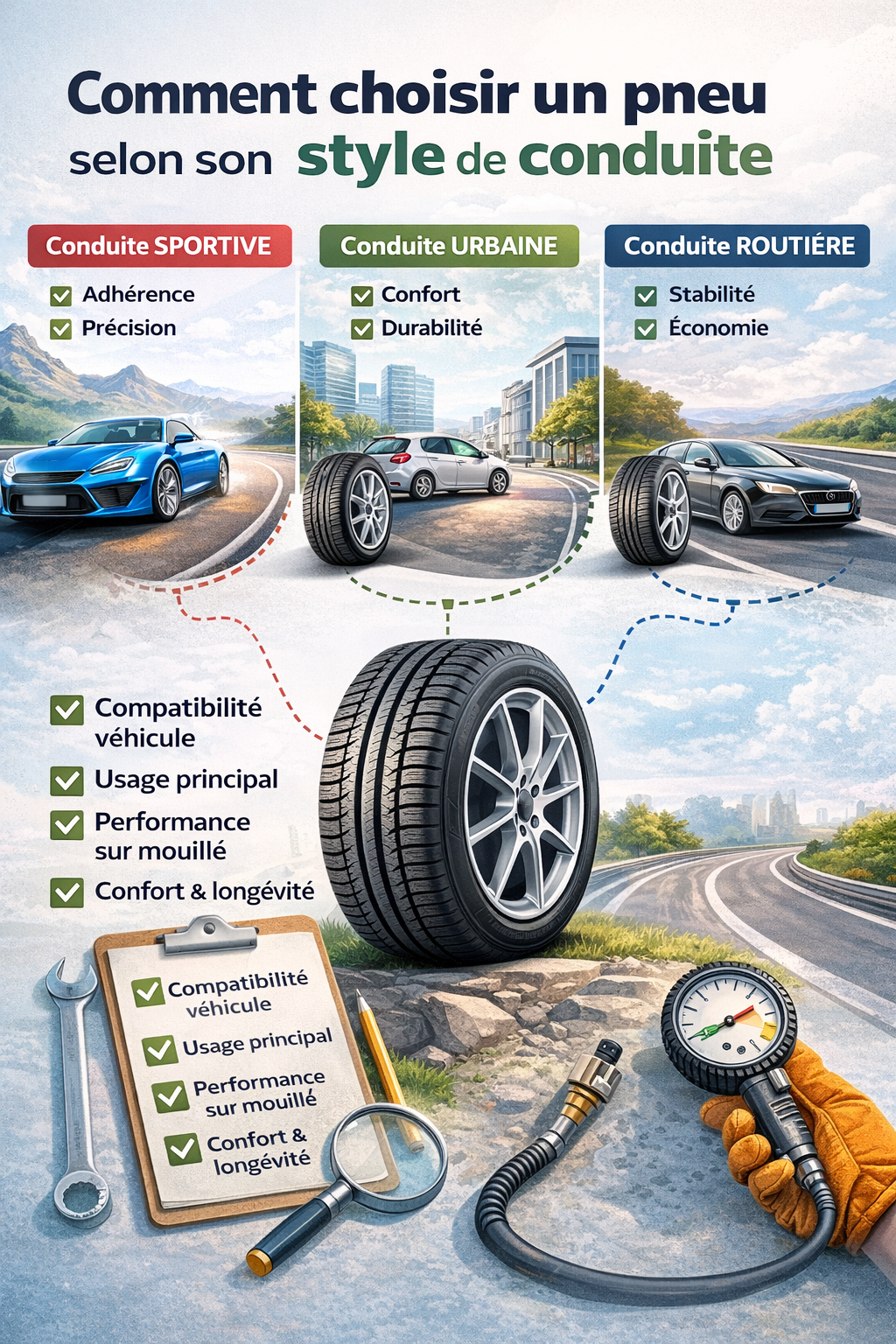
Choose new tyres It's not just about noting the dimensions inscribed on their sidewall. Your driving style also counts. Indeed, it influences grip, comfort, fuel consumption, and wear rate.
A sporty driver does not look for the same qualities as a car owner who mostly drives in the city. Similarly, a high-mileage driver generally prioritises stability and longevity.
So, to choose a tyre based on your driving style, you need to start with your actual journeys. Sporty driving, urban commuting or long distances: discover the criteria to prioritise to find the right balance between safety, enjoyment and budget.
Betting on robustness
First, look for sufficiently robust tyres. They will be better equipped to handle minor daily impacts.
However, no tyre can withstand a violent impact against a kerb or into a pothole without risk. After a significant impact, therefore, check for cuts, deformation, or bulges.
Next, regularly check the condition of the tread. The guide on tyre wear and tear helps you recognise the main signs of wear and tear.
Do not neglect braking in the rain
In urban environments, the road surface can become slippery. Pedestrian crossings, metal plates and road markings can sometimes reduce grip when wet.
So, performance in the rain must remain a central criterion. Don't choose solely based on price or advertised lifespan.
Furthermore, progressive behaviour facilitates emergency braking. The vehicle then remains more predictable when conditions deteriorate.
To seek comfort and silence
Cobblestones, kerbs, and minor deformations can quickly become tiring. Therefore, a tyre capable of absorbing irregularities significantly improves comfort.
Road noise also deserves your attention. It's especially important with an electric or hybrid vehicle, whose engine is quieter at low speeds.
Adopting the correct maintenance practices
Short journeys don't always allow tyres to reach a regular temperature. Furthermore, numerous bends and parking manoeuvres put more strain on the shoulders.
To limit wear and tear:
- regularly check the tyre pressure ;
- Avoid mounting pavements abruptly. ;
- check the geometry in case of irregular wear; ;
- Inspect the flanks after an impact; ;
- control the depth of the carvings.
4. Which tyre to choose for road driving?
On roads and motorways, the tyre works for long periods. Therefore, it needs to remain stable, quiet, and durable.
In addition, it must maintain good performance despite temperature variations and weather changes.
Search for excellent stability
When travelling at a steady speed, a road tyre should follow its intended path without requiring constant corrections. Good stability thus reduces driver fatigue.
The handling should also remain progressive in corners. Furthermore, the tyre must handle lane changes and braking without giving a feeling of imprecision.
Prioritize longevity
For someone who covers a lot of miles, lifespan is an important criterion. However, it must never take precedence over safety.
The best choice therefore depends on a balance between:
- endurance ;
- wet grip; ;
- comfort ;
- The sound level ;
- rolling resistance.
To compare these items, consult the car tyre tests. They allow for the observation of assessments related to handling, comfort, noise, and wear.
Take consumption into account
A low rolling resistance tyre requires less energy to move forward. It can therefore help to limit fuel consumption.
Similarly, this criterion is important for the range of an electric car. However, do not choose a tyre solely for its energy efficiency. Also check its performance in the rain.
Owners of electric models can consult the selection of tyres for electric vehicles.
Keeping comfortable on long journeys
Over several hundred kilometres, a noisy tyre quickly becomes tiring. Therefore, check the noise level indicated on the European label.
Also choose a model capable of absorbing minor irregularities. This will ensure the vehicle remains comfortable on long stages.
5. Which tyre to choose for mixed use?
Many motorists drive in cities, on country roads and on motorways. In this case, there is no need to seek out the sportiest or most economical tyre.
It is better to choose a versatile model.
To start from its most frequent route
First, observe your movements for a typical week. Then, rank them by importance.
For example, if you drive in the city every day but use the motorway twice a month, favour urban comfort. Nevertheless, check that the tyre remains stable on fast roads.
Conversely, if your commutes are mainly on motorways, opt for endurance and silence.
Choosing the right season
The choice between Summer, winter, or all-season tyres depends on the climate, the terrain, and your travel.
Summer tyres are suitable for mild and warm temperatures. In contrast, winter tyres are designed for cold periods and winter conditions.
Finally, all-season tyres offer a practical solution in regions with a moderate climate. They are particularly suitable for drivers who occasionally encounter cold or light snow.
Before choosing, you can compare the winter tyres and the all-season tyres.
6. How to quickly compare multiple tyres?
To choose a tyre that suits your driving style, follow this simple method.
Step 1: Check compatibility
First, note down the dimensions of your current tyres. Then, check the recommendations in your vehicle's manual or on the manufacturer's sticker.
You can also perform a Tyre search by vehicle.
Step 2: Define your main use
Next, choose your priority:
- Sporting behaviour: grip and precision ;
- Urban driving: robustness and comfort ;
- Road handling: stability and durability ;
- Mixed use: overall balance.
Step 3: Watch performance in the rain
Whatever your profile, wet weather performance remains essential. Therefore, compare grip, braking and water drainage capability.
Step 4: compare comfort and noise
Next, consider the noise level. This point is particularly important for long journeys and quiet vehicles.
Step 5: consider the lifespan
Longevity matters if you cover a lot of miles. However, it also depends on pressure, geometry and how you drive.
Step 6: check the overall budget
Finally, don't just compare the purchase price. Also take into account the lifespan, consumption, and installation costs.
7. What mistakes should be avoided?
Choose based on price only
A cheaper tyre isn't necessarily a bad option. However, it must remain suitable for your vehicle and your driving conditions.
So compare the performance before looking at the price difference.
Ignore the clues
An unsuitable load or speed index can compromise the mounting's compliance. Therefore, always adhere to the specifications intended for your vehicle.
Mixing tyres that are too different
To maintain consistent handling, choose identical tyres on the same axle. Ideally, fit the same model on all four wheels as well.
To neglect pressure
Incorrect pressure affects grip and accelerates wear. Furthermore, it can increase consumption.
So, check the pressure when cold and follow the manufacturer's recommendations.
Waiting until the last moment to replace your tyres
A tyre may need to be replaced before it reaches the wear indicator. This is particularly true in cases of a bulge, a deep cut, or a deformation.
See our tips for when changing your tyres.
Forget the editing
Even an excellent tyre will lose some of its qualities if it is fitted or balanced incorrectly. Therefore, entrust the installation to a professional.
You can search for a Pneus Online fitting centre near you.
8. FAQ: Tyres and Driving Style
Which tyre to choose if I drive in the city and on the motorway?
Choose a versatile, comfortable and durable tyre. Also, check its wet performance.
If the motorway accounts for the majority of your mileage, opt for stability, quietness and low rolling resistance too.
Is a sports tyre dangerous in the rain?
No, not necessarily. Some sports tyres offer excellent performance in wet conditions.
However, other models favour drier conditions more. Therefore, you must compare their results and adapt your speed to the conditions.
How do I know if my driving is causing my tyres to wear out too quickly?
Rapid wear on the shoulders can indicate dynamic driving or insufficient pressure. Uneven wear can also point to a geometry problem.
In that case, check the pressure. Then, have the alignment and balancing checked.
Do budget tyres really reduce fuel consumption?
A low rolling resistance tyre can help reduce the energy required for movement. However, the outcome also depends on the vehicle, tyre pressure, and type of journey.
Therefore, choose a model that is efficient but also performs well in the rain.
Are all-season tyres suitable for urban driving?
Yes, all-season tyres can be suitable for urban or suburban use. They offer a practical solution in regions with a moderate climate.
On the other hand, winter tyres remain more suitable for difficult or regular winter conditions.
Les signes qui indiquent qu’il faut remplacer un pneu sont l'usure de la bande de roulement, les fissures ou coupures sur les flancs, les renflements ou "ampoules" sur le flanc, les vibrations inhabituelles lors de la conduite, ou encore si le témoin d'usure du pneu est visible.
Check the depth of the treads, the sidewalls and the tread pattern. In particular, look for cracks, cuts, bulges and deformities.
Furthermore, repeated pressure loss or unusual vibrations require professional inspection.