Les dimensions de pneus les plus courantes varient en fonction du type de véhicule, de l'année de fabrication et du marché. Cependant, certaines dimensions sont retrouvées plus fréquemment que d'autres. Les dimensions de pneus les plus courantes sont souvent celles qui équipent les citadines, les berlines compactes et les SUV familia
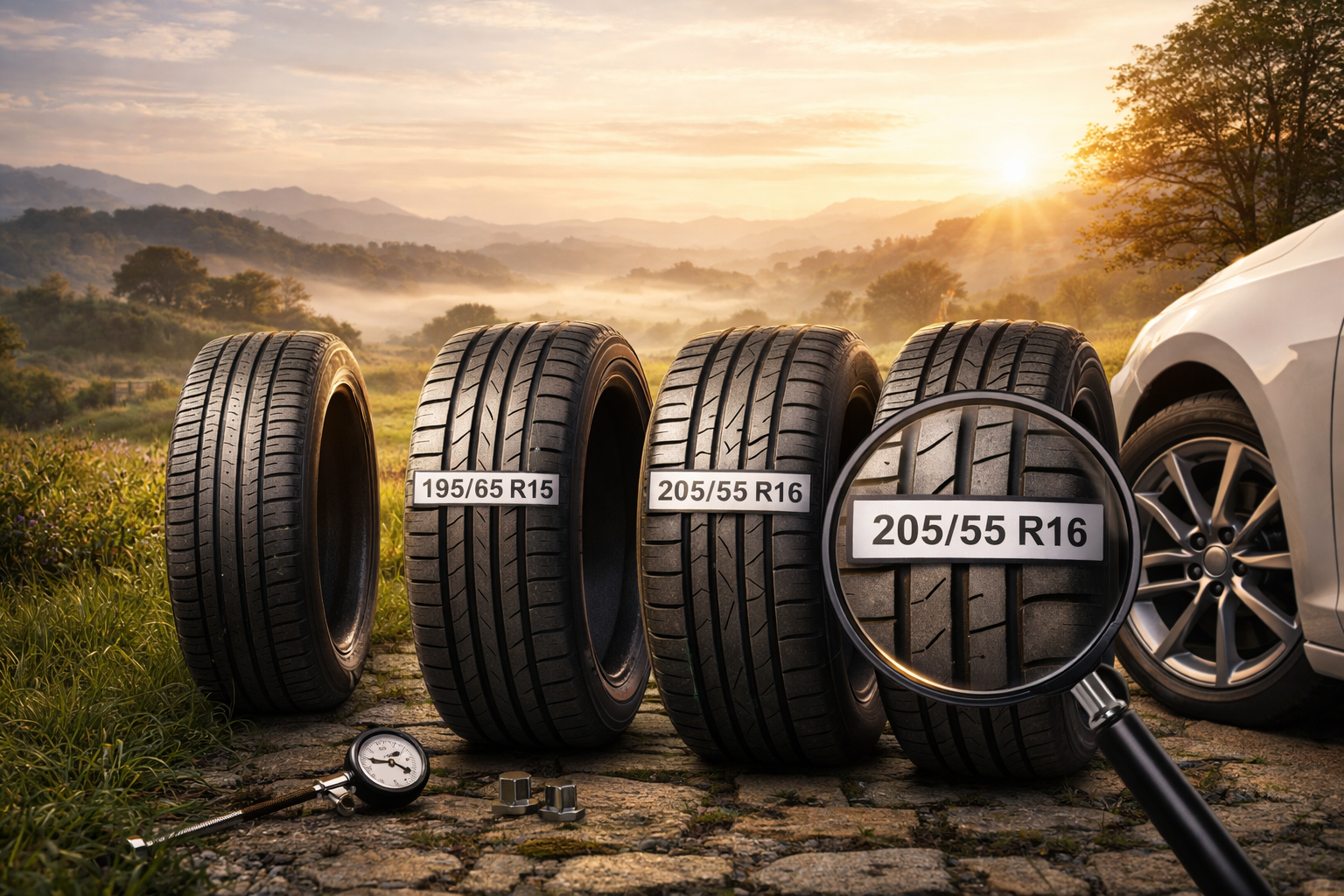
The most common tyre sizes are not chosen at random. They correspond to the real needs of drivers: comfort, safety, controlled consumption, road holding and reasonable cost. Certain sizes appear more often than others because they equip a large number of city cars, compacts, saloons and SUVs. In this guide, you will understand What are the most common tyre sizes, How to read them and Why do they dominate the market?.
What does a tyre size mean?
A tyre dimension like 205/55 R16 reads in four parts:
- 205 tyre width in millimetres
- 55 Flank height as a percentage of width
- R Radial structure
- 16 = rim diameter in inches
This reading is essential, as the Tyre size directly influences handling, comfort, braking, driving precision, and sometimes even fuel or energy consumption.
The most common tyre sizes
On the European market, some Tyre sizes come back very often, as they correspond to the best-selling vehicles. Here are some of the most common formats.
| Dimension | Frequent vehicle type | Why is it common |
|---|---|---|
| 175/65 R14 | Citadines | Economical, comfortable and suitable for small cars |
| 185/65 R15 | Citadines and compacts | Good balance between comfort, price and availability |
| 195/65 R15 | Compact and saloon | A very popular format on many versatile models |
| 205/55 R16 | Compact and family-friendly | Excellent compromise between stability, comfort and cost |
| 225/45 R17 | Saloon cars, dynamic compacts | Improved driving precision and a sportier look |
| 215/65 R16 | Compact SUVs | Good visual ground clearance and comfort on varied roads |
| 225/65 R17 | SUVs and crossovers | Adapted for the greater weight of SUV vehicles |
| 235/55 R18 | Modern SUVs | Very common on recent medium-sized SUVs |
Among all these dimensions, 195/65 R15 and 205/55 R16 are often considered benchmarks, as they are fitted to a very large number of compact and family vehicles.
Why are certain tyre sizes more common?
Because they equip the best-selling segments
City cars, compacts, saloons and compact SUVs represent a major share of the car parc. The dimensions designed for these vehicles therefore become mechanically the most in-demand.
2. Because they offer a good compromise
A popular dimension is often a balanced dimension. It allows for a reconciliation of:
- a Ride comfort,
- the stability,
- the Longevity,
- A reasonable price,
- A wide availability.
3. Because they are easier to produce and distribute
When a size is in high demand, manufacturers produce it in larger quantities. As a result, distributors stock it more often, the choice of brands is wider, and the prices are generally more competitive.
4. Because they meet current manufacturer standards
Modern vehicles must meet requirements for safety, emissions, acoustic comfort, and road performance. The most common dimensions are those that best fulfil these expectations across a wide variety of models.
Common dimensions by vehicle type
Citadines
Small cars often come with dimensions like 165/70 R14, 175/65 R14 Or 185/65 R15. These tyres favour comfort, fuel efficiency and a more affordable purchase price.
Compact
The compacts very often use the dimensions 195/65 R15 and 205/55 R16. These sizes are popular as they offer an excellent compromise between everyday comfort, efficiency, and reassuring road behaviour.
Salons and estates
On modern saloons, you frequently find 205/55 R16, 225/45 R17 Or 225/50 R17. Manufacturers are looking for more stability at sustained speeds here, without entirely sacrificing comfort.
SUVs and crossovers
SUVs often use wider dimensions like 215/65 R16, 225/65 R17, 235/55 R18 Or 255/45 R20. These formats better support the vehicle's weight and enhance stability, particularly on dry roads.
Sports cars
Performance-oriented cars receive wider tyres, with lower sidewalls, such as 225/40 R18, 235/35 R19 or more. The goal is to improve driving precision, grip, and responsiveness.
Why a popular dimension isn't necessarily the best for everyone
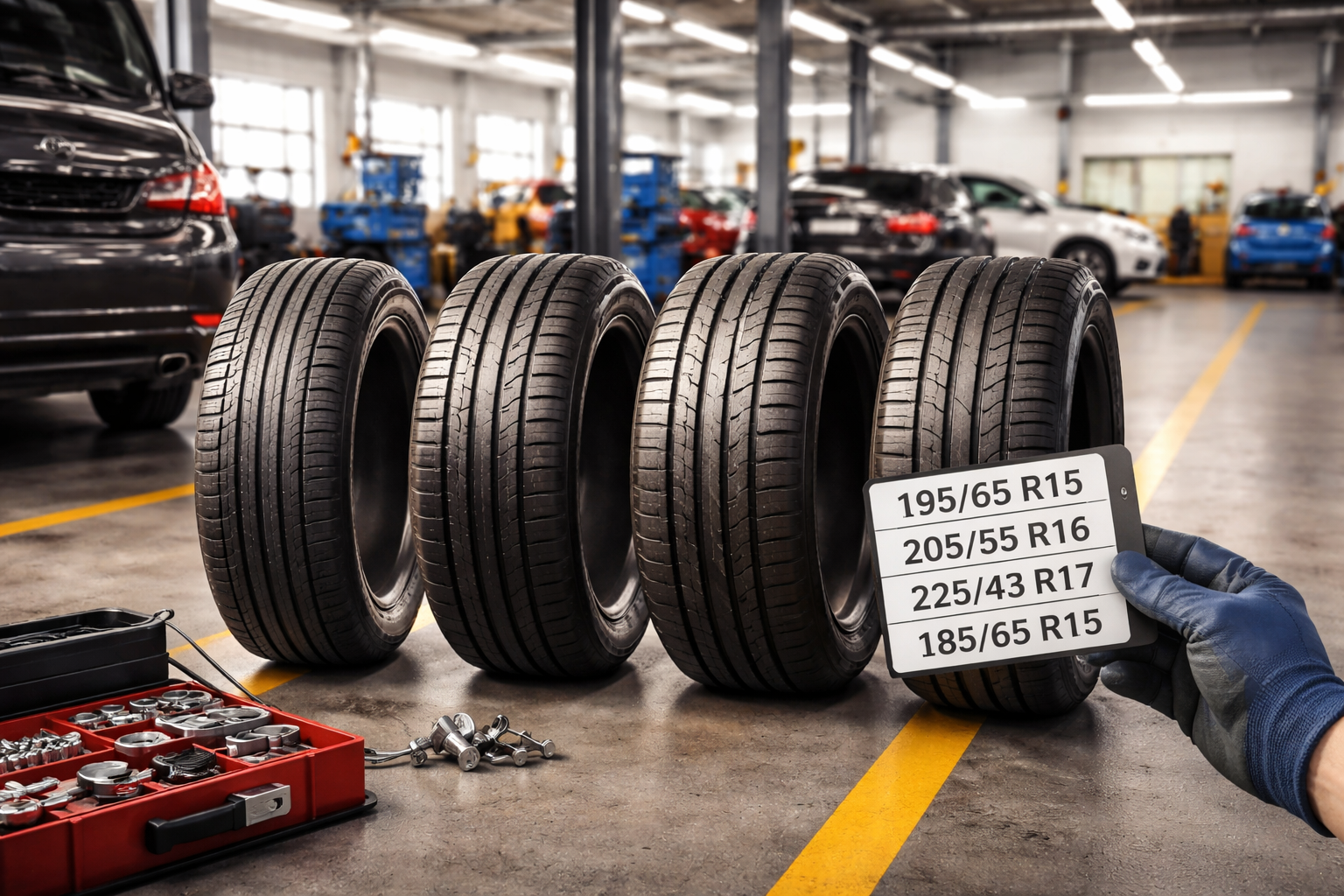
A common dimension is often easy to find, but that doesn't mean it's suitable for all vehicles or all uses. The right choice always depends on several criteria:
- the manufacturer's recommendations,
- the type of journeys made,
- the season,
- the vehicle's engine,
- the carried load,
- driving style.
In practice, the approved dimensions will remain the benchmark. A very common tyre will be simpler to buy, but it must first and foremost be compatible with your car.
How to choose the right tyre size?
To choose the right size, you need to check the indicated dimension:
- on the side of the current tyre,
- on the label located in the door frame,
- in the fuel flap on some vehicles,
- in the manufacturer's manual.
It is also necessary to respect the load index and The speed rating. Even if a similar size appears compatible, a non-compliant change can alter the vehicle's behaviour and cause an homologation issue.
To summarise: the most common dimension is often the one that combines Versatility, Good value for money and wide distribution. But the best size is always the one that precisely matches your vehicle.
To remember
The most common tyre sizes are mostly those found on the most common passenger cars on the road. Sizes like 185/65 R15, 195/65 R15 Or 205/55 R16 dominant because they meet the majority of market needs: safety, comfort, controlled cost, and availability.
For a driver, understanding these dimensions allows them to choose their tyres better, compare offers more easily, and avoid compatibility errors.
FAQ – Most common tyre dimensions
Les dimensions de pneus les plus courantes pour une voiture de tourisme sont généralement comprises entre 15 et 18 pouces de diamètre, avec des largeurs variant entre 185 mm et 225 mm, et des rapports d'aspect (la hauteur du flanc du pneu par rapport à sa largeur) allant de 45 à 65.
The most common dimensions are often 175/65 R14, 185/65 R15, 195/65 R15, 205/55 R16 and 225/45 R17. They correspond to widely distributed segments such as city cars, compact cars, and family cars.
Why is the 205/55 R16 size so popular?
Because it offers an excellent compromise between comfort, road holding, stability, price and availability. It is fitted to many vehicles, making it an easy size to find from most manufacturers.
How do I know which tyre size is suitable for my car?
You must check the approved dimensions indicated by the manufacturer, either on the tyre currently fitted, on the vehicle's sticker, or in the owner's manual.
Can we fit a different tyre size from the original?
In certain cases, an equivalent dimension may be accepted, but it must comply with the permitted tolerances, the load rating, the speed rating, and the manufacturer's recommendations.
Do SUVs always use larger tyres?
Often yes, as they are heavier and generally have larger diameter rims. Therefore, dimensions such as 225/65 R17 Or 235/55 R18.