
How to detect a deformed tyre: signs, risks and solutions
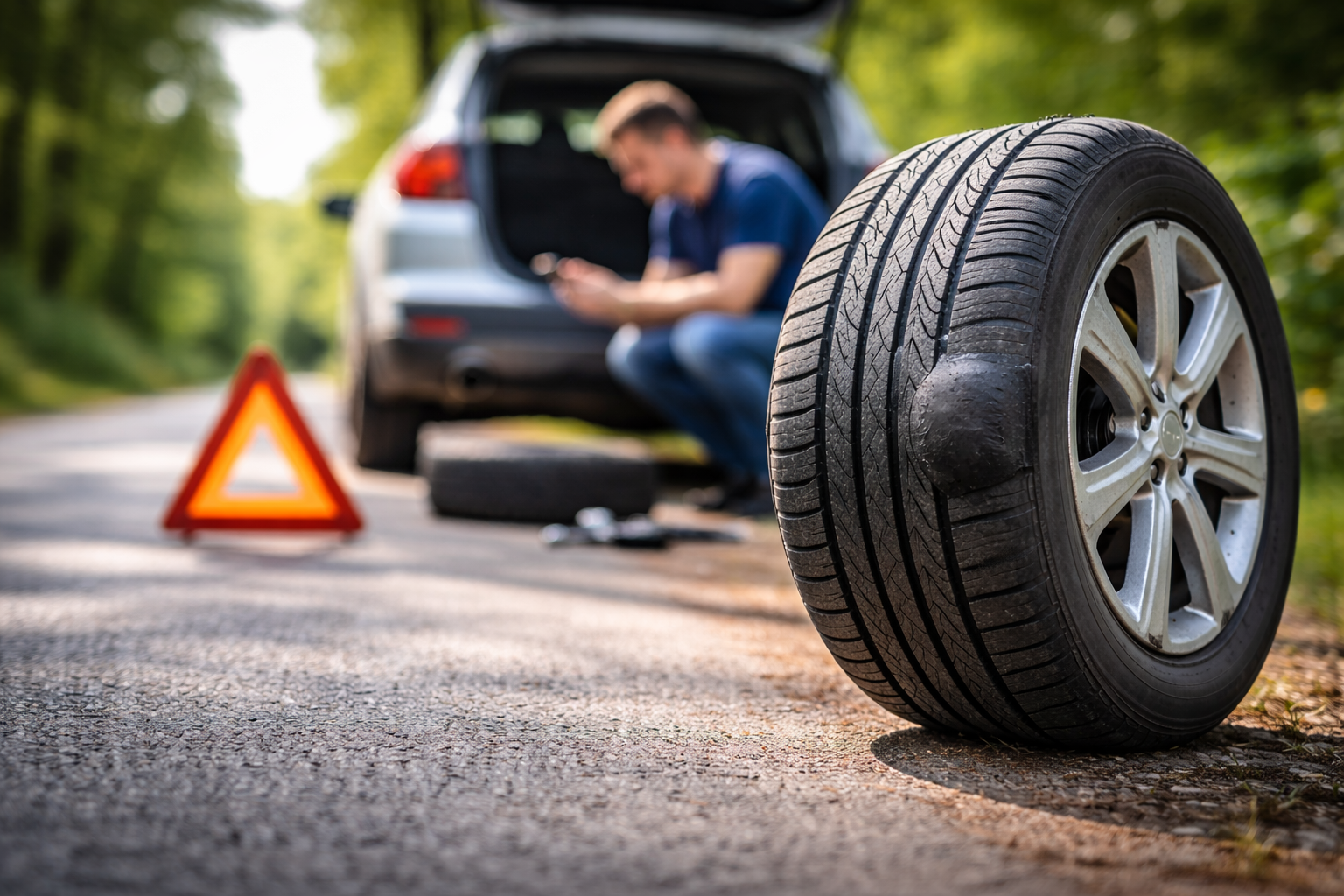
A deformed tyre can cause vibrations, loss of grip and premature wear. Here's how to spot it quickly, understand the causes, assess the risks and choose the right solution (check, replacement, prevention).
What is a deformed tyre?
One deformed tyre is a tyre whose shape is no longer regular. This can concern the Tread, the Flanc, the carcass (internal structure) or the talon (rim contact area).
The deformation can be visible (boss, hernia, flat) or invisible (internal rupture, ovalisation, delamination).
Important: a deformation is not It's always a simple balancing problem. Even if the symptoms are similar, structural damage to the tyre needs to be treated with caution.
Signs of a deformed tyre
1) Signs felt while driving
- Vibrations in the steering wheel (often from 80–110 km/h) or in the seat/dashboard.
- “Skippity” You feel a bouncing wheel sensation, especially at medium speed.
- Car that jerks on the one hand (if the geometry and pressure are correct).
- Abnormal noises Humming, regular beating, snoring that varies with speed.
- Loss of comfort and less precise direction.
2) Visible signs at the stop (inspection)
- Boss / Hernia on the flank: critical sign (risk of bursting).
- Plate on the tread (after prolonged immobilization, heavy braking, or impact).
- Uneven wear facets (cupping), smoother areas, “steps” on the rubber pads.
- Fissures, unusual cracks, delamination (rubber coming unstuck).
- Heel deformity Your tyre is poorly seated on the rim (uneven fitting line).
3) Inflation indices
- Pressure that falls rapidly without obvious perforation.
- Flank that appears to “live” or undulate when the wheel turns slowly (to be checked safely).
To keep in mind A working on the flank = potentially dangerous tyre Vehicle stop and immediate check.
Common causes of a deformed tyre
- Chocolate Pothole, kerb, speed bump hit too fast → internal rupture, hernia.
- Underinflation warm-up, carcass crushing → delamination / progressive deformation.
- Surcharge Exceeding the load index → sagging, wear and deformation.
- Prolonged immobilisation temporary (sometimes reversible) lesions, especially in cold weather.
- Assembly fault : off-centre tyre, poor seating on rim, valve/leak, damaged rim.
- Bent wheel rim gives an impression of a deformed tyre (or worsens the deformation).
- Advanced wear or ageing: hardened rubber, weakened structure.
Risks and dangers: why not ride with a distorted tyre
Continuing to drive with a deformed tyre can lead to serious consequences, especially if the internal structure is affected.
- Loss of grip Longer braking distances, degraded road holding.
- Burst Increased risk in case of hernia, delamination or overheating.
- Accelerated wear tyre “eaten” in a few thousand kilometres.
- Mechanical damage Bearings, shock absorbers, wishbones, ball joints subjected to vibration.
- Rising consumption and reduced comfort.
If in doubt: Slow down, avoid the motorway and get the tyre checked quickly.
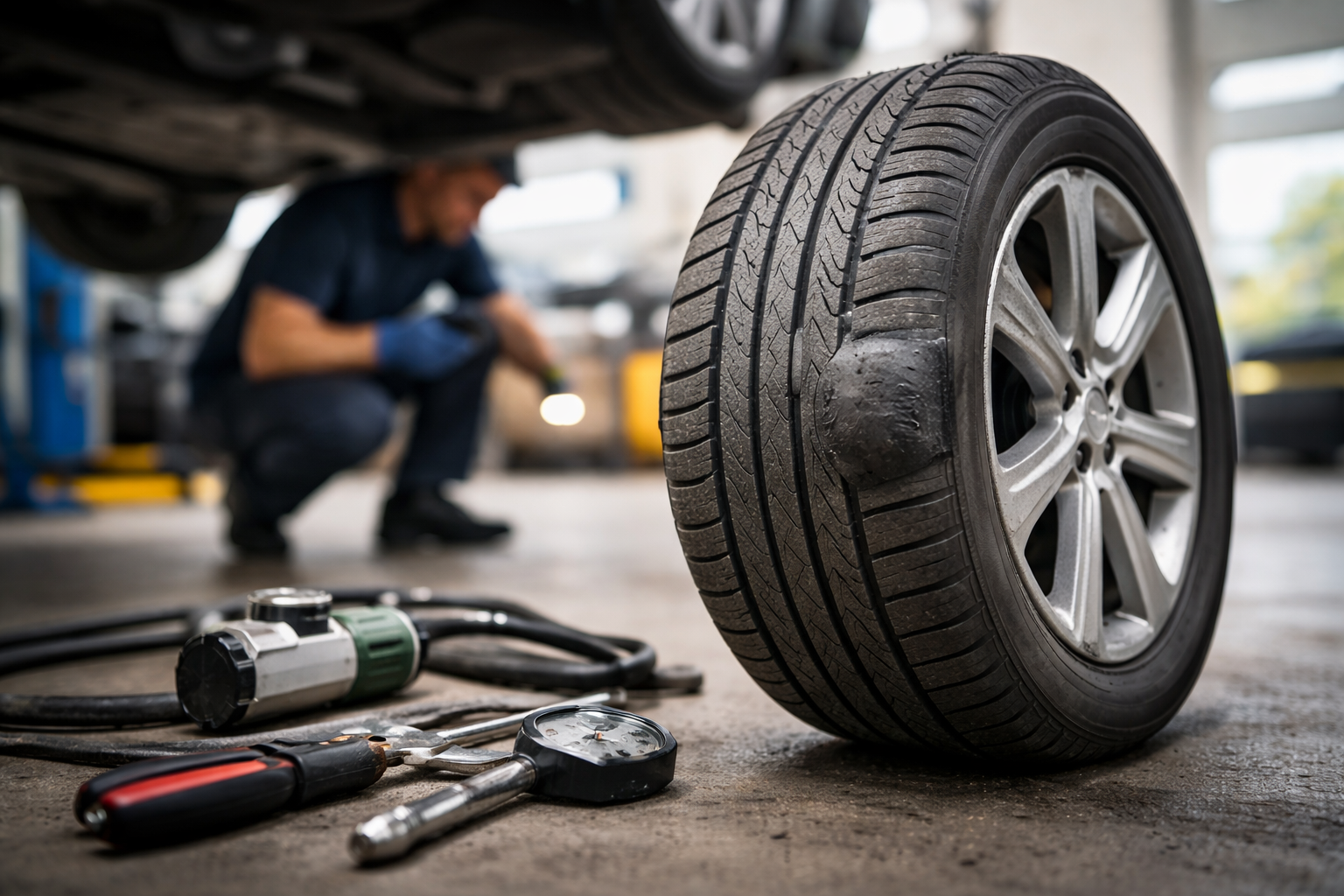
Diagnostic: how to check step by step
Step 1 – Quick visual inspection
- Park on a level surface with the handbrake engaged.
- Inspect each tyre: sidewalls, tread, check for bulges, cuts, cracks, abnormal wear.
- Check that the tyre is properly seated on the rim (regular mounting line all around).
Step 2 – Pressure and Load Check
- Measure the cold pressing and adjust according to manufacturer recommendations.
- Check that you are not exceeding the maximum load (tyre load index + vehicle laden).
Step 3 — Differentiate deformation vs. balancing / geometry
- Balancing : vibrations, particularly within a speed range, sometimes appearing after fitting.
- Geometry : pulling to one side + scalloped wear or edge wear.
- Deformation Noise/vibration more “regular”, “oval” wheel feel, visible bulge, flats.
Step 4 — Workshop check (recommended)
A professional can check: Wheel trim, Ovalisation on a balancing machine,
Internal state (if it works/impacts) and confirm if the tyre is still usable.
Solutions: what to do and when to replace
Case 1 - Temporary plate (immobilisation)
If the vehicle has been parked for a long time, a flat spot may disappear after a few kilometres at moderate speed.
If the vibrations persist, Have it checked.
Case 2 — Bulge / hernia on flank
Immediate replacement. A hernia often indicates a rupture of the inner layers: risk of bursting.
Do not repair and do not race “to finish the season”.
Case 3 – Irregular wear (facets, “scalloping”)
- Check shock absorbers, Pressure and Geometry.
- Depending on wear and tear, a replacement may be necessary.
Case 4 — Warped rim or faulty fitting
- Rim repair/replacement, then balancing and assembly control.
- In some cases, the tyre will also have suffered: an inspection is essential.
When is it absolutely necessary to replace?
- Hernia/lump on flank, delamination, deep cut.
- Persistent vibrations despite balancing and correct pressure.
- Deformation confirmed on wheel balancer (ovalisation, runout).
- Any doubt after a violent shock (pothole, kerb).
Good reflex: If you change a tyre on an axle, check the condition of the other tyre and
Follow the fitting recommendations (often the newest tyres on the rear).
Prevention: avoiding tyre distortion
- Pressure Check once a month and before long journeys (when cold).
- Driving Avoid bumps (kerbs, potholes) and slow down on damaged roads.
- Charge Observe the indicators and adjust the pressure if recommended by the manufacturer when loaded.
- Balancing : after assembly, and if vibrations appear.
- Geometry : uneven wear or vehicle pulling.
- Storage Tyres protected from heat, ozone, UV; avoid leaving the vehicle stationary for long periods.
FAQ: Deformed tyre
Les symptômes les plus fréquents d’un pneu déformé sont les suivants : * **Vibrations au volant :** C'est souvent le premier signe perceptible. Vous sentirez des secousses ou des vibrations à travers le volant, surtout à certaines vitesses. * **Bruit inhabituel :** Un pneu déformé peut provoquer un bruit de battement, de cliquetis, ou un bourdonnement constant qui n'est pas normal. * **Conduite erratique :** La voiture peut avoir tendance à tirer d'un côté, à rouler de travers, ou donner une sensation de "flottement" et d'instabilité. * **Usure irrégulière des pneus :** Inspectez vos pneus. Une déformation peut entraîner une usure anormale, comme des bosses localisées, des craquements ou une usure plus prononcée à certains endroits. * **Sensation de guidonier :** Le volant peut sembler plus dur à tourner, ou au contraire, il peut sembler moins précis et réactif. * **Vérification visuelle :** Parfois, vous pouvez voir la déformation en regardant le pneu de côté, surtout lorsqu'il est au ralenti. Il peut y avoir une zone qui semble plus plate ou enfoncée que le reste. Si vous suspectez qu'un de vos pneus est déformé, il est crucial de le faire vérifier par un professionnel rapidement. Un pneu déformé peut compromettre la sécurité de votre conduite et endommager d'autres composants de votre véhicule.
The most common ones are the vibrations, one cyclic noise, one irregular wear,
and sometimes a Visible boss on the flank.
Is it dangerous to drive with a deformed tyre?
Yes. Depending on the cause, the risk ranges from loss of grip to’burst. In case of a hernia, you must
replace immediately.
How to tell the difference between a deformed tyre and poor balancing?
Imbalance often causes vibrations within a specific speed range. A deformation can produce
more constant vibrations, a “bounce” and sometimes visible signs. A wheel balancing check confirms this.
Can a deformed tyre be repaired?
A structural defect (bulge, internal rupture, delamination) It can't be repaired.
Only certain external causes (fitting, rim, balancing) can be rectified if the tyre is sound.
What to do after hitting a pothole?
Inspect the tyre and wheel, watch out for any vibrations/noises, check the pressure and get it checked quickly if you have any doubts.
A bump or a crack = replacement.
You might be interested in these articles:
 Pneumatic Innovations 2025: The Future of the Smart, Sustainable, and Connected Tyre
 Chinese vs European tyres: what are the real differences in 2025?
 What tyres to drive on snow safely? The ultimate 2025 guide
 Continental ContiSportAttack 5: The new supersport motorcycle tyre that redefines performance