
How to choose a tyre based on your driving style (sporty, urban, road)
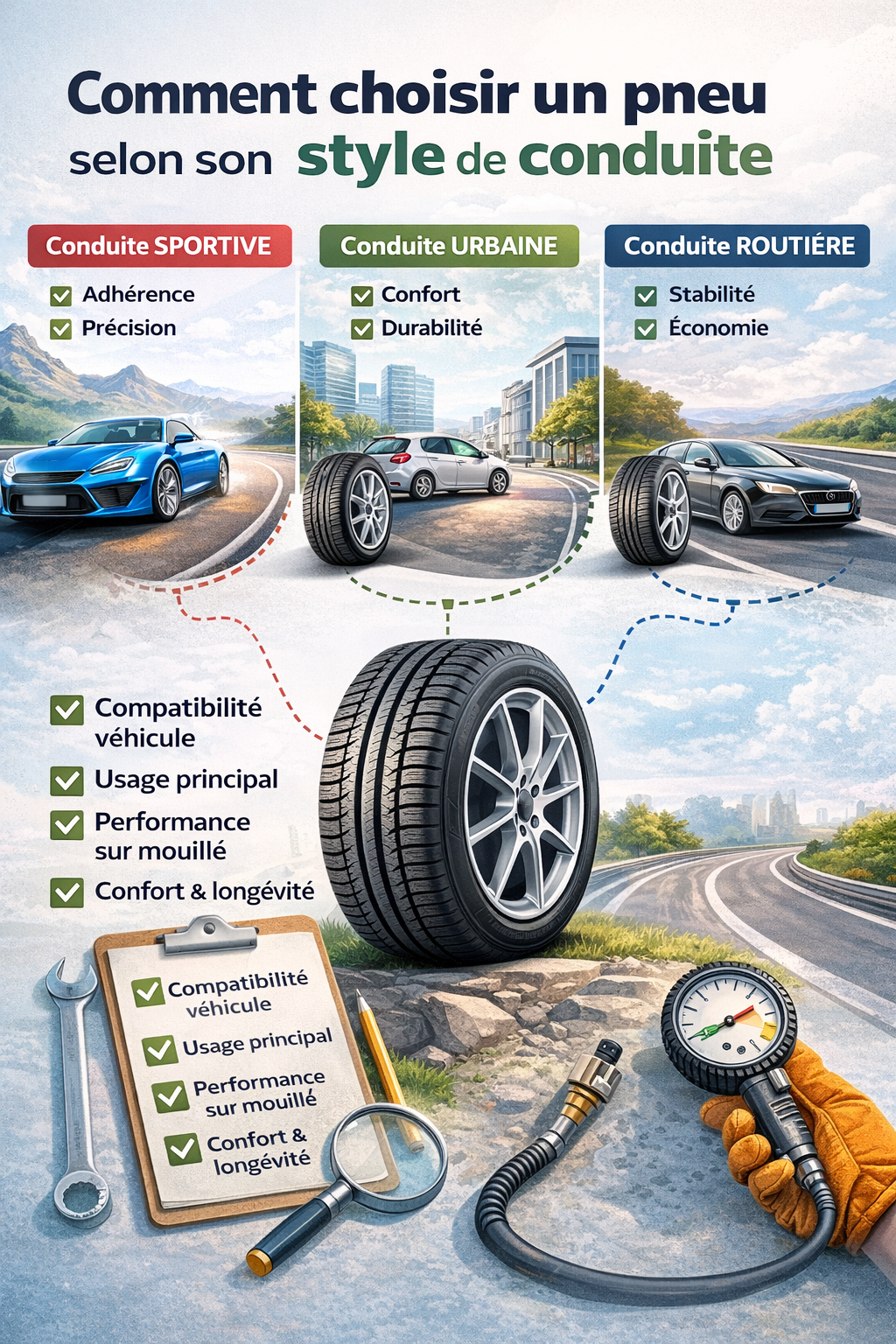
Choosing the right tyres isn't just about the size on the sidewall: your Driving style directly influences grip, comfort, consumption, and wear. Driving Sporty, journeys Urban long-distance Roads Each use case favours different characteristics. In this guide, discover how to select the most suitable tyre, with practical advice and a FAQ.
Pourquoi le style de conduite change-t-il ?
The tyres are the only point of contact between your vehicle and the road. Depending on how you drive, you stress the rubber, structure, and tread differently:
- Sporty accelerations, heavy braking, fast corners → need for grip and road holding.
- Urban Frequent stops, potholes, pavements, short distances → need for robustness and comfort.
- Trucker Long distances, stabilised speeds, possible rain → need for stability, endurance and economy.
Before buying, always check the non-negotiables: dimensions, Load index, Speed index and conformity to manufacturer recommendations.
Tyre for sporty driving: grip and precision
For dynamic driving, the priority is the performance A sports tyre should offer excellent grip, precise steering and short braking distances, particularly on dry roads.
Features to prioritise
- Grip on dry ground Softer rubber, reinforced shoulders to better absorb pressure.
- Braking and traction Optimised sculpture and chassis rigidity for sharper reactions.
- Road holding Cornering stability, steering precision, better steering feel.
- Wet grip Essential if you drive all year round, even with a sporty driving style.
What this implies (trade-offs)
- Faster wear A high-performance eraser often wears out faster.
- Comfort and noise sometimes less good: stiffer sidewalls, firmer feel.
- Consumption potentially higher: sometimes higher rolling resistance.
Typical profile
You'll be concerned if you favour driving pleasure, winding roads, or if you wish to maximise precision and braking (while respecting the Highway Code).
Tyre for urban driving: comfort and durability
In town, tyres are subjected to numerous stresses: stop-starts, speed bumps, cobbles, potholes, manoeuvres and sometimes impacts against kerbs. The objective: resist, remain Comfortable and maintain good performance in wet conditions.
Features to prioritise
- Robustness sides more resistant to shock and abrasion.
- Braking on a wet surface : essential criterion in urban conditions (pedestrian crossings, smooth surfaces, rain).
- Comfort absorption of irregularities (paving stones, joints, deformations).
- Bearing noise a quiet tyre significantly improves comfort in the city.
- Longevity : important if you drive a lot daily.
Tip according to your use
If your journeys are mostly short, remember that tyres can wear unevenly (less regular heating). Check the pressure and wear to extend their lifespan.
Typical profile
You mainly drive in urban areas, with degraded roads, and you are looking for a reliable, comfortable, and durable tyre.
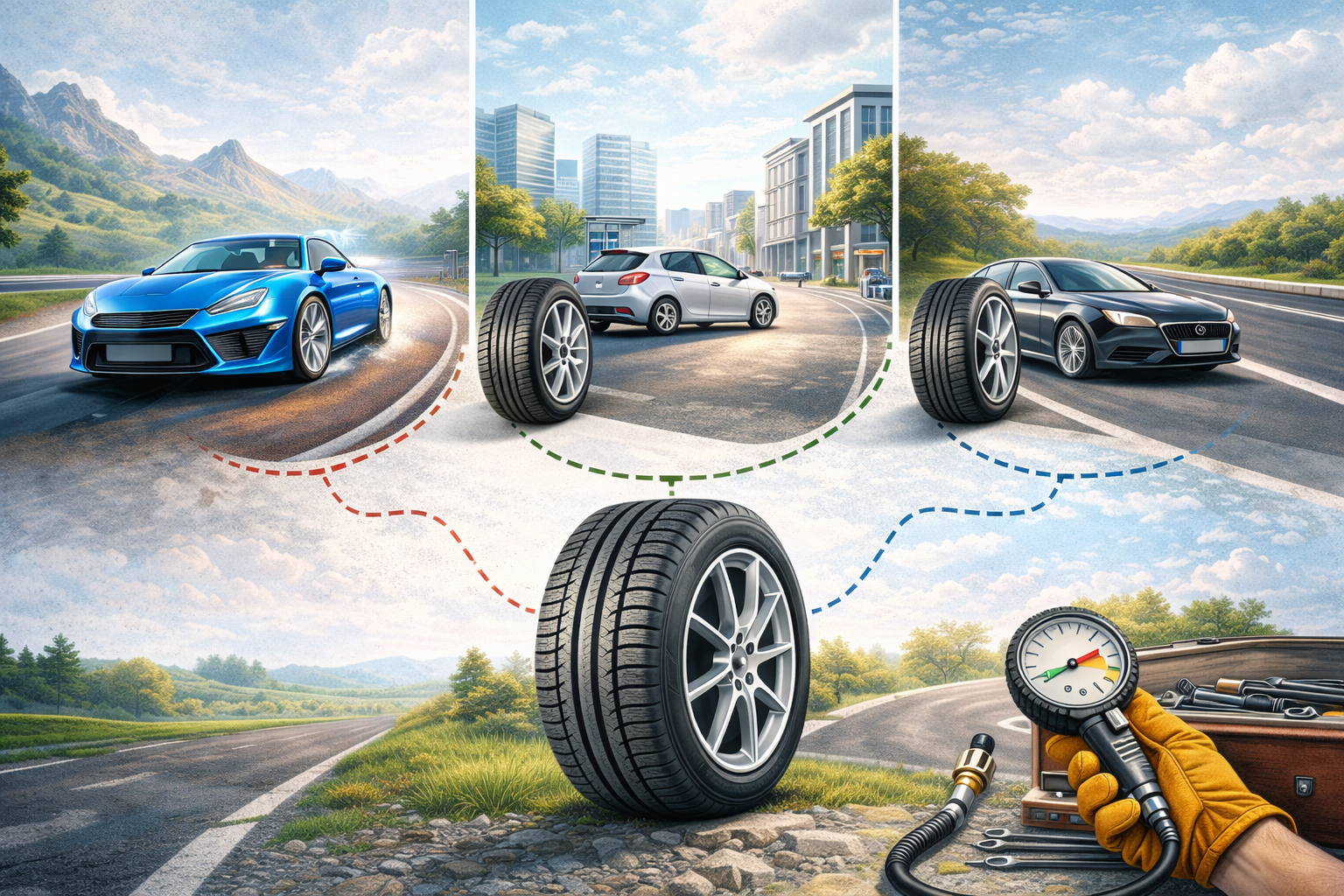
Tyre for road driving: stability and economy
On the road and motorway, you're looking for a tyre that can eat up the miles with excellent stability, good wet grip and decent acoustic comfort. Here, the priority is’endurance and the Security over time.
Features to prioritise
- Stability : Healthy behaviour at stabilised speed, progressive steering.
- Rolling resistance helps to reduce consumption and range (important for EVs).
- Comfort and quiet less fatigue on long journeys.
- Wet weather behaviour Reassuring water drainage and braking.
- Normal wear and tear High mileage and consistent performance.
Typical profile
You cover many miles, with daily commutes or weekend/holiday trips. You want a tyre that is balanced, durable, and efficient.
Mistakes to avoid
- To choose only by price Wet grip and road holding are priorities.
- Ignore the clues Load and speed must comply with type approval.
- Mixing very different tyres Prefer a consistent assembly (same model per axle, ideally per train).
- To neglect pressure Incorrect pressure increases wear and compromises safety.
- Forget the season A summer tyre is not made for the cold or snow.
FAQ: Tires and Driving Style
What tyre should I choose if I drive both in the city and on the motorway?
Choose a tyre all-purpose Comfort/longevity focused, with good wet grip.
If your journeys are predominantly on motorways, opt for endurance and low rolling resistance.
Is a sports tyre dangerous in the rain?
Not necessarily. Some sport tyres excel in the wet, while others are primarily optimised for dry conditions.
Check performance on wet roads (tests, reviews, and recognised behaviour), and always adapt your speed
under the conditions.
How do I know if my driving style is wearing my tyres out too quickly?
Excessive wear on the shoulders, facets, or a marked difference between the front and rear can indicate unbalanced driving
dynamic, under-inflation, or a geometry problem. Have the wheel alignment/balancing checked and monitor the pressure.
Should I choose “eco” tyres to reduce fuel consumption?
For road driving (long journeys), yes: a tyre with low rolling resistance can help reduce
consumption (or increase the range of an electric vehicle). However, ensure it remains high-performing in wet conditions.
Are all-season tyres suitable for a city driver?
Often, yes: for urban and suburban use, the 4-season [tyre] can be very practical. It is particularly relevant
if you occasionally encounter cold or light snow, without wanting to change your tyres twice a year.
What are the signs that your tyres need replacing?
Replace them if the tread depth reaches the wear indicator, if you notice cracks, bulges,
cuts, or a significant drop in grip. If in doubt, have it checked by a professional.
You might be interested in these articles:
 Pneumatic Innovations 2025: The Future of the Smart, Sustainable, and Connected Tyre
 Chinese vs European tyres: what are the real differences in 2025?
 What tyres to drive on snow safely? The ultimate 2025 guide
 Continental ContiSportAttack 5: The new supersport motorcycle tyre that redefines performance
How to quickly compare (checklist)
To choose a tyre that suits your driving style, use this simple checklist:
Dimensions and indices compatible with your vehicle (mandatory).
2) Priority of use Sporty (grip) / Urban (robustness) / Road (endurance & economy).
3) Wet performance Indispensable for safety, whatever the profile.
4) Comfort & Noise : especially in the city and on motorways.
5) Longevity Expected mileage and journey type.
6) Season Summer, winter, or 4 seasons depending on your climate and your travels.
Practical advice: If you're unsure between two tyres, choose the one that matches the most frequent scenario in your week (rather than the exception).