Punctured tyre: repair or replacement? The complete guide
A flat tyre on the road or in your garage: should you repair or replace it? This comprehensive guide will help you decide
quickly, safely, depending on the type of puncture, the condition of the tyre, and the rules to be aware of.
Quick diagnostic: 5 questions to ask yourself
Before choosing between repair and Replacement, begin by identifying
where and comment The tyre has been damaged. These 5 questions cover the essentials:
- Where is the puncture? (tread, shoulder, sidewall) Tread is the most repairable area. The Flanc is
Generally not repairable. - What is the size of the hole?A small puncture (nail/screw) is often repairable. A tear or large hole usually requires replacement.
- Did the tyre run flat?Driving under-inflated or flat can damage the internal structure, even if the puncture appears minimal.
- What is the age and wear of the tyre?A tyre close to the tread wear indicator or very old is not worth repairing.
- Was there a rapid loss of air?➡️ A sudden pressure drop could indicate more serious damage than just a simple nail.
Golden Rule Safety: if you have any doubts about the tyre's integrity (marked sidewall, bulge, tear,
(flat tyre), favour the Replacement.
When repair is possible (and recommended)
Repair is often possible if the perforation is Small, located on the
Tread and if the tyre has not sustained structural damage.
- Nail/screw perforation on the central tread area.
- No prolonged flat run (no internal heating or deformation).
- Flank intact no tears, no hernias, no alarming cracks.
- Fair wear and tear tyre still in good general condition (sufficient tread depth).
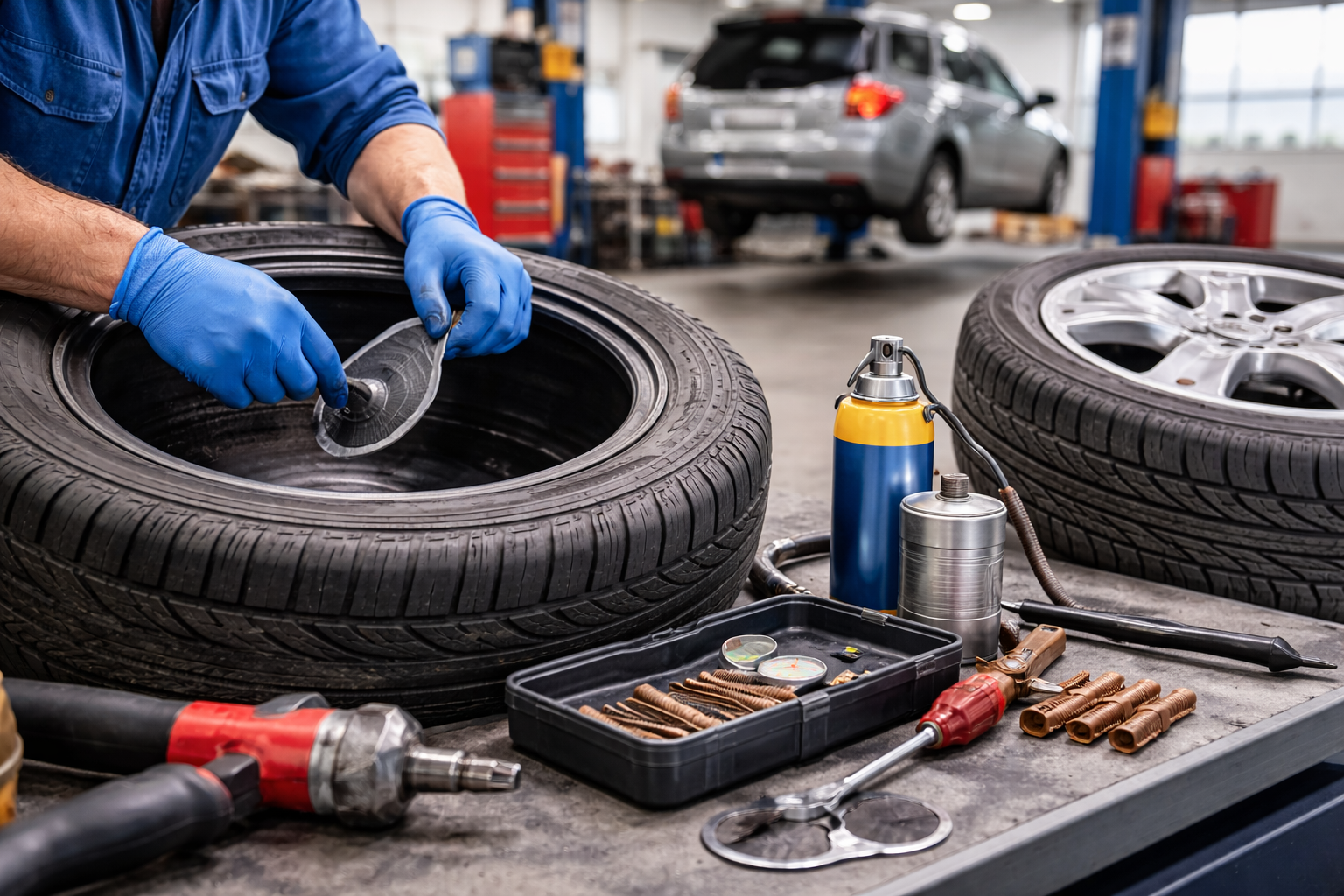
- Repair carried out by a pro (Ideally by an internal repair, “mushroom” type).
Top tip: If the tyre is recent and the puncture is simple, a professional repair is often the most economical and ecological solution.
When it's time to replace (without hesitation)
Certains cas rendent la réparation risquée, voire impossible. Replace the tyre if you notice any of the following:
- Puncture on the sidewall (tear, notch, side perforation).
- Hernia / bulge Sign of damaged structure.
- Tear Trou important (objet large, impact violent).
- Flat tyre overheating traces, worn rubber, black dust, smell, delamination.
- Very worn tyre (close to the witness) or Very old Hardened/cracked rubber.
- Multiple repairs too many punctures close to each other.
Important: A repair “at all costs” can lead to a loss of roadholding, a risk of failure at high speed and uneven wear. On motorways and when carrying a load, caution must take precedence.
Repair methods: plug, mushroom, kit
Wick (external repair)
The wick it is quick and can help in a pinch, but it is often considered a stopgap Temporary depending on the case, as it does not always allow control of the inside of the tyre.
Mushroom (internal repair)
The repair by Mushroom The patch-plug is generally the most reliable: the tyre is removed, inspected from the inside, and then permanently repaired if the conditions are right.
In practice: this is the preferred solution when repair is possible.
Puncture repair kit (aerosol + compressor)
One Puncture repair kit allows to re-inflate and temporarily seal a small hole, but it can:
- Does not work on cuts or large holes.,
- complicating subsequent repair (sealant product to clean),
- require a quick check by a professional.
Good reflex: After a kit, drive gently and get the tyre checked as soon as possible.
Special cases: Runflat, reinforced tyres, TPMS
Runflat tyres
Tires Run-flat can allow for driving a limited distance at reduced speed after a loss of pressure. But this increases the risk of internal damage.
➡️ Professional inspection is essential. Depending on the internal condition, repair may be refused.
Reinforced tyres (XL) and heavy vehicles
On loaded vehicles (SUVs, vans, towing), the stress is greater.
Even a minor puncture can have consequences if the tyre has been driven on while underinflated. Internal inspection becomes even more important.
TPMS sensors
With a Tyre Pressure Monitoring System (pressure sensors), an alert doesn't always mean a puncture: it could be a slow leak.
After repair or replacement, check the pressure and, if necessary, the reset procedure
of the system.
Can you drive on a flat tyre?
As a general rule: No. Driving on a flat (or severely underinflated) tyre can:
- destroy the internal carcass, making repair impossible,
- damage the rim,
- significantly increase the risk of accident (overheating, bursting).
If you must move the vehicle for safety reasons (dangerous area), do so at a very low speed and on a very
short distance. Otherwise, favour Spare wheel, Kit Or Troubleshooting.
Costs, deadlines and sound economic sense
A repair generally costs much less than a replacement, but the decision must remain
Safety first.
- Repair (pro) Often quick (same day depending on the workshop) and economical.
- Replacement Required if structural damage, side impact, worn/old tyre.
Advice: If you replace a single tyre on an axle, check the wear difference with the other.
A significant deviation can impact grip (and, on some vehicles, assistance systems).
As the case may be, replace in pairs may be preferable.
Best practices after repair or replacement
- Pressure control Immediately, then after a few days.
- Visual inspection : check for any persistent deformation or leakage.
- Balancing Recommended during a replacement, and sometimes after an intervention.
- Geometry : If there is uneven wear or impact (pothole), have the wheel alignment checked.
- Careful driving The first few kilometres, especially after a repair.
To keep in mind A quality repair + professional inspection = better safety and lifespan.
FAQ: frequently asked questions
Can a flat tyre still be repaired?
No. The repair primarily depends on the affected area (tread vs sidewall) and the size of the damage.
and from having driven on a flat. A sidewall puncture or structural damage usually requires replacement.
Plug or mushroom: which repair to choose?
Internal “mushroom” repair is generally the most reliable as it includes disassembly and inspection
inside of the tyre. The plug can help in an emergency, but it doesn't always guarantee full control from the inside.
Can I drive after a repair?
Yes, if the repair was carried out correctly and the tyre has been inspected. Check the pressure
After the procedure and monitor for any air loss in the following days.
What to do if the tyre pressure warning light (TPMS) comes on but the tyre looks fine?
Check the pressure when cold: a slow leak may not be visible. If the pressure drops again,
Have the tyre (nail, valve, rim) checked by a professional.
Should tyres be replaced in pairs after a puncture?
Not always. If the wear difference between the two tyres on the same axle is significant, replace them as a pair.
Can improve balance, grip and stability. A professional can advise you based on wear and the vehicle.