Full table of tyre size equivalencies
You are looking for a Full table of dimension equivalences tyres To find out if you can change the size without compromising your vehicle's safety, comfort or compliance? This guide explains how to read a dimension, understand the rules of’equivalence tyre, use a Correspondence table and avoid errors when replacing your tyres.
The key takeaways
- One Equivalent tyre size It must maintain an overall diameter close to the original fitment.
- You can change the width, sidewall height and rim diameter, but not just any old how.
- A change in dimension influences the comfort, the Driving precision, the consumption and the counter.
- Il faut toujours vérifier la Vehicle compatibility, the rim, the’Load index and the’Speed index.
- The table below gives Indicative equivalences among the most sought-after sizes.
- Before any purchase, you must confirm the fitment authorized by the manufacturer or by the applicable regulations for your vehicle.
How to read a tyre size
Before using a Tyre equivalence chart, one must know read a dimension. Let's take the example 205/55 R16.
- 205 Tyre width in millimetres
- 55 : series, i.e. the height of the sidewall as a percentage of the width
- R Radial structure
- 16 Rim diameter in inches
A wider tyre is not automatically equivalent. To talk about’dimension equivalence, It is essential to maintain a consistent outer diameter so as not to disrupt the vehicle's geometry or the speedometer readings.
What is a tyre dimension equivalence?
One Tyre size equivalence refers to an alternative size whose total diameter remains very close to that of the original fitment. The objective is to maintain consistent road holding, a similar ground clearance, and for the speedometer reading to be as accurate as possible.
In practice, when increasing the wheel rim diameter, the sidewall height is often reduced to compensate. This is the basis for tyre size equivalencies.
Classic example:
- 195/65 R15
- 205/55 R16
- 225/45 R17
These dimensions are often brought together in equivalence tables, as their overall diameter remains similar.
Rules to follow before changing dimensions
1. Observe the approved mounting
The first instinct is to check the dimensions intended for your vehicle. All theoretically “close” sizes are not necessarily permitted on your model.
2. Check compatibility with the rim
Each tyre width corresponds to a range of compatible rim widths. An equivalent dimension must remain suitable for the rim fitted to the vehicle.
3. Maintain a sufficient load index
spare tyre must have a Load index at least equal to that required for the vehicle, except in specific cases provided for by local regulations.
4. Maintain a suitable speed rating
The’Speed index It must correspond to the vehicle's intended use and obligations. It must not be overlooked when changing size.
5. Do not mix dimensions without a clear rule
Unless a different differential is fitted as standard, you should avoid driving with different sizes on the same axle.
Full table of tyre size equivalencies
The table below presents some Common tyre size equivalents. This is a handy reference for understanding the correspondences between fittings. This table remains Indicative Before fitting, always confirm actual compatibility with your vehicle, wheels, and applicable legal requirements.
| Reference mount | Common Equivalents | Frequent use |
|---|---|---|
| 145/80 R13 | 155/70 R13, 165/65 R13 | Small old city cars |
| 155/70 R13 | 145/80 R13, 165/65 R13 | Micro-cars |
| 165/70 R14 | 175/65 R14, 185/60 R14 | Citadines |
| 175/65 R14 | 165/70 R14, 185/60 R14, 195/55 R14 | Citadines and compacts |
| 185/65 R14 | 195/60 R14, 205/55 R14 | Compact |
| 185/60 R15 | 195/55 R15, 205/50 R15 | Versatile citadels |
| 195/65 R15 | 205/55 R16, 205/60 R15, 225/45 R17 | Compact saloons |
| 195/60 R15 | 205/55 R15, 215/50 R15 | Compact |
| 195/55 R15 | 185/60 R15, 205/50 R15, 215/45 R15 | Bustling cities |
| 205/60 R15 | 195/65 R15, 215/55 R15 | Saloon cars |
| 205/55 R16 | 195/65 R15, 215/50 R16, 225/45 R17 | Compact, saloon, estate |
| 215/55 R16 | 205/60 R16, 225/50 R16, 235/45 R17 | Saloon cars |
| 215/60 R16 | 225/55 R16, 235/50 R16 | Monospaces and light SUVs |
| 215/50 R17 | 205/55 R16, 225/45 R17, 235/40 R18 | Sports compacts |
| 225/45 R17 | 205/55 R16, 215/50 R17, 235/40 R18 | Saloons, coupés, premium compacts |
| 225/50 R17 | 215/55 R17, 235/45 R17 | Hatchbacks and urban SUVs |
| 225/40 R18 | 215/45 R18, 235/35 R18 | Sports versions |
| 235/45 R18 | 225/50 R17, 245/40 R18 | Luxury saloons |
| 235/40 R18 | 225/45 R17, 245/35 R18 | Sport and premium |
| 245/45 R18 | 235/50 R18, 255/40 R18 | Large saloons and SUVs |
| 255/35 R19 | 245/40 R19, 265/30 R19 | Performance |
| 215/65 R16 | 225/60 R16, 235/55 R16 | Compact SUVs, light utility vehicles |
| 225/65 R17 | 235/60 R17, 245/55 R17 | SUVs and crossovers |
| 235/55 R17 | 225/60 R17, 245/50 R17 | Family SUVs |
| 235/60 R18 | 225/65 R17, 245/55 R18 | Road SUVs |
Frequently searched correspondences
Voici quelques recherches fréquentes relatives aux tyre equivalents :
- 195/65 R15 equivalent 205/55 R16, 225/45 R17
- 205/55 R16 equivalent 195/65 R15, 225/45 R17
- 225/45 R17 equivalent 205/55 R16, 235/40 R18
- 215/55 R16 equivalent 205/60 R16, 225/50 R16
- 225/40 R18 equivalent 215/45 R18, 235/35 R18
Tyre and wheel fitment
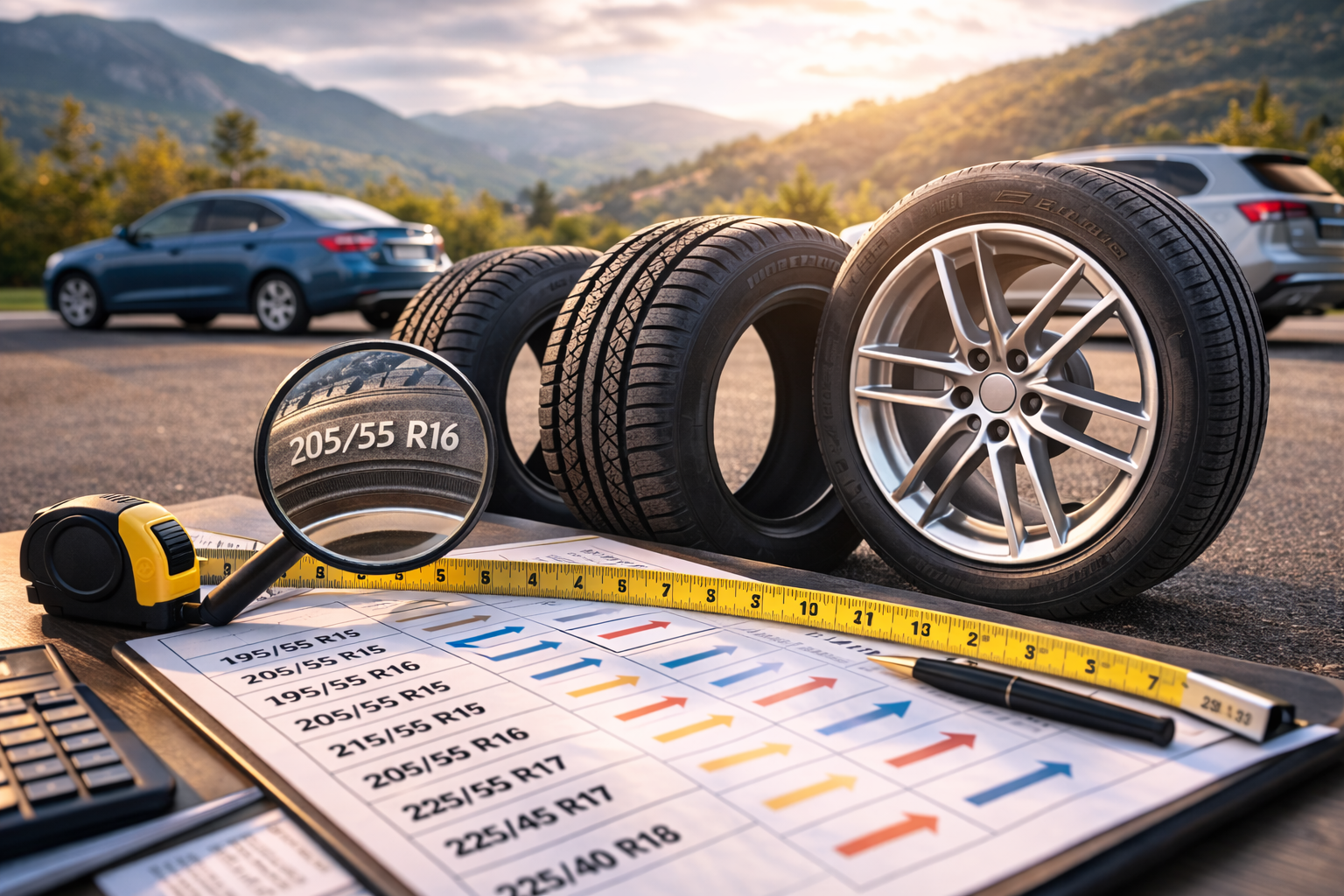
One Dimensional equivalence is only useful if the rim suit. The last number of the dimension, for example 16 in 205/55 R16, indicate the compatible rim diameter in inches.
If you switch to a larger rim, the tyre's sidewall usually needs to be lower to compensate. This is often called the plus sizing. This practice can offer a sportier look and more precise steering, but it often reduces comfort and exposes the rim more to impacts.
Example of matching logic
- 195/65 R15
- 205/55 R16
- 225/45 R17
- 235/40 R18
We observe here a progressive increase in the rim diameter, compensated by a decrease in the sidewall height.
How to choose the right tyre equivalent
To choose a Equivalent tyre size relevant, several criteria must be crossed:
- the original dimension fitted to the vehicle; ;
- the sizes permitted by the manufacturer ;
- The available rim size ;
- intended use: comfort, precision, aesthetics, charge; ;
- the load and speed indices ;
- summer, winter, or 4 seasons.
In short, a Tyre size chart serves as a basis, but the final decision must always take into account the vehicle and its actual use.
Errors to avoid with dimension equivalences
- To choose a “close” size by eye only
- Forgetting to check the compatible rim width
- Ignore the load or speed index
- To raise an unintended dimension on a heavily loaded vehicle
- Mixing several dimensions on the same axle
- Confusing theoretical equivalence with actual approval
FAQ - Tyre Dimension Equivalence Chart
What is a tyre dimension equivalence?
A tyre size equivalent corresponds to an alternative size where the overall diameter remains close to the original fitment, in order to maintain consistent road handling.
Can I change my tyre size freely?
No. Even if a size appears equivalent, it must remain compatible with the vehicle, the rim, the load index, the speed rating, and applicable regulations.
What is the equivalent of a 205/55 R16?
Among commonly cited sizes are 195/65 R15 and 225/45 R17, subject to actual vehicle compatibility.
What is the equivalent of a 225/45 R17?
This size is often compared to 205/55 R16 and 235/40 R18 in indicative equivalence charts.
Is the equivalence chart sufficient for buying my tyres?
No. The chart helps to understand the correspondences, but you must always confirm the permitted size for your vehicle before purchase and fitting.
Does changing the wheel rim alter the tyre size?
Yes. If the rim diameter increases, the sidewall height often has to decrease to maintain a total diameter close to the original equipment.
Conclusion
The Full tyre size equivalence chart is an excellent starting point for comparing the most common sizes and better understanding the correspondences between tyres and rims. It allows for a quick visualisation of which dimensions are close in overall diameter and which are frequently associated.
But a tyre equivalence should never be chosen at random. For a safe and consistent replacement, compatibility with original fitment, wheels, technical ratings and manufacturer constraints must always be checked.