❄️ Which tyres to drive on snow safely? The ultimate 2025 guide

Driving safely in snow requires preparation. With sub-zero temperatures, black ice and sometimes heavy snowfall, tyre choice becomes crucial. This article is a comprehensive guide for anyone who wants to understand how to equip themselves properly for winter, avoid accidents and remain compliant with regulations.
Nous allons aborder en détail : Les différents types de pneus adaptés à la neige (hiver, 4 saisons, cloutés…), le fonctionnement des gommes à basse température, les normes européennes, les conseils de conduite sur neige et une FAQ exhaustive en fin d’article.

1. Why are specific snow tyres needed?

Classic tyres (so-called summer tyres) are designed for temperatures above 7°C. Below this, their rubber hardens, their grip decreases and braking becomes risky.

What a good snow tyre does:

Retains its elasticity at low temperatures

Drain and dispose of meltwater and water through a specific design

Hook the snow for the “snow-on-snow” effect (better traction)

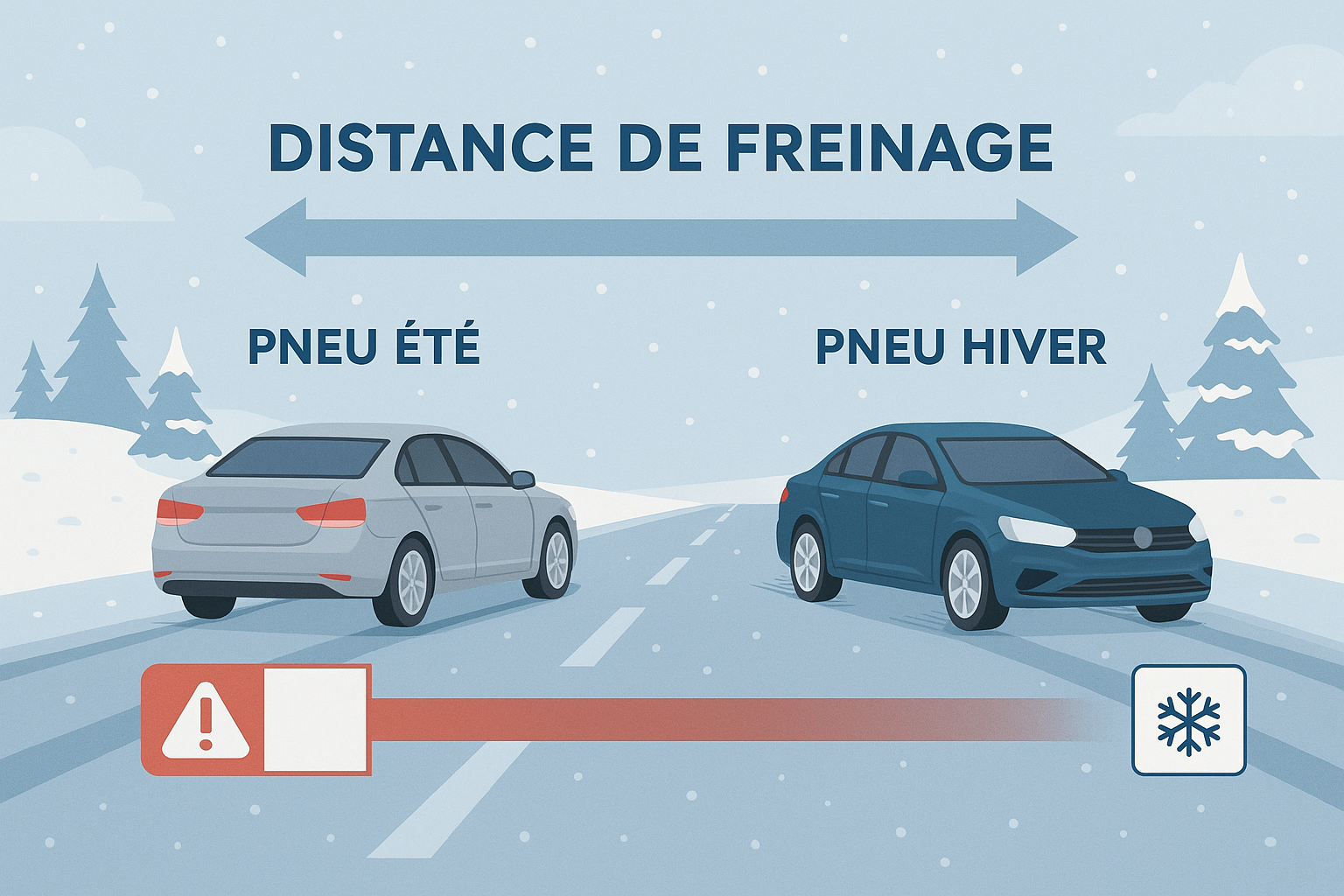
Reduces braking distances on cold, wet or slippery roads

Comparative study

According to tests carried out by organisations such as the TCS or ADAC, a summer tyre takes up to twice as long to stop on snowy roads compared to a winter tyre.

2. Impact of temperatures on safety and rubber

Cold weather doesn’t just affect the weather. It radically alters the behaviour of materials, particularly rubber. At 0°C, a summer tyre loses up to 30 % of its flexibility.

What is happening in the rubber?

The rubber hardens, reducing the ground contact area.

The grooves are no longer so worn and do not drain water well.

Braking distances become considerably longer.

Pro tip: Even without visible snow, winter tyres remain more efficient as soon as the asphalt is damp and cold.

2. Les différents types de pneus pour la conduite sur neige

2.1. Les pneus hiver (M+S avec flocon 3PMSF)

This is the best choice for frequent driving in winter conditions (snow, ice, cold rain).

Flexible rubber down to -30°C

Multiple lamellae for improved grip

3PMSF (Three Peak Mountain Snow Flake) symbol guaranteeing snow performance

Ideal for: mountainous areas, regular winter use
Examples: Michelin Alpin 6, Continental WinterContact TS 870, Nokian Snowproof

2.2. Les pneus 4 saisons (All Season)

A compromise for those who want to avoid changing tyres twice a year. Increasingly high-performing, some models are now winter-approved (3PMSF).

Good grip down to -10°C

Performance on wet surfaces

Less effective than winter tyres in heavy snow

Ideal for: low-exposure areas, urban drivers
Examples: Goodyear Vector 4Seasons Gen-3, Michelin CrossClimate 2, Vredestein Quatrac

2.3. Les pneus cloutés (ou cramponnés)

Used in Nordic countries or areas with extreme snow, they offer incomparable grip on ice.

Banned in many countries for road safety and tarmac wear reasons

Very noisy

Require dedicated wheels

Ideal for: Sweden, Norway, Finland — not recommended in Switzerland

2.4. Les chaînes et chaussettes neige

These are not tyres, but mandatory complementary equipment in certain areas.

Snow chains: occasional use, excellent grip, but difficult to install

Snow socks: easy to fit, suitable for vehicles that cannot be chained, less effective

➡️ Some signs indicate «special equipment required» (chains or winter tyres).

3. Pneus neige rechapés : une solution économique et durable ?

More and more motorists are looking for responsible solutions. Retreaded tyres involve replacing the worn tread of a tyre with a new one.

Advantages:

Prices up to 40 % cheaper

Circular economy: waste reduction

Suitable for winter, some models are 3PMSF certified

Disadvantages

Lower performance on motorways

Limited offer for modern vehicles

Recommended for short journeys, utility fleets, or secondary vehicles.

4. Réglementation et obligations légales en Suisse et en Europe

In Switzerland

No legal obligation for winter tyres

MOREOVER: in the event of an accident or traffic obstruction, liability will be incurred if the vehicle is not properly equipped

Mountainous areas: «special equipment» signs»

Montagne Law

Since November 2021, in 48 French departments, winter tyres or equivalent have been compulsory from 1 November to 31 March.

Germany

Winter tyres are mandatory in winter conditions (snow, ice, frost). A fine of €60 + penalty points will be applied for non-compliance.

5. Comment choisir les meilleurs pneus neige pour votre véhicule ?

A. Check compatibility

Exact dimensions (e.g. 205/55 R16)

Load and speed indices

Manufacturer's recommendations

B. Compare the performance:

Grip on snow / ice

Wet braking distance

Wear / lifespan

Sound level

The ADAC, TCS, AutoBild and TestPneus tests are excellent references.

6. Conseils de conduite sur neige

Even with the best tyres, driving in snow requires vigilance and adaptation.

Our recommendations:

Anticipate braking: double the safety distances

Accelerate smoothly

Never use cruise control

Maintain a high rapport to avoid loss of grip

When going downhill, shift to a lower gear rather than braking.

Tip: When going uphill, if the wheels spin, start in second gear to limit the torque.

7. Entretien des pneus hiver

✅ Pressure

Check them every 2 weeks (cold reduces pressure)

Still cold

✅ Storage

If you alternate between summer and winter tyres, store the unused tyres in a cool, dry place.

Label each tyre so they can be put back in the correct place (N/S/F, O/S/R, etc.)

✅ Wear and tear

Replace from a depth of 4 mm (even if the legal limit is 1.6 mm)

8. Pneus hiver et assurance auto : ce qu’il faut savoir

Many drivers are unaware that insurance companies can refuse compensation in the event of an accident if the vehicle was not suitable for the climatic conditions.

✅ Best practices:

Keep proof of assembly or purchase invoice

Check if your car insurance policy contains a winter clause

Ask your insurer for a seasonal compliance certificate

In Switzerland, the law is clear: you are responsible for your vehicle. These are not mandatory rules, but rather preventive logic.

9. Pneus neige : les différences selon le type de véhicule

Internal combustion engine cars

Petrol or diesel vehicles make up the majority of the fleet. The behaviour of their tyres is well documented.

Average traction on snow

Weight distributed primarily to the front

Significant risk of wheelspin when accelerating

Electric vehicles

They are heavier (battery) but offer immediate torque.

Reinforced winter tyres recommended

Risks of premature wear with unsuitable tyres

Some manufacturers offer specific EV Snow Performance tyres.

SUV & 4x4

Beware of the false sense of security: all-wheel drive is only useful with appropriate tyres!

XL winter tyres often necessary

Better handling, but long braking distances with bad tyres

10. Cas pratiques et situations réelles

Col de la Forclaz, February 2024

A driver using summer tyres lost control of their vehicle on a downhill stretch, causing a two-hour traffic blockage. They were fined for using inappropriate equipment.

Geneva – urban journeys

A nurse driving a Peugeot 208 opted for Michelin CrossClimate all-season tyres. Result: no immobilisation, even during the snowy spells of January 2025.

Test customer: Skoda Octavia + Nokian Snowproof

“I gained 2 metres of braking on icy roads compared to my old mid-range winter tyres.”

11. Les nouvelles technologies dans les pneus neige

Connected tyres

Some tyres (Michelin or Continental) incorporate onboard sensors that transmit:

The rubber temperature

Real-time pressure

The degree of wear

Adaptive nanogums and polymers

New intelligent gum blends capable of adapting to micro-temperature variations. Advantage: constant grip.

3D lamellae and directional profiles

The new profiles are designed to:

Clear snow to the rear

Create grip micro-grooves

Optimise cornering stability

12. Pneus neige et environnement : un enjeu écologique

Winter tyres are constantly evolving to meet the challenges of climate and sustainable development.

Green labels

Some manufacturers display tyres:

Made from durable natural rubber

Reducing rolling resistance (lower CO₂)

80 per cent recyclable %

Recycling of used tyres

Crushed tyres to create road asphalt

Reuse for soundproofing or street furniture

Remoulded tyres for professional use

13. Budget et aides pour s’équiper

Average cost

Winter tyres: £70 to £160 each

All-season tyres: €90 to €170

Assembly + balancing: €15 to €25 per tyre

Budget tip

Shop out of season (May to September) to enjoy discounts of up to 30 %.

Indirect aid

Certain insurance companies offer premium reductions if you have winter tyres fitted (check the terms and conditions).

14. FAQ complète sur les pneus neige

From what temperature should winter tyres be fitted?

As soon as temperatures drop below 7°C, it is recommended to fit winter tyres.

Can you drive in summer with snow tyres?

No, because the rubber wears out very quickly in hot weather. This also increases fuel consumption and lengthens braking distances.

What is the lifespan of a winter tyre?

Approximately 30,000 to 50,000 km, depending on driving style and maintenance.

Are all-season tyres sufficient?

Yes for mild winters and the city. No for mountains or regular snow.

How to recognise a genuine winter tyre?

Look for the 3PMSF symbol (mountain + snowflake). It's the only guarantee of a validated test.

Are snow tyres compulsory in Switzerland?

No, but highly recommended. In the event of an accident with unsuitable tyres, you could be held responsible.

Can I fit my own snow tyres myself?

Yes, if you have the right tools, but it's better to go through an authorised centre for correct balancing and tightening.

Are snow chains still useful with winter tyres?

Yes, under certain extreme conditions or in regulated areas. They remain a mandatory addition in some mountain passes.

❓ What is 3PMSF marking?

This is an official European symbol guaranteeing that a tyre has passed specific snow tests. Not to be confused with M+S, which is not certified.

Is it legal to drive with summer tyres in winter?

Yes in Switzerland, but dangerous. In case of an accident, you could be held liable if the conditions required appropriate equipment.

Can I only fit two snow tyres?

No. Always install 4 identical tyres. Otherwise, you create a dangerous imbalance between the axles.

Are snow chains better than winter tyres?

Not really. Chains are effective at very low speeds and on thick snow, but they don't replace winter tyres on icy or wet roads.

❓ How long can you keep unused winter tyres?

Stored in good conditions (bag, dry location), tyres can be kept for up to 5 years with no major loss of performance.

Are there “quiet” snow tyres?

Yes. Certain models such as the Nokian Snowproof or Michelin Alpin 6 are renowned for their quietness, even on motorways.

Can I use snow tyres on the front only for a front-wheel drive car?

No. This causes a loss of control of the rear. Always fit to all 4 wheels.

Do winter tyres increase fuel consumption?

Yes, slightly (+3 to 5 %) because the rubber is softer, but significantly less than with chains or worn tyres.

Do vehicles with TPMS need to have their pressure reprogrammed?

Yes, especially after installation. Reprogramming is necessary to avoid false alerts.

Où acheter ses pneus neige ?

Online at Pneus-Online.co.uk

Garages partenaires

Concessions automobiles

Faut-il équilibrer les pneus neige à chaque saison ?

Yes. Poor balancing leads to premature wear, vibrations and loss of comfort.

Are snow tyres taxed differently?

No. They are subject to standard VAT. However, some countries apply eco-responsable taxes based on the tyre's label.

Can a 4x4 SUV do without snow tyres?

No. Even with four-wheel drive, the tyres must be suitable for winter.

Can I leave snow tyres on all year round?

No. They wear out very quickly in summer, with a loss of grip and a risk of overheating.

Are winter tyres compatible with alloy wheels?

Yes, provided the dimensions are respected. Tip: opt for steel wheels in winter to avoid kerb impacts and salt.

Are winter tyres reimbursed by my employer or company?

Some companies offer travel allowances or cover part of the cost of safety equipment if you use your personal vehicle for business purposes. Check your collective agreement or internal company policy.

Is it useful to have temperature sensors on my tyres?

Yes. Smart TPMS sensors allow you to adapt your driving and detect a pressure drop due to cold or a mechanical problem.

Yes, there are snow tyres for vans and motorhomes.

Yes, several manufacturers offer reinforced “C” ranges (Michelin Agilis Alpin, Continental VanContact Winter) specifically designed for heavy loads and long winter distances.

Should you inflate tyres more than usual in winter?

Yes, because air contracts in cold weather. It is recommended to inflate tyres to 0.2 to 0.3 bar more in winter, while respecting the manufacturer's maximum values.

How to recycle my old snow tyres?

Entrust them to approved centres or partner garages. These can be:

Crushed to make roads

Reused as sound insulation

Reused in urban furniture

Should a winter tyre be replaced if it is more than 5 years old?

Not necessarily. You need to check:

Tread depth (>4 mm)

The absence of cracks or hernias

The manufacturing date (DOT): beyond 8 years, replace them, even if little worn.

Is it dangerous to drive with very worn winter tyres?

Yes. Below 4 mm, performance on snow decreases drastically, even though the law allows for as little as 1.6 mm. The sipes lose their effectiveness.

Can you combine snow tyres and snow chains?

Yes, they are even mandatory on some passes (e.g. Simplon Pass). Use snow chains compatible with your wheels and do not drive faster than 30 km/h with them.

Are there “quiet” winter tyres?

Yes. High-end tyres like the Michelin Alpin 6 or Bridgestone Blizzak LM005 incorporate low-speed noise reduction technologies.

What is the maximum speed with snow tyres?

This depends on the tyre's speed rating (e.g. “T” = 190 km/h). Always respect the approved rating for your vehicle. Beyond this, the tyre may deform or burst.

18. Les erreurs les plus fréquentes avec les pneus neige

Even experienced drivers can make misjudgements:

❌ 1. Keeping your snow tyres on in summer

Premature wear + performance loss

❌ 2. Fit only two wheels

Dangerous vehicle behaviour imbalance

❌ 3. Choosing a tyre based solely on price

Some “cheap” tyres have no snow certification.

❌ 4. Believing you're invincible with a 4x4

A SUV with summer tyres remains a slippery hazard on ice.


Conclusion

Driving in winter without the right tyres is like going hiking without shoes: dangerous, uncomfortable, and above all, avoidable.

Snow tyres are an investment in safety, but also a responsible gesture towards other road users. With this guide, you have all the keys to:

Choosing wisely (tyre type, model, budget)

Ride calmly, even in the worst conditions

Respecter la réglementation européenne