

 Belgique (français)
 Canada (english)
 Deutschland
 España
 France
 Ireland
 Italia
 Luxembourg (français)
 Nederland
 Portugal
 Schweiz (deutsch)
 United Kingdom
 Österreich


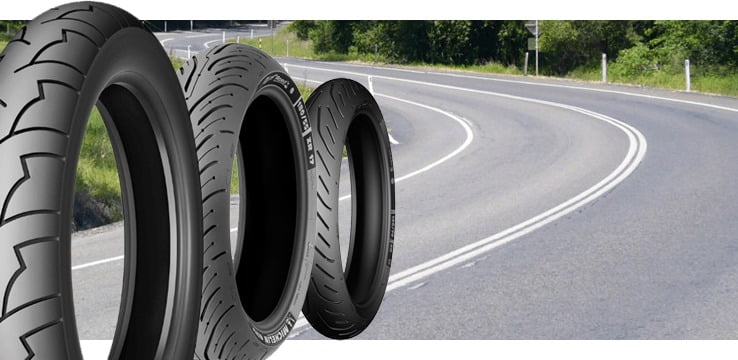
Pneus online, the online motorcycle tyre specialist
Choosing motorcycle tyres: what to check before you buy
The correct tyre needs to match the motorcycle, the front or rear position and the intended use. Size alone does not confirm that a tyre is suitable.
Choose the tyre category that matches your riding
Roadsters, sports bikes, tourers, adventure bikes, cruisers and scooters place different demands on their tyres. Start by narrowing the search to the category designed for the way you actually ride. Browse motorcycle tyre categories
Check front and rear fitments separately
The front tyre has a major influence on steering and braking, while the rear transmits drive and carries more load. Front and rear sizes, ratings and profiles can therefore be different.
Read the full sidewall marking
A code such as 120/70 ZR17 M/C 58W includes width, aspect ratio, rim diameter, construction, motorcycle designation, load index and speed rating. Check the full line rather than the size alone.
Keep the construction compatible with the motorcycle
Radial or cross-ply, tubeless or tube-type: the tyre construction must suit the wheel and the motorcycle manufacturer’s specification. A matching size does not make every construction interchangeable.
Which motorcycle tyre suits your riding in the UK?
British riding can combine commuting, wet roads, B-roads and motorway miles in the same week. Choose around the conditions you see most often.
Commuting and city riding
For daily use, predictable behaviour at low speed, confidence on cool or damp tarmac and steady wear can matter more than outright sports performance.
Wet roads and changeable weather
When rain is a regular part of the ride, look for progressive feedback and dependable wet behaviour. Painted lines, drain covers and polished surfaces still require extra care regardless of tyre choice.
B-roads and weekend rides
On twistier roads, steering response, stability under braking and consistency through repeated corners become more noticeable. A balanced tyre is often easier to trust than one built around a single headline strength.
Motorways, pillions and luggage
For longer journeys, give more weight to stability, mileage and load capability. Use the pressure figures specified for the motorcycle when carrying a passenger or luggage.
Adventure bikes used on and off tarmac
Adventure tyres range from road-focused designs to much more off-road-oriented patterns. Choose the road/off-road balance that reflects how often you genuinely leave tarmac.
How to compare compatible motorcycle tyres
Once fitment is confirmed, compare tyres built for a similar purpose and focus on the characteristics that matter to your riding.
Compare like with like
A sport-touring tyre, hypersport tyre and off-road tyre are designed around different priorities. Keep the comparison within the same category.
Look at grip, handling and wear together
Dry and wet grip are important, but so are stability, steering feel, comfort and mileage. The best choice is the one with the balance that suits your use.
Use rider reviews as supporting evidence
Reviews can reveal useful patterns in wear, wet-weather confidence or steering feel. They should support, not replace, the technical fitment checks.
Compare the exact tyre range, not just the brand
Major brands offer several product families with very different characteristics. The specific model and its intended use tell you more than the badge alone. Browse motorcycle tyre brands
Fitting, pressures and the first rides
Correct fitting and pressure are essential if the new tyres are to perform as intended.
Search by motorcycle if you are unsure of the fitment
If you do not have the full tyre code, use the motorcycle search to identify the intended front and rear sizes before ordering.
Check exactly what the fitting centre includes
Confirm that the workshop handles motorcycles and whether the price covers wheel removal, balancing, valves or fitting to loose wheels. Services vary between centres.
Check pressures when the tyres are cold
Use the motorcycle manufacturer’s figures and take account of passenger or luggage loads where different pressures are specified. Motorcycle tyre pressure advice
Build up gradually on new tyres
A fresh profile can make the motorcycle steer more quickly than it did on worn tyres. Use the first rides to get used to the new feel before increasing lean angle, braking force or acceleration. Advice for new motorcycle tyres
Frequently asked questions about motorcycle tyres
Can I fit a wider tyre than standard?
Only if that size is approved for the motorcycle. A wider tyre can change its profile on the rim and alter steering behaviour.
Do front and rear tyres have to be replaced together?
Not always, because they can wear at different rates. The remaining tyre and the new tyre must still form a compatible front/rear combination.
What do TL and TT mean?
TL means Tubeless. TT means Tube Type. The wheel and the specified fitment determine which is appropriate.
Can I mix different front and rear tyre models?
Some combinations are acceptable and others are not recommended. Check manufacturer guidance if you are not fitting a matched pair.
When should a motorcycle tyre be checked or replaced?
Uneven wear, flattening, cracking, cuts, deformation or an unusual change in handling are all reasons to have the tyre inspected.
Where can I find the tyre manufacturing date?
The DOT code includes the week and year of manufacture. Age alone does not determine condition; storage, use and visible deterioration also matter.


