What is the best wet tyre? Comparison and advice
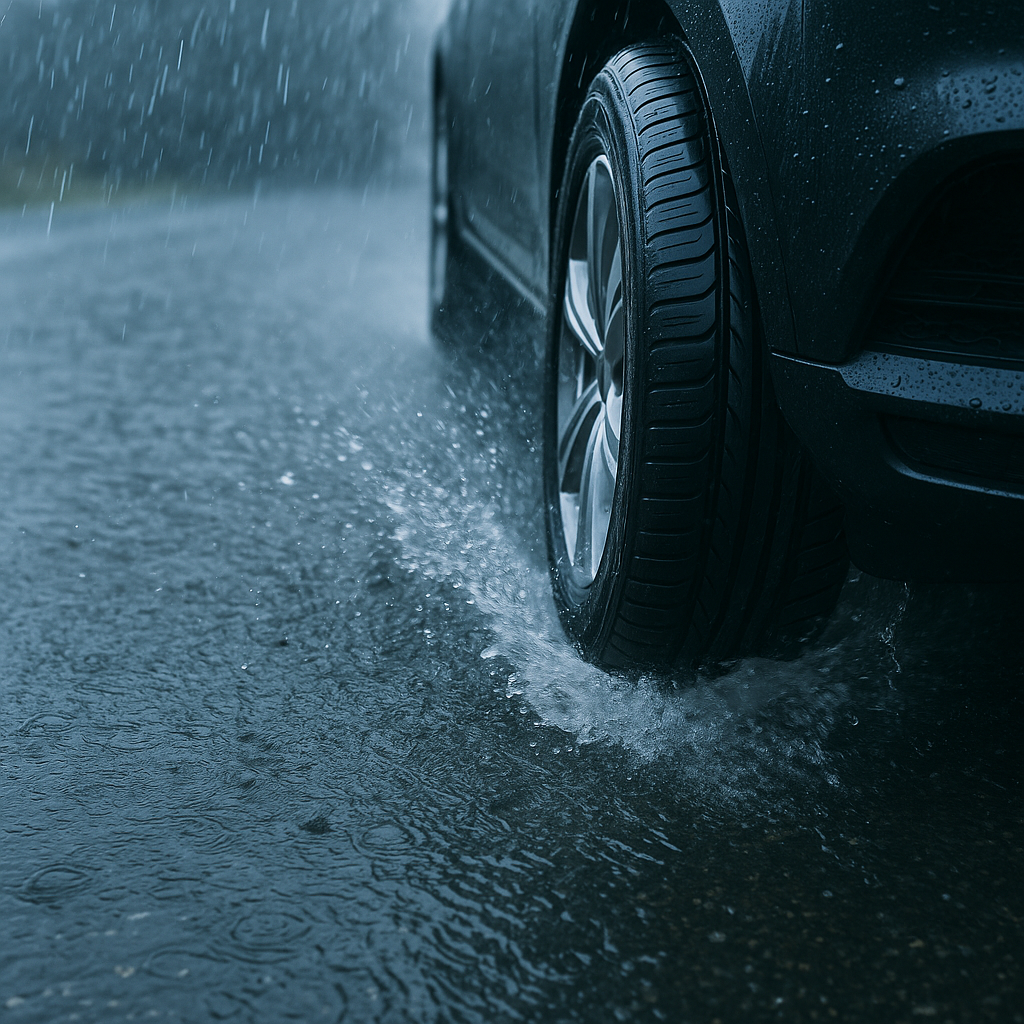
When it rains, the tyres play an essential role in vehicle safety. They must quickly evacuate water, maintain good grip, and allow the driver to brake while maintaining a stable trajectory.
The Continental PremiumContact 7 ranks among the top-performing tyres in wet conditions. It stands out for its braking, stability and balanced handling. However, the best wet tyre also depends on your vehicle, the size you're looking for, your driving style and your budget.
In this guide, discover the most effective tyres in the rain, the criteria to compare, and best practices for reducing the risk of aquaplaning.
Summary
- Are there actually wet tyres?
- Aquaplaning: what are the risks?
- How are tyres tested in the rain?
- The criteria for choosing a good rain tyre
- A comparison of the best wet-weather tyres
- Which rain tyre to choose according to your needs?
- When to buy or replace your tyres?
- Maintenance, pressure and storage
- Mistakes to avoid
- Recycling and innovation
- FAQ on wet-weather tyres
1. Are there actually such things as wet-weather tyres?
The term «rain tyre» does not correspond to a specific regulatory category, unlike summer, winter, or all-season tyres.
It generally refers to a Summer tyre with particularly good performance on wet roads. Certain models are specially designed to offer efficient water evacuation and reduce the risk of aquaplaning.
These tyres generally have:
- large longitudinal grooves ;
- channels facilitating the evacuation of water; ;
- A silica-enriched rubber compound ;
- an optimised tread for grip; ;
- stable handling during braking and when changing direction.
A good rain tyre must also remain progressive. The driver must be able to feel any loss of grip and correct their trajectory without the vehicle reacting abruptly.
To better understand tyre behaviour, consult our Tyre grip guide.
2. Aquaplaning: what are the risks?
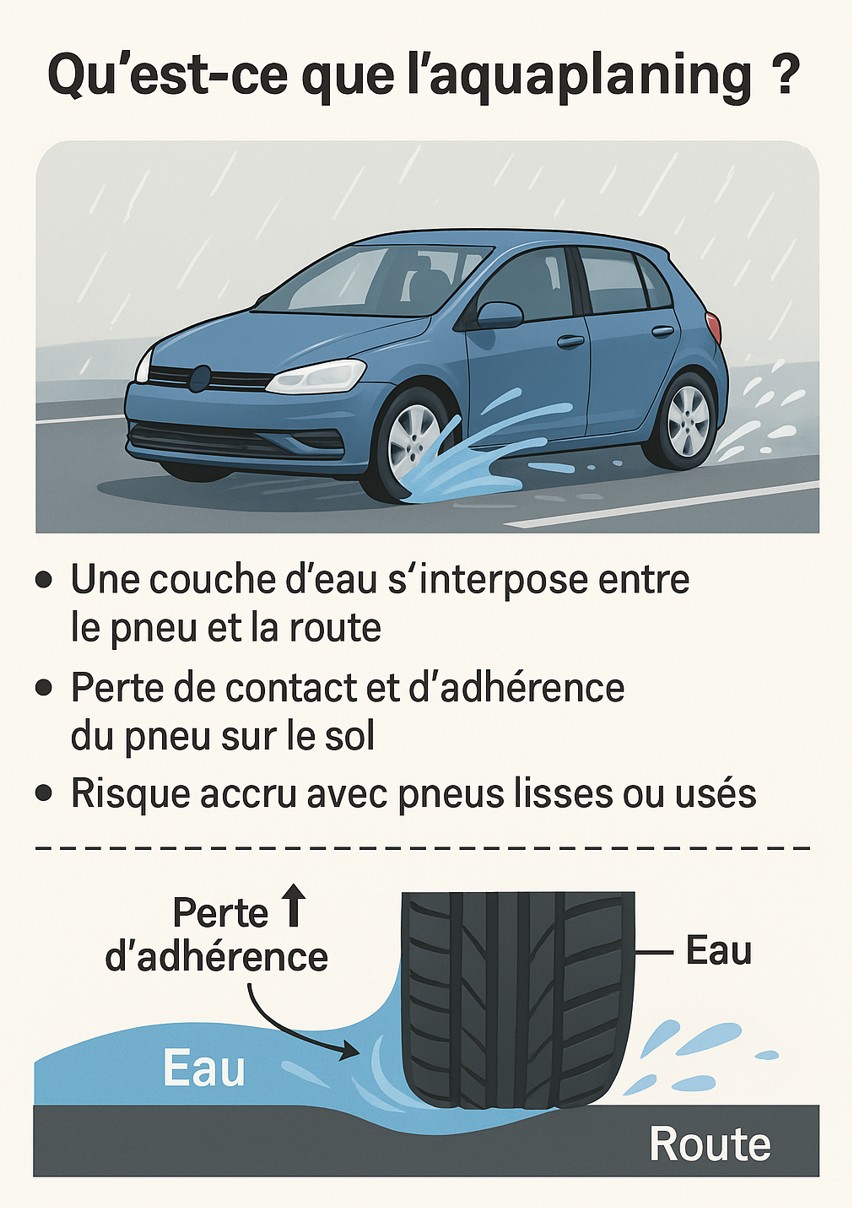
Aquaplaning occurs when too much water builds up between the tread and the road surface. The tyre is then unable to displace enough water and temporarily loses contact with the road.
The driver may experience:
- a suddenly lighter direction ;
- a loss of motor function ;
- a reduction in braking efficiency; ;
- a lateral movement of the vehicle ;
- difficulty maintaining its trajectory.
Several factors increase the risk of aquaplaning:
- too high a speed ;
- worn sculptures ;
- incorrect tyre pressure ;
- a significant amount of water on the road; ;
- very wide tyres ;
- faulty shock absorbers or geometry.
In case of aquaplaning, avoid braking sharply. Gradually release the accelerator, keep the steering wheel pointing in the desired direction, and wait for the tyres to regain grip.
3. How are tyres tested in the rain?
Automotive organisations and specialist magazines evaluate tyres under controlled conditions. The tests are carried out at a precise dimension, with the same vehicle and on a road surface with comparable moisture levels.
Braking on a wet surface
The vehicle performs an emergency stop from a set speed. The distance required to bring the car to a complete halt is then measured.
A difference of a few metres can be decisive in a real-life situation.
Handling on wet roads
Testers evaluate steering precision, cornering stability, traction and the ease with which the driver can correct their trajectory.
Aquaplaning in a straight line
The car drives through an area covered with water. The testers measure the speed at which the wheels begin to lose contact with the road surface.
Aquaplaning when cornering
This test measures the tyre's ability to maintain its path when encountering a build-up of water in a curve.
General behaviour
Comfort, noise, wear and rolling resistance are also taken into account. The final ranking is therefore not based solely on braking distances.
As results may vary depending on the size, it is advisable to consult the summer tyre tests matching your watch as closely as possible.
4. The criteria for choosing a good wet-weather tyre
Wet grip
The European tyre label allows you to compare the wet braking performance of tyres.
A good rating generally indicates a shorter braking distance during the regulatory test. However, it does not provide direct information on aquaplaning resistance, cornering grip or tyre progressivity.
The water drainage capacity
Deep and properly oriented grooves facilitate the evacuation of water towards the sides of the tyre.
This architecture helps to maintain a sufficient contact patch between the tyre and the road.
Braking and stability
A good wet tyre must remain stable during heavy braking. It must also offer precise and predictable response during direction changes.
The depth of the carvings
The more worn the tread, the less the tyre is able to clear water.
Performance in the wet can therefore decrease well before the tyre reaches the legal limit.
If you frequently drive on wet roads, have your tyres checked as soon as the tread depth approaches approximately 3 to 4 mm.
Load and speed ratings
Always comply with the approved dimensions as well as the load and speed ratings for your vehicle.
An incorrect size can affect the handling, the operation of electronic aids and the accuracy of the speedometer.
Rolling resistance
Low rolling resistance can help reduce fuel consumption or improve the range of an electric vehicle.
However, it must not be favored to the detriment of braking and grip on wet surfaces.
The sound level
Tyre rolling noise affects comfort, particularly on the motorway. The European label indicates the external noise level expressed in decibels.
5. Comparison of the best wet-weather tyres
Results may vary depending on the dimension tested. There is therefore no single tyre that is systematically better in all sizes and on all vehicles.
1. Continental PremiumContact 7 : the best all-round choice
The Continental PremiumContact 7 is one of the best choices for everyday use in the rain.
It offers:
- excellent wet braking; ;
- a precise direction; ;
- good cornering stability ;
- progressive behaviour ;
- a convincing balance between safety and comfort.
Ideal for: saloons, compact SUVs, family cars and drivers looking for a reassuring everyday tyre.
Discover also all the Continental tyres.
2. Goodyear Eagle F1 Asymmetric 6: for dynamic driving
The Goodyear Eagle F1 Asymmetric 6 combine sporty handling with an excellent level of safety in the wet.
Its main strengths are:
- a reactive management; ;
- excellent road holding ;
- high-performance wet braking ;
- good high-speed stability ;
- balanced handling on both dry and wet roads.
It is particularly suited to powerful vehicles and drivers who want to maintain precise handling without compromising safety.
Find the others Goodyear tyres.
3. Pirelli Cinturato C3: safety and comfort
The Pirelli Cinturato C3 is designed for passenger cars and drivers looking for a versatile tyre.
He is distinguished by:
- his balanced behaviour ;
- its effective braking; ;
- its stability on wet roads; ;
- its ride comfort; ;
- its versatility for daily commutes.
View our selection of Pirelli tyres.
4. Michelin Pilot Sport 5: performance and longevity
The Michelin Pilot Sport 5 is designed for sports cars, high-performance saloons and drivers looking for high precision.
He suggests:
- an excellent response from management; ;
- very good grip on wet roads; ;
- high stability at sustained speed ;
- generally even wear; ;
- a good compromise between performance and lifespan.
Discover all Michelin tyres.
5. Uniroyal RainSport 5: the rain specialist
The Uniroyal RainSport 5 is specially geared towards wet-road driving.
Its tread features wide grooves designed to rapidly evacuate water.
Its advantages include:
- high resistance to aquaplaning; ;
- good grip on wet roads; ;
- reassuring behaviour in heavy rain ;
- good value for money ;
- a wide range of sizes.
It represents a relevant solution for frequently rainy regions and drivers looking for an affordable tyre.
Find the Uniroyal tyres.
6. Bridgestone Turanza 6: comfort and efficiency
The Bridgestone Turanza 6 is intended for drivers who prefer comfort, stability and long journeys.
It offers:
- good braking on wet surfaces ;
- stable handling on the motorway ;
- a refined ride comfort; ;
- controlled rolling resistance; ;
- compatibility with numerous electric vehicles.
See also the Bridgestone tyres.
Comparative table of the best wet-weather tyres
| Model | Main advantage | Recommended use | Positioning |
|---|---|---|---|
| Continental PremiumContact 7 | Excellent balance in the wet | Daily and family use | Premium |
| Goodyear Eagle F1 Asymmetric 6 | Precision and dynamic handling | Saloons and sports cars | Premium |
| Pirelli Cinturato C3 | Safety and comfort | Town, road and motorway | Premium |
| Michelin Pilot Sport 5 | Performance and longevity | Sporty driving | Premium |
| Uniroyal RainSport 5 | Aquaplaning resistance | Very wet regions | Intermediary |
| Bridgestone Turanza 6 | Comfort and efficiency | Long journeys and motorway | Premium |
Our verdict
For versatile use, the Continental PremiumContact 7 is among the best wet-weather tyres.
For a more sporty drive, the Goodyear Eagle F1 Asymmetric 6 and the Michelin Pilot Sport 5 offer greater precision.
The Uniroyal RainSport 5 represents an excellent option for drivers looking for strong aquaplaning resistance at a generally more accessible price.
6. Which wet-weather tyre to choose according to your usage?
For urban driving
In town, choose a progressive, comfortable tyre that is effective when braking.
The Pirelli Cinturato C3 and the Continental PremiumContact 7 are particularly well suited to this type of use.
For motorway journeys
On the motorway, look for good stability, efficient water clearance and a low noise level.
The Bridgestone Turanza 6, Continental PremiumContact 7 and Michelin Pilot Sport 5 make for interesting choices.
For sporty driving
Dynamic drivers may prefer the Goodyear Eagle F1 Asymmetric 6 or the Michelin Pilot Sport 5.
These models offer more direct steering and better stability when changing weight distribution.
For a very rainy region
The Uniroyal RainSport 5 is particularly suited to regions regularly exposed to heavy rainfall.
However, the Continental PremiumContact 7 remains more versatile if you are also looking for comfort and good dry-road performance.
For an electric vehicle
An electric vehicle often requires tyres capable of handling greater weight and torque.
Check in particular:
- the load index ;
- rolling resistance ;
- The sound level ;
- the compatibility specified by the manufacturer; ;
- wet braking performance.
7. When should you buy or replace your tyres?
It is best to anticipate the purchase before a period of heavy rain or before a long journey.
Do not wait until the tread reaches the legal limit to consider replacing them. In the rain, a tyre's performance decreases progressively as the groove depth reduces.
Have your tyres checked or replaced when you notice:
- insufficient tread depth; ;
- cracks ;
- a flank hernia ;
- a deep cut ;
- uneven wear ;
- unusual vibrations ;
- more frequent loss of grip in the rain.
Lifespan does not depend solely on mileage. It varies depending on the vehicle, driving style, pressure, geometry, roads used and storage conditions.
8. Maintenance, pressure and storage
Check the pressure every month
Incorrect pressure increases wear, heating and consumption. It can also impair vehicle stability in the rain.
Carry out the check when cold and observe the value specified by the manufacturer, which is usually found on the door frame, the fuel flap or in the vehicle manual.
Find all our advice in our guide dedicated to the tyre pressure.
Check the tread wear
Inspect the main grooves and wear indicators regularly.
Uneven wear on one side may indicate an alignment, suspension or pressure issue.
Have the balancing and wheel alignment checked
Incorrect adjustment can cause uneven wear and reduce the contact area with the road.
After a heavy impact against a kerb or pothole, have the vehicle checked by a professional.
Rotate the tyres when possible
Rotation can help to even out wear, but it must comply with the manufacturer's recommendations.
It may be impossible on certain vehicles fitted with different dimensions at the front and rear or with directional tyres.
Store your tyres properly
Store the tyres in a cool, dry place out of direct sunlight.
Keep them away from hydrocarbons, solvents and heat sources. Also, consult our guide on the fitting and storage of tyres.
9. Mistakes to avoid
Choose based on price only
A very budget tyre can offer decent performance under certain conditions, but longer braking distances in the rain.
Compare the price with the test results, the European label and the estimated lifespan.
Rely solely on the European label
The wet grip rating is important, but it does not measure all aspects of road behaviour.
Also check out the aquaplaning, handling and braking tests carried out in a size close to yours.
Mixing different tyres on the same axle
The two tyres fitted on the same axle must have compatible characteristics.
Avoid mixing tyres with very different characteristics, as this can unbalance the vehicle when braking or cornering.
Replace only one tyre
Except in special circumstances approved by a professional, replace tyres in pairs on the same axle.
When only two tyres are replaced, it is generally advisable to fit the new or least worn tyres on the rear in order to improve vehicle stability.
Driving with under-inflated tyres
Under-inflation causes excessive tyre deformation, increases its temperature and can reduce steering precision.
Mistaking a wet-weather tyre for a winter tyre
A high-performance wet-weather tyre does not necessarily replace a winter tyre.
When temperatures drop or the road is covered in snow or ice, use tyres suited to winter conditions.
10. Recycling and innovations
Worn tyres must be handed over to a professional or an approved collection scheme.
They can then be:
- processed into aggregates ;
- used in certain coatings; ;
- processed into industrial fuel; ;
- re-employed when they meet the necessary conditions; ;
- recycled in order to recover certain materials.
Manufacturers are also working on new rubber compounds, recycled materials and bio-based components in order to reduce the environmental impact of tyres.
When placing your order, you can search for a professional among the Partner fitting centres offered by Pneus Online.
11. Wet tyres FAQ
What is the best wet tyre?
The Continental PremiumContact 7 is one of the best all-round choices. It offers excellent wet braking, good stability and reassuring handling.
The result may nevertheless vary depending on the size, the vehicle and the test conditions.
Which tyre has the best resistance to aquaplaning?
The Uniroyal RainSport 5 is specially designed to promote water evacuation.
The Continental PremiumContact 7 and the Goodyear Eagle F1 Asymmetric 6 also offer very good performance on wet roads.
Is a wet tyre a summer tyre?
In most cases, yes. The expression «pneu pluie» generally refers to a summer tyre whose tread and rubber compound perform particularly well on wet roads.
Can you use a winter tyre in summer?
This practice is not recommended. Under high temperatures, the rubber of a winter tyre becomes softer.
This can increase its wear, reduce steering precision and lengthen braking distances.
Are all-season tyres effective in the rain?
Yes, some all-season tyres offer very good performance on wet roads.
However, their performance must be checked model by model. An all-season tyre remains a compromise between summer and winter conditions.
At what depth do you need to replace your tyres?
The legal limit is set at 1.6 mm in the main grooves.
However, water clearance capacity decreases with wear. When you regularly drive in heavy rain, have your tyres checked before reaching this limit.
Can you change only the front tyres?
It is possible to replace only two tyres, but the new or least worn tyres must generally be fitted to the rear.
This arrangement helps to limit the risk of losing control of the rear axle.
Do rain tyres increase fuel consumption?
That depends on their rolling resistance, size and pressure.
Check the European label to compare energy efficiency, without neglecting wet grip.
Checklist before buying a wet weather tyre
Before ordering, check the following items:
- the width, height and rim diameter; ;
- the load and speed indices ;
- the wet grip rating; ;
- the results obtained in the independent tests; ;
- the water drainage capacity; ;
- The sound level ;
- rolling resistance ;
- compatibility with your vehicle; ;
- delivery and assembly conditions.
Conclusion: which tyre should you choose for driving in the rain?
The Continental PremiumContact 7 is among the best rain tyres for versatile use. It combines braking, stability and comfort on wet roads.
The Goodyear Eagle F1 Asymmetric 6 and the Michelin Pilot Sport 5 are better suited to dynamic driving. The Uniroyal RainSport 5 for its part, represents an interesting solution for very rainy regions.
Whichever model you choose, adhere to the approved dimensions, check the pressure regularly and do not wait for excessive wear before replacing your tyres.
Compare tyres suitable for your vehicle on Pneus Online France and check them tyre tests before making your choice.