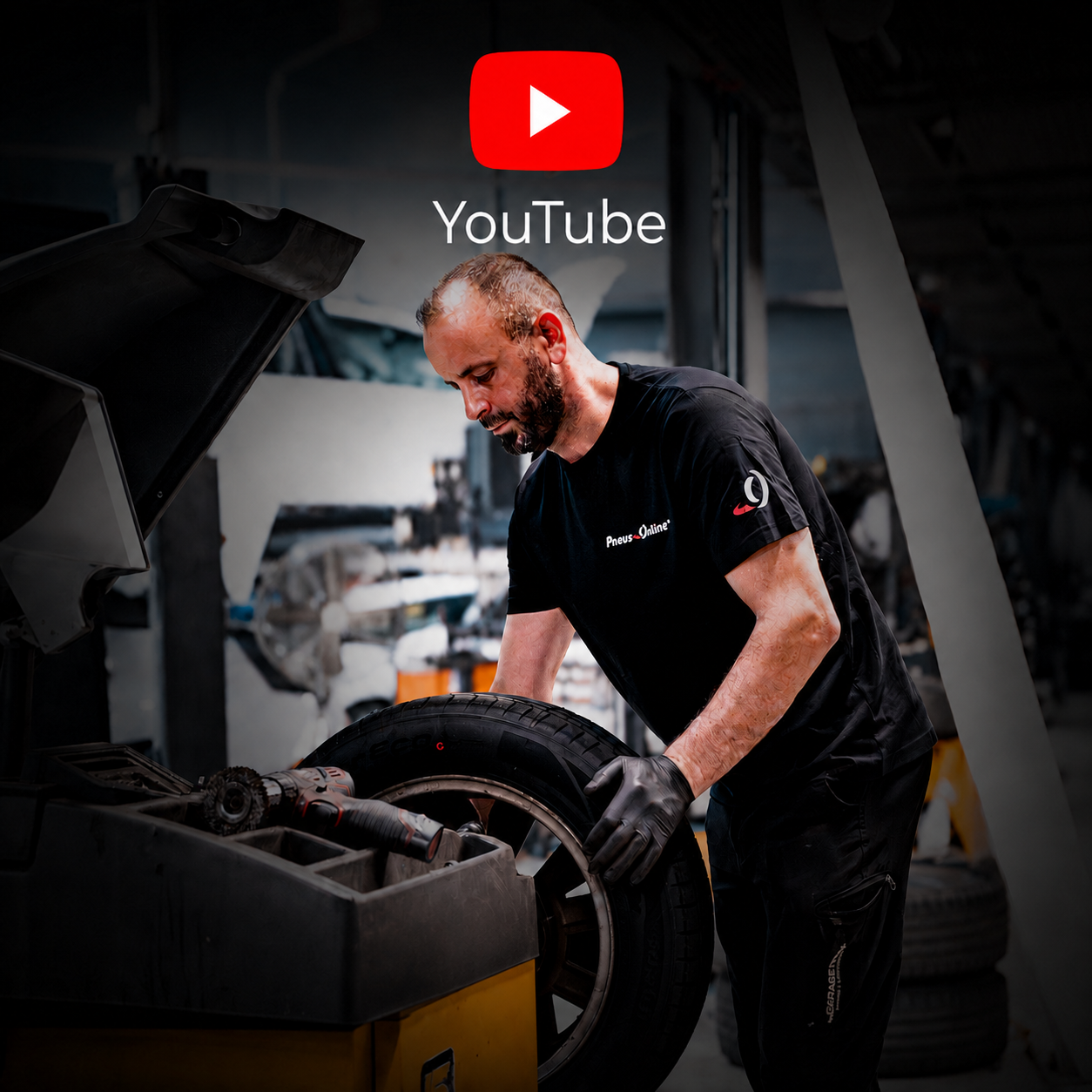
Should you change your tires?
by 2 or 4?
Advantages, risks, recommendations —
The complete guide 2025

Introduction
Changing your tires is an essential maintenance task for any vehicle. But one question often arises: should you change your tires in two or all four at once? This comprehensive guide explores the technical, economic, safety, and regulatory implications to help you make the best decision.
1. Basic reminders about tire wear
1.1 How do tires wear out?
The wear of tires depends on many parameters:
- The type of conduct (sports, economic, urban, highway…)
- The air pressure (underinflation = wear on the sides, overinflation = wear in the center)
- The type of transmission (traction, propulsion, all-wheel drive)
- The alignment adjustment and the geometry
1.2 When is a tire considered worn?
- Sculpture depth < 1.6 mm (legal minimum in Europe)
- Evidence of visible wear
- Cracks, hernias, deformations or cuts
2. The different scenarios
2.1 Two worn tires
The replacement of two or four tires is possible depending on the overall wear condition of the vehicle.
2.2 Four tires near the wear limit
In this case, the recommendation is clear: replace the four tires simultaneously.
2.3 One damaged tire
It must be replaced with a model that is strictly identical (same brand, model, index, size).

3. Advantages of replacing with two tires
- Economy immediate (reduced investment)
- Possibility of Intelligent rotation with the existing tires
- Viable if the other tires still have > 50% tread
4. Disadvantages of partial change
- Imbalance of motor skills
- Less efficiency Electronic aids (ABS, ESP, traction control)
- Uneven wear accelerated
5. Why change the four tires?
- Homogeneity of road behavior
- Optimized adhesion in all conditions
- Preservation electronic safety aids
6. Special vehicles
- 4×4 Replacing the 4 that are often mandatory (otherwise there is a risk of transmission)
- Electric vehicles High-status couple = faster wear and a need for homogeneity
- Sports cars Very sensitive to differences in tire performance
7. Practical recommendations
- Mounting the New tires at the rear
- Avoid doing mix brands, sizes or types
- Make an replacement every 10,000 to 15,000 km
- Check the pressure once a month
8. Regulation
France Tyres on the same axle = same dimensions, same type.
Germany/Switzerland Obligation to mark 3PMSF for winter tires.
EU : compliance with the legal minimum wear tolerance (1.6 mm).
9. Specific cases
- C3 traction Front tires at 20%, rear at 70% → new tires at the rear
- Audi Quattro Used AV/AR at 30/40% → replace the 4
- Tesla Model 3 : CRUCIFIED AR → replace the 2 AR with identical tires

10. FAQ
- Is changing the 4 tires mandatory?
Recommended if the wear difference exceeds 30% or on a 4×4 vehicle. - Why put new tires on the rear?
To ensure stability when turning and on wet ground. - Can two brands of tires be mixed?
Yes, if the model, type, dimensions and indices are identical. - Does the roadworthiness test check the tires?
Yes, if the wear is excessive or asymmetrical = counter-thread. - Can we mix summer tires and 4-season tires?
Yes, but never on the same axle. - Average lifespan of a tire?
Between 30,000 and 50,000 km depending on driving style. - Is it necessary to balance the system after each installation?
Yes, to avoid vibrations and irregular wear. - Can a flat tire be repaired?
Yes, if the perforation is < 6 mm and located in the tread. - Can a tire dry over time?
Yes, beyond 5 to 6 years, even if they are not driven much, they crack. - How to store your tires?
In a dry place, protected from the sun and moisture.
Conclusion
Changing your tires is not just a simple mechanical operation; it is a decision that directly impacts your driving experience. Security, the performance and the Longevity The choice between replacing two or four tires depends on several factors: the type of vehicle, the overall wear of the rolling train, the driving style, but also the climate and the regulations in effect in your country.
While replacing only two tires may seem advantageous in the short term from an economic perspective, this solution often presents problems in the long run. Technical limitations and can generate motor skills imbalances, especially on modern cars equipped with electronic driving aids. Conversely, replacing the four tires guarantees a homogeneity of behavior, Improved grip and reduced risk of aquaplaning, loss of control when turning, or increased braking.
It should not be forgotten that the tires are the only point of contact between your car and the road Investing in their quality and renewal is not an unnecessary expense, but a a guarantee of safety For you, your passengers and other users. That is why it is recommended to always prioritize consistency of equipment, to regularly check the pressure and to adopt appropriate driving techniques to prolong their lifespan.
In short, although each situation is unique, the golden rule remains the following:
-
Two new tires, still at the rear, To preserve stability.
-
Four new tires as soon as possible, Especially on 4×4s, electric vehicles or powerful vehicles.
-
Anticipate change rather than waiting for the legal limit, because a worn tire is synonymous with a loss of safety.
By adopting these good practices, you will make a choice at the same time Reasonable, economical and safe, which will allow you to drive with peace of mind regardless of road and weather conditions.