
MO, AO, ★, N0… What do the manufacturer codes inscribed on some tires mean?
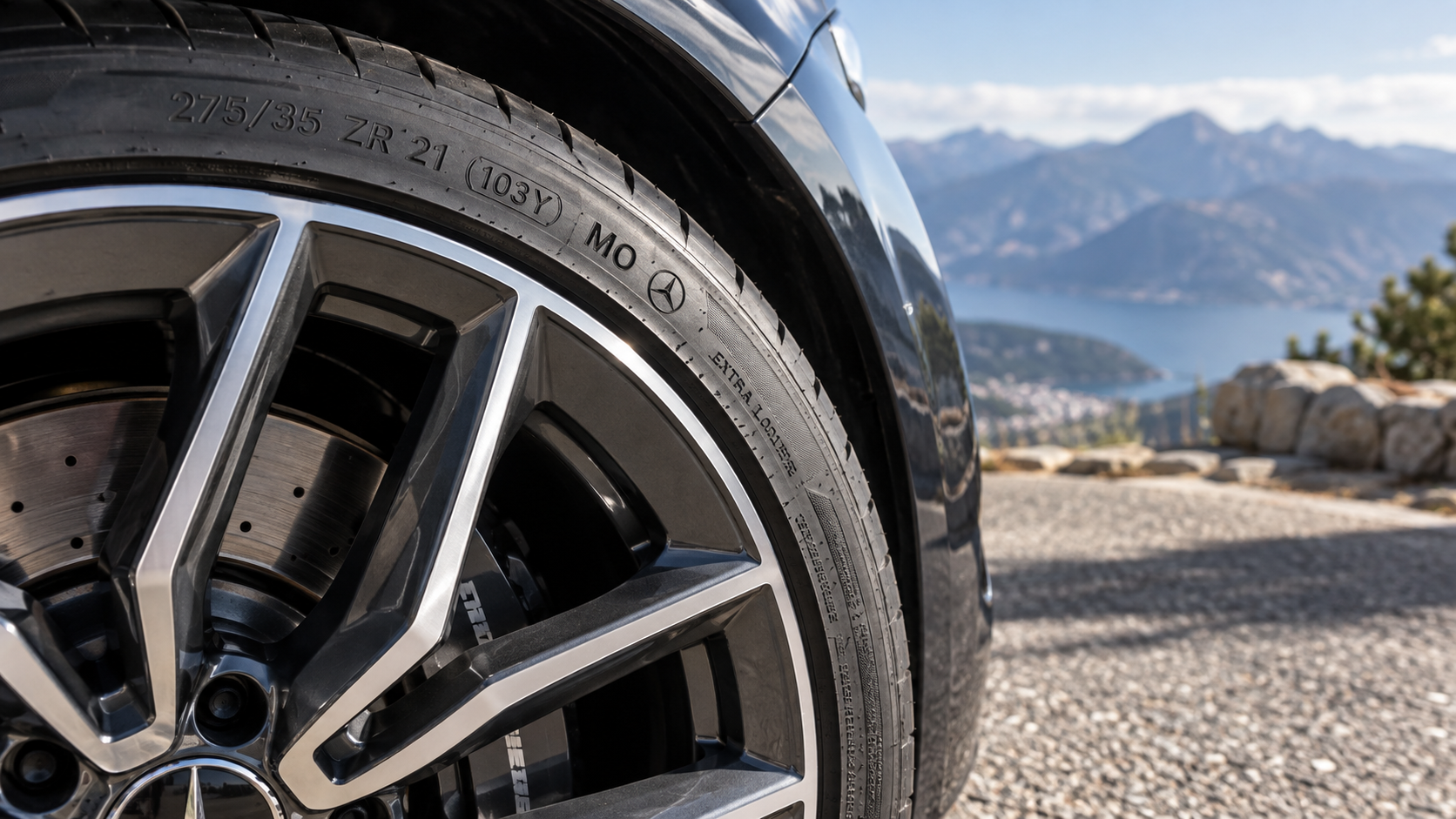
205/55 R16, 91V, XL, RunFlat… The sidewall of a tire already contains many important information.
But on some references, one can also see small codes like MO, AO, ★, N0, J or T0.
They do not correspond to the tire’s size or its speed rating. These markings are associated with certain automobile manufacturers.
Mercedes, Audi, BMW, Porsche and Jaguar can thus have tires developed or homologated for some of their vehicles.
So, what do these letters really mean? Is a tire bearing the same trade name necessarily identical? And is it absolutely necessary to choose a tire with the same marking when replacing it?
Here's how to better understand these little codes that are often misunderstood.
Summary
- What is a manufacturer homologation?
- What do MO, AO, ★ and N0 mean?
- Can two tires of the same model be different?
- 4 tires and their homologations to discover
- Should the same marking be required to be retained?
- Can different homologations be mixed?
- What are the other codes to know?
- How to choose the right reference?
- FAQ: manufacturer homologation of tires
1. What is a manufacturer homologation?
When developing a vehicle, the car manufacturer works on many parameters: suspension, steering, braking, weight, power, and noise level.
The tires also directly contribute to the car's behavior.
Some manufacturers are therefore developing specific versions of their tires in collaboration with automobile manufacturers.
Once validated, this version can receive a specific manufacturer marking.
This makes it easier to identify the tire that corresponds to certain original tires.
2. What do MO, AO, ★ and N0 mean?
Here are some of the markings that are regularly found on tires:
- MO : Mercedes-Benz homologation; ;
- AO : Audi type-approval; ;
- ★ BMW/MINI homologation; ;
- N0, N1, N2… Porsche homologations; ;
- J : Jaguar homologation; ;
- VOL : Volvo homologation; ;
- T0, T1, T2… Developed references for certain Tesla vehicles.
These codes are usually indicated in the product description and can also be visible on the tire.
To understand the other inscriptions found on your tires, see our guide here. read the tyre marking.
3. Can two tires with the same name be different?
Yes.
That is precisely what makes these homologations interesting.
Two tires can have the same trade name, the same dimensions, and come from the same manufacturer, but correspond to different versions.
According to the automobile manufacturer's specifications, certain parameters can be adjusted.
This may include:
- of the tire structure; ;
- of a gum mixture; ;
- of rigidity; ;
- dynamic behavior; ;
- comfort; ;
- noise; ;
- or of resistance to rolling.
These differences are not necessarily visible to the naked eye.
That is why it is important to check all the characteristics of a reference and not just its name.
4. 4 manufacturer-approved tires to discover on Pneus Online
Four concrete examples of manufacturer markings
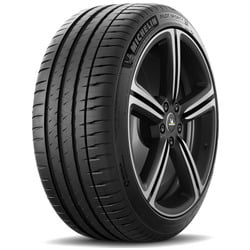
Michelin Pilot Sport 4 — MO
The Michelin Pilot Sport 4 is a summer tire designed for sporty and powerful vehicles. Some sizes offered on Pneus Online are available with the marking. MO, corresponding to a Mercedes-Benz homologation.
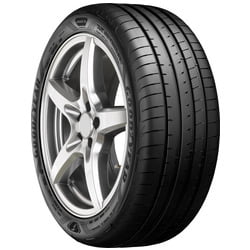
Goodyear Eagle F1 Asymmetric 5 — AO
The Goodyear Eagle F1 Asymmetric 5 is a high-performance summer tire. Among the many available models, some sizes bear the marking AO, Used for Audi-approved tires.
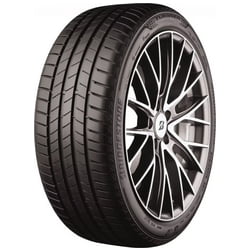
Bridgestone Turanza T005 — ★
The Bridgestone Turanza T005 is an all-season summer tire. Some of its dimensions are offered with the symbol ★, Used to identify homologated versions for BMW and MINI.
Pirelli P Zero — N0
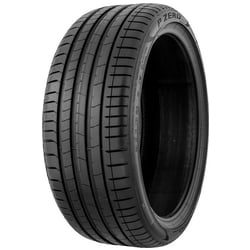
The Pirelli P Zero is available in a wide range of sizes and homologations. Some models, in particular, bear the marking N0, corresponding to a Porsche homologation.
5. Is it mandatory to keep the same marking?
The answer depends on the vehicle and the recommendations of its manufacturer.
The first reflex is therefore to consult the vehicle manual or the instructions from the car manufacturer.
In all cases, the characteristics compatible with the car must be respected:
- dimensions; ;
- load index; ;
- speed index; ;
- type of tire; ;
- and any specific requirements from the manufacturer.
A manufacturer approval provides an additional indication that allows a version developed or validated for certain applications to be identified.
6. Can different homologations be mixed?
Even when the dimensions appear identical, two homologated versions can have different characteristics.
It is therefore preferable to seek out homogeneous equipment and to follow the recommendations of the vehicle manufacturer.
When replacing only two tires, check the reference currently installed, in particular.
The tire name is not always enough: also look at the letters, symbols, and other markings that accompany its dimensions.
7. What are the other codes that can be encountered?
The list is long.
According to manufacturers and vehicles, it is possible to encounter, among others:
- J for Jaguar; ;
- VOL for Volvo; ;
- AR for certain Alfa Romeo applications; ;
- MGT for Maserati; ;
- RO1 / R01 for certain Audi sports cars; ;
- T0, T1 or T2 for certain Tesla applications.
And be careful not to confuse these codes with other mentions such as XL, RunFlat, FR, FSL or Seal, which indicate other technical characteristics.
Our dedicated page tyre markings helps you find the meaning of many abbreviations.

8. How to choose the right reference?
When a model exists in several versions, the most important thing is to compare the complete tire specifications.
Don't just look at it:
Michelin Pilot Sport 4
but for example:
225/45 R18 95 W XL MO
Each element provides additional information.
Before ordering your car tyres, well, check this out:
- the exact size; ;
- the load index ;
- the speed index ;
- any manufacturer approvals ;
- specific technologies such as RunFlat or Seal; ;
- and the recommendations for your vehicle.
The European tire label then allows for the comparison of other characteristics such as energy efficiency, wet grip, and external noise.
FAQ: manufacturer homologation of tires
What does MO mean on a tire?
The MO marking is associated with Mercedes-Benz and allows the identification of certain homologated references for vehicles of the brand.
What does AO mean?
AO corresponds to certain Audi homologations.
Why do you find a ★ star on some tires?
The ★ symbol is used to identify certain homologated references for BMW and MINI.
What does N0 on a Porsche tire mean?
The N marking is used for certain Porsche homologations. The numbers that accompany it allow, among other things, to distinguish different evolutions of a model reference.
Are two tires of the same size necessarily identical?
No. They can have different structures, technologies, indices, or homologations despite having the same dimensions.
Where can I see the homologation of a tire?
It can be indicated on its side as well as in the specifications of the reference when purchasing.
Conclusion
MO, AO, ★ or N0: these few characters may seem anecdotal, but they allow us to identify particular versions of tires associated with certain automobile manufacturers.
Two tires bearing the same name and the same dimension are therefore not necessarily exactly the same reference.
Before replacing them, take a few seconds to look at the entire marking on your current tires and check the recommended specifications for your vehicle.
Find all the dimensions and homologations available among our tyres on P.