Winter tyres: why are they essential and how to choose the right ones?
❄️
When temperatures drop, driving conditions can change within a few hours. Cold rain, freezing fog, slush or patches of black ice then reduce the vehicle's grip. In this context, the choice of tyres plays a vital role.
Unlike summer tyres, winter tyres keep a more flexible rubber compound when the thermometer drops. In addition, their tread pattern helps to clear water and slush. They therefore offer better traction, more effective braking and a more reassuring drive.
However, not all winter tyres are created equal. Size, 3PMSF marking, vehicle type and frequency of journeys must also guide your choice. Here are the criteria to know before equipping your vehicle.
Summary
- Why winter tyres are essential
- How a winter tyre works
- What does French regulation provide for?
- How do I recognise a compliant winter tyre?
- When to fit and replace winter tyres?
- How to choose your winter tyres
- Some winter tyre models to discover
- Winter tyres or all-season tyres: which should you choose?
- Which tyres should I choose for an electric car?
- Which winter tyres to choose for an SUV?
- How to maintain and store your tyres?
- Winter tyre FAQ
1. Why winter tyres are essential
An eraser designed for low temperatures
A summer tyre works effectively when temperatures remain mild. However, its rubber gradually stiffens as the cold sets in. The tyre then loses flexibility and adapts less well to the irregularities of the road surface.
Conversely, a winter tyre uses a rubber compound specially formulated to remain flexible in cold weather. As a result, it maintains more consistent contact with the road.
The 7 °C threshold generally serves as a guideline for considering the switch to winter tyres. It does not constitute an absolute boundary. Nevertheless, it helps motorists to anticipate the first cold spells.
Better grip on winter roads
Winter conditions are not limited to snow. Indeed, a cold and wet road surface can already become slippery. Frost, slush or wet leaves also increase the risk of losing grip.
Thanks to their numerous sipes, winter tyres create more contact edges with the ground. Moreover, their deep grooves clear water and slush more easily.
Consequently, the vehicle gains traction when pulling away. It also remains more stable when cornering and braking.
For which drivers are they particularly useful?
Winter tyres are recommended in particular for drivers who:
- live in a cold or mountainous region; ;
- travel early in the morning or late at night; ;
- regularly use minor roads; ;
- make long journeys during the winter; ;
- must drive whatever the weather conditions.
Therefore, you don't need to live in the high mountains to enjoy their benefits.
2. How does a winter tyre work?
A softer rubber compound
Winter performance starts with the compound of the rubber. This generally contains silica, polymers and various agents that preserve its elasticity.
Thanks to this compound, the tread remains active in cold weather. It can therefore better follow the road surface irregularities and maintain grip.
On the other hand, this rubber becomes too soft when it is hot. This is why it remains inadvisable to drive all year round on winter tyres.
Sipes that improve grip
The tread features numerous thin sipes. When they come into contact with the road, these create additional biting edges.
Therefore, the tyre grips better on packed snow, rime and damp surfaces. Some sipes also have a three-dimensional structure. They then limit the deformation of the rubber blocks when cornering.
Deeper grooves
The grooves of a winter tyre are generally wider and deeper than those of a summer tyre. They therefore make it easier to clear water, mud and slush.
Therefore, they reduce the risk of losing contact with the road surface. However, caution remains essential when the road is wet or icy.
A structure suited to winter conditions
Finally, the tyre includes several internal layers. The steel cords provide stability, while the carcass absorbs some of the stresses.
This architecture helps the tyre to maintain precise handling. It also contributes to the tyre's comfort and durability.
3. What does French regulation provide for?
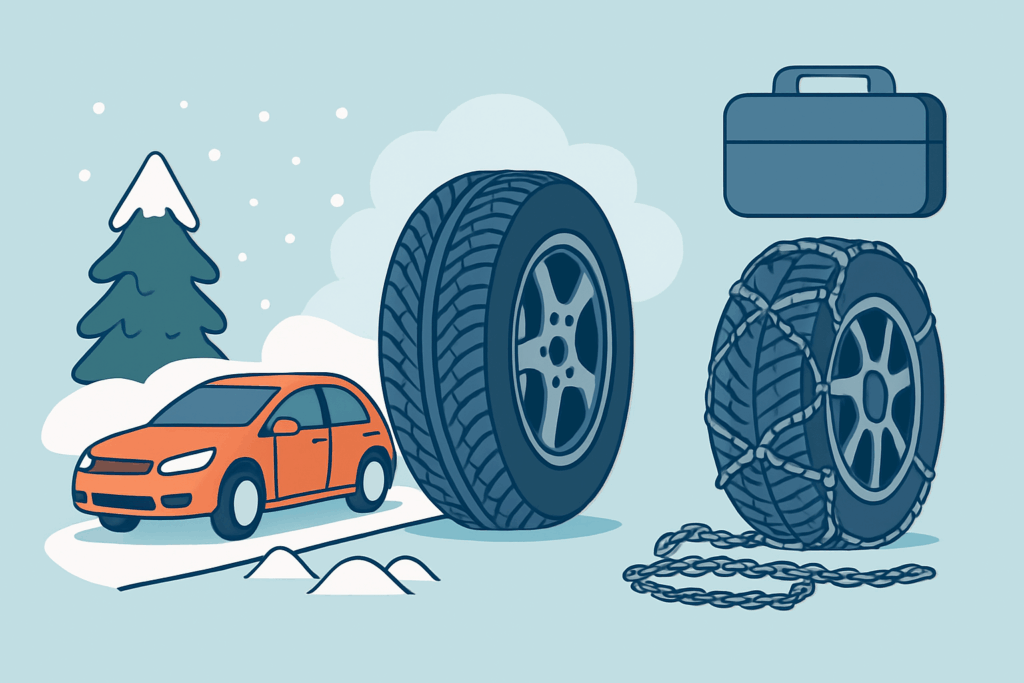
Between 1 November and 31 March, winter equipment is compulsory in certain communes located in mountainous regions.
In the designated zones, light vehicles must:
- either be fitted with four tyres bearing the 3PMSF marking; ;
- either have snow chains or snow socks to fit on at least two drive wheels.
Since 1 November 2024, the M+S marking used alone no longer means a tyre can be considered equivalent to snow chains. The 3PMSF symbol therefore becomes the main indicator to check.
However, this obligation does not apply to the whole of French territory. The communes concerned are defined by the prefects and indicated by specific signs.
Before a mountain trip, remember to check the rules applicable in the departments you will be driving through.
4. How to identify a compliant winter tyre?
The 3PMSF marking
The 3PMSF symbol represents a three-peaked mountain containing a snowflake. It indicates that the tyre has passed a standardised snow traction test.
This marking appears directly on the tyre sidewall. Today, it constitutes the essential reference point for driving in areas subject to winter regulations.
M+S marking
The letters M+S stand for «Mud and Snow». However, this marking is based primarily on the design characteristics declared by the manufacturer.
It therefore does not replace the 3PMSF symbol in areas where winter tyres are required as an equivalent to snow chains.
The dimensions and indices
Seasonal labelling is not enough. The tyre must also comply with:
- the intended width for the vehicle; ;
- the flank height ;
- the rim diameter ;
- the load index ;
- the permitted speed rating.
For example, the inscription 205/55 R16 91H corresponds to a specific size and load/speed rating. Before purchasing, always check the manufacturer's recommendations.
5. When to fit and replace your winter tyres?
Anticipate the first cold spells
It is best not to wait for the first snowfall. Indeed, garages often experience high demand as soon as the cold weather arrives.
Keep an eye on average temperatures instead. When they consistently stay close to 7 °C, it is generally time to arrange fitting.
Furthermore, early installation avoids having to drive on summer tyres during a sudden frost.
Check the depth of the carvings
As the tyre wears down, its grooves become shallower. It then evacuates water and slush less effectively.
Although the legal wear limit remains lower, many specialists recommend closely monitoring winter tyres when their tread approaches 4 mm. Below this level, their performance on snow can decrease significantly.
Check the general condition of the tyre
Mileage is not the only criterion. It is also necessary to look for:
- Power cuts ;
- cracks ;
- a distortion ;
- uneven wear ;
- an unusual vibration ;
- a steady loss of pressure.
Also, check the DOT code written on the sidewall. It is used to identify the week and year the tyre was manufactured.
6. How to choose your winter tyres?
Start with the right dimensions
First of all, choose an approved size for your car. You will find this information in the vehicle manual, on the sticker located in the door frame or on the tyres already fitted.
Next, check the load index. This must be suitable for the vehicle's weight, especially for an SUV, a van or an electric car.
Check wet grip performance
French winters are often characterised more by rain than by snow. Consequently, grip on wet roads must remain a priority criterion.
Check the European tyre label. In particular, it shows:
- energy efficiency ;
- wet grip; ;
- the external noise level.
However, this label does not sum up all performance aspects. Comparative tests and user reviews therefore provide a useful complement.
Fit the tyre to your application
An urban driver will mainly look for reassuring braking, comfort and a low noise level.
By contrast, a motorist who frequently drives in the mountains will prioritise snow traction and lateral stability.
Finally, a high-mileage driver will also need to take into account longevity and rolling resistance.
You can check the Winter tyre comparison Pneus Online in order to compare the models according to several criteria.
7. Some winter tyre references to discover
There is no single ideal tyre for all drivers. The right choice depends on the size, the car, the climate and the type of journey.
| Model | Highlights | Recommended profile |
|---|---|---|
| Michelin Alpin 6 | Consistent performance and longevity | High-mileage drivers |
| Continental WinterContact TS 870 | Balance between grip, comfort and precision | Daily commutes and versatile use |
| Bridgestone Blizzak LM005 | Reassuring handling on wet roads | Cold and rainy regions |
| Goodyear UltraGrip Performance+ | Winter grip and stability | Diverse routes and long journeys |
These models are available in several sizes. However, their characteristics may vary depending on the size, load index and chosen homologation. It is therefore necessary to compare the specifications corresponding precisely to your vehicle.
8. Winter tyres or all-season tyres: which should you choose?
The all-season tyres combine certain characteristics of summer and winter tyres. They thus make it possible to keep the same equipment all year round.
However, they remain a compromise. They are mainly suited to temperate climates, city driving and drivers who occasionally encounter snow.
Quick comparison
| Criterion | Winter tyres | All-season tyres |
|---|---|---|
| Marked cold | Very well suited | Adapted according to the model |
| Frequent snow | Best choice | More limited |
| Temperate climate | Possible, with seasonal change | Very handy |
| Mountain driving | Recommended | For suitable 3PMSF tyres only |
| Annual management | Two setups | One game |
| Hot summer | To be replaced | Usable all year round |
Choosing winter tyres when...
Choose dedicated winter tyres when you drive regularly:
- on snow-covered roads ;
- in the mountains ;
- at very low temperatures; ;
- early in the morning on roads prone to frost; ;
- with a heavy or powerful vehicle.
Choosing 4-season tyres when…
All-season tyres represent a relevant solution when:
- the climate remains mild; ;
- snow remains occasional; ;
- you mostly drive in town or on the flat; ;
- your annual mileage remains reasonable; ;
- you want to avoid changing your tyres twice a year.
Among the available models, you can consult in particular the Michelin CrossClimate 2, the Goodyear Vector 4Seasons Gen-3, the Continental AllSeasonContact 2 or Bridgestone Turanza All Season 6.
In any case, look for the 3PMSF symbol if you need to drive in an area where winter equipment is compulsory.
9. Which tyres to choose for an electric car?
Electric vehicles place heavy demands on their tyres. First of all, the battery generally increases the vehicle's mass. Secondly, the instantly available torque can accelerate wear in the event of dynamic driving.
Furthermore, the lack of engine noise makes road noise more noticeable. Finally, rolling resistance directly influences energy consumption and range.
To choose electric car tyres, well, check this out:
- the load index ;
- rolling resistance ;
- The sound level ;
- braking stability ;
- vehicle compatibility ;
- the possible presence of an EV marking.
However, a tyre does not necessarily have to bear the EV marking to be suitable for an electric car. Its dimensions and ratings must above all comply with the manufacturer's recommendations.
Among the energy-efficiency-oriented models, the Michelin e.Primacy constitutes, for example, a reference to be studied depending on the desired dimension.
10. Which winter tyres should I choose for an SUV?
An SUV places greater strain on its tyres than a light city car. Its weight, centre of gravity and dimensions mean that particular attention must be paid to load indices.
A good tyre for an SUV should therefore offer:
- a sufficiently sturdy frame; ;
- good stability when cornering; ;
- reassuring braking on wet roads; ;
- effective drainage; ;
- a certified dimension; ;
- a suitable load index.
You can consult the tyres for 4x4s and SUVs to compare the available sizes.
For year-round use in a temperate climate, the Michelin CrossClimate 2 SUV is one of the all-season models worth considering.
Do all four tyres need to be replaced?
In a four-wheel-drive vehicle, a significant difference in tyre wear between the axles can disrupt the operation of the drivetrain.
Consequently, it is often recommended that all four tyres be replaced. Alternatively, adhere strictly to the manufacturer’s specified tolerances and seek advice from a professional.
Even on a front-wheel-drive or rear-wheel-drive vehicle, it is best to fit tyres of the same model on the same axle.
11. How should you look after and store your tyres?
Check the pressure regularly
Incorrect tyre pressure increases wear and tear and can affect handling. Check it when the tyres are cold, ideally once a month and before a long journey.
In winter, changes in temperature can cause tyre pressure to fluctuate more rapidly. You should therefore be particularly vigilant.
Check the wear on all four tyres
Differences in tyre wear between the inner and outer sides may indicate an alignment problem. Similarly, more pronounced wear on a single axle may require checking.
Where the manufacturer permits it, rotating the tyres periodically can help to even out wear and tear.
Storing tyres in the right conditions
After the winter season, clean the tyres and leave them to dry. Then store them in a cool, dry place away from direct sunlight.
Also keep them away from chemicals, heat sources and ozone-generating devices.
Finally, note their position before disassembly. This will allow you to organise their rotation during the next assembly.
12. FAQs on winter tyres
Are winter tyres compulsory throughout France?
No. The requirement applies to certain municipalities located in mountainous areas and indicated by road signs. However, winter tyres are still useful elsewhere when temperatures are low.
Is the M+S marking sufficient?
No, not in areas where the tyre must be recognised as winter equipment equivalent to snow chains. The 3PMSF marking is therefore required.
Do all-season tyres comply with the regulations?
Yes, provided it bears the 3PMSF symbol. Otherwise, you must have suitable snow chains or snow socks when local regulations require it.
Can you fit only two winter tyres?
This solution is still not recommended. A difference in grip between the axles can unbalance the vehicle. To maintain consistent handling, fit four winter tyres.
Can you drive all year round on winter tyres?
This remains technically possible, but is not recommended. In hot weather, their soft rubber compound wears out more quickly and their handling becomes less precise.
What is the lifespan of a winter tyre?
There is no universal lifespan. Tyre life depends on mileage, storage conditions, tyre pressure, driving style and the temperatures encountered.
When should you change from winter tyres to summer tyres?
Wait until temperatures remain consistently milder. This way, you avoid premature wear of your winter tyres while maintaining good safety during the final cold mornings.
Where to compare winter tyres?
The section winter tyre tests and comparisons allows you to view different models. You can then look for the right size among the car tyres available on Pneus Online.
Conclusion
Winter tyres are not only useful for driving on snow. They also improve traction and stability on cold, wet or icy roads.
To choose the right model, start by checking the dimensions and ratings recommended by the manufacturer. Then, look for the 3PMSF marking and compare wet grip performance, comfort and longevity.
Finally, tailor your choice to your actual use. A dedicated winter tyre remains preferable in the mountains or when the cold weather sets in for good. On the other hand, an approved all-season tyre may be suitable for moderate driving in a region with a milder climate.