Understanding the structure of a tyre: the complete guide to choosing the right tyres
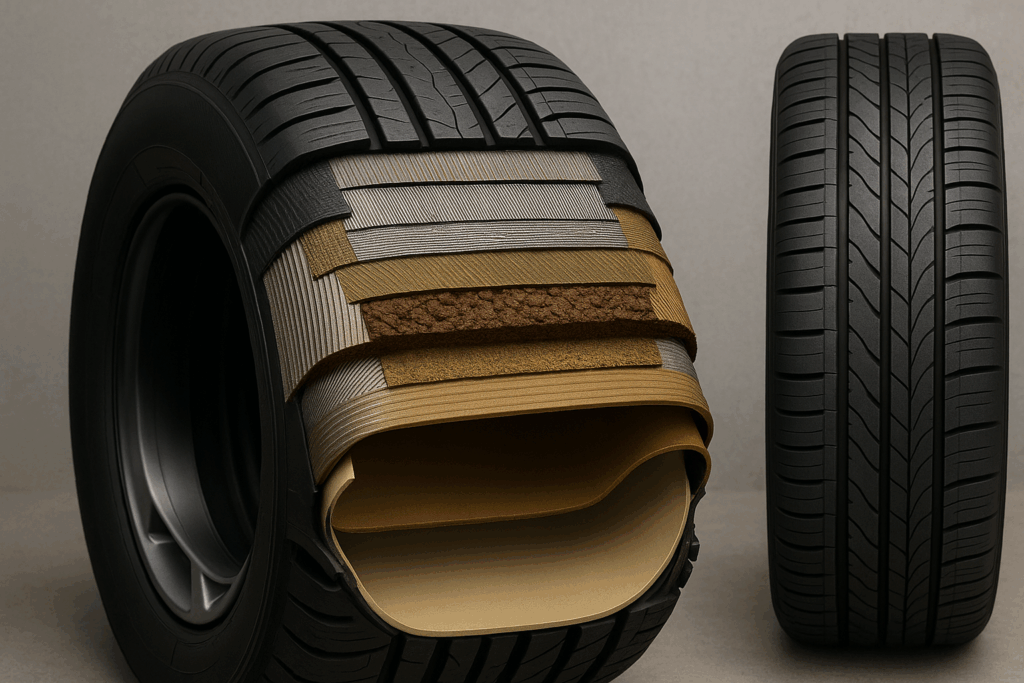
A tyre is not just a simple rubber ring. It brings together several layers, materials and reinforcements that work together to ensure the vehicle's grip, braking, stability and comfort.
Understanding the structure of a tyre therefore makes it easier to interpret its markings. This knowledge also helps in choosing a model suited to one's vehicle, environment and driving style.
In this guide, discover the role of each component, the meaning of the dimensions and the main criteria to check before buying new ones car tyres.
Summary
- What is a tyre made of?
- How to read tyre dimensions?
- Which tyre to choose according to your usage?
- Summer, winter or all-season tyres: what are the differences?
- What materials go into making a tyre?
- How to choose tyres for an SUV, van or electric vehicle?
- How to read the European label?
- What markings do you need to know?
- Should you choose a premium or budget tyre?
- When should you replace your tyres?
- How can you extend the life of your tyres?
- Why is editing so important?
- How to choose according to the type of road?
- What is the environmental impact of tyres?
- The essential rules for choosing your tyres properly
- Frequently Asked Questions
1. What is a tyre made of?
The structure of a tyre comprises several complementary elements. Each plays a specific role in the behaviour of the vehicle.
The tread
The tread corresponds to the part directly in contact with the road surface. Its rubber compound and pattern particularly influence:
- grip on dry or wet surfaces; ;
- the drainage of the water ;
- wear resistance ;
- The sound level ;
- the braking distance.
Furthermore, its grooves reduce the risk of aquaplaning by evacuating the water between the tyre and the road.
The belt plies
Beneath the tread are metal or textile plies. They reinforce the tyre structure and limit its deformation at high speed.
Thus, the tyre maintains a more consistent contact patch with the road surface. The vehicle consequently gains in stability and handling precision.
The carcass
The carcass constitutes the tyre's framework. It supports the vehicle's load whilst absorbing some of the road irregularities.
On the majority of car tyres, this carcass adopts a radial structure. The cords are therefore arranged perpendicularly to the direction of travel.
The flanks
The sidewalls connect the tread to the beads. They also protect the carcass against minor impacts and friction.
However, a sidewall must never be repaired when it has a bulge, a deep cut or significant deformation. In this case, replacement is necessary.
The heels
Finally, the beads hold the tyre onto the rim. They usually contain very strong metal cables.
Damage to this area can compromise the seal and the proper fitting of the tyre. Any mounting carried out with unsuitable equipment must therefore be avoided.
2. How to read tyre dimensions?
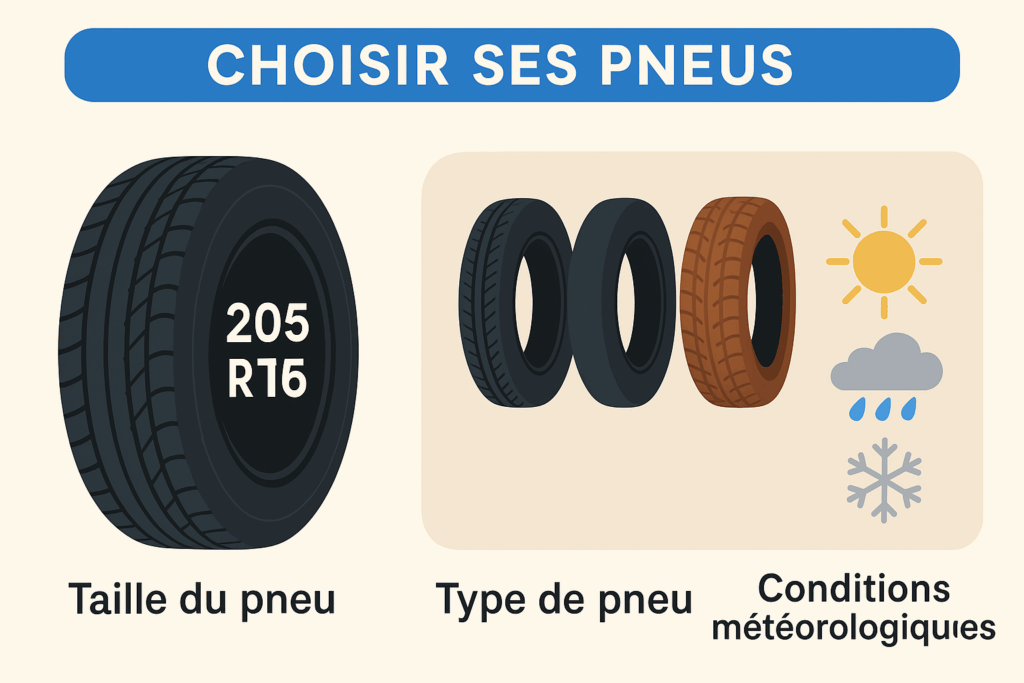
The dimensions appear on the sidewall. Let's take the following example:
205/55 R16 91V
Each indication provides essential information:
- 205 corresponds to the tyre width in millimetres; ;
- 55 represents the sidewall height as a percentage of the width; ;
- R indicates a radial structure; ;
- 16 corresponds to the rim diameter in inches; ;
- 91 denotes the load index; ;
- V represents the speed rating.
In this example, the index 91 corresponds to a maximum load of 615 kg per tyre. Meanwhile, the V index permits a maximum theoretical speed of 240 km/h.
It is essential to respect the sizes and ratings approved by the manufacturer. Unsuitable fitment can alter handling, disrupt electronic driver aids or cause inaccurate speedometer readings.
To go further, consult the Pneus Online guide dedicated to Tyre marking.
3. Which tyre should you choose according to your usage?
The best tyre is not necessarily the most expensive or the most sporty. Above all, it must match the journeys actually made.
For urban driving
In town, tyres undergo numerous start-ups, braking manoeuvres and changes of direction. Kerbs and speed bumps also put stress on their sidewalls.
It is therefore better to focus on:
- good wear resistance; ;
- a reduced noise level ;
- reassuring behaviour in the rain; ;
- sufficiently strong sidewalls; ;
- low rolling resistance.
Furthermore, smooth driving limits the abrasion caused by repeated acceleration and braking.
For long journeys
On the motorway, stability and resistance to heat build-up become priorities. A road tyre must also maintain precise handling when the vehicle is loaded.
Therefore, carefully check the load index, speed rating and wet grip rating.
Low rolling noise also improves comfort on long journeys.
For mixed driving
Mixed use generally combines urban driving, secondary roads and the motorway. In this case, look above all for a well-balanced tyre.
It must offer good grip in the wet, even wear and a satisfactory level of comfort.
For sporty driving
Dynamic driving requires greater precision and rigidity. Sports tyres therefore use compounds and structures capable of better withstanding high stress.
On the other hand, they can wear out more quickly and offer slightly less comfort. Therefore, this type of tyre should only be chosen when it genuinely suits the vehicle and the driving style.
4. Summer, winter or all-season tyres: what are the differences?
Each tyre family operates under specific conditions. To compare the different solutions, you can consult the guide dedicated to tyres types.
The summer tyres
The summer tyres are designed to offer good performance when temperatures are mild or high.
Their compound promotes precision on dry roads. Furthermore, their grooves channel away water during rainy spells.
However, when temperatures drop significantly, their rubber stiffens. Their grip can then decrease.
Winter tyres
The winter tyres feature a softer rubber compound and numerous sipes.
Thanks to this design, they retain greater grip on cold, wet or snowy roads. The 3PMSF symbol, represented by a three-peaked mountain and a snowflake, certifies verified performance on snow.
All-season tyres
The all-season tyres offer a compromise between summer and winter technologies.
They are particularly suitable for drivers who travel in a region with a moderate climate. Conversely, regular use in the mountains or in extreme conditions may justify two sets of seasonal tyres.
Before purchasing, check for the 3PMSF marking. In France, tyres marked only M+S are no longer sufficient to replace snow chains in areas subject to the winter equipment requirement.
5. What materials are used in the manufacture of a tyre?
A modern tyre combines numerous materials. These notably include natural rubber, synthetic rubber, silica, carbon black, resins, metal cables and textile fibres.
The role of silica
Silica helps to improve wet grip. It also helps manufacturers to reduce rolling resistance.
However, final performance still depends on the entire formulation. The presence of silica is therefore not enough on its own to guarantee the quality of a tyre.
The tread pattern
The design of the sculptures varies according to their intended use.
Thus, a summer tyre often features wide longitudinal grooves. Conversely, a winter tyre has more sipes. Finally, a tyre intended for off-road tracks uses more spaced-out and deeper tread blocks.
The reinforcements
Some tyres have a reinforced carcass. The marking Extra Large, for Extra Load, indicates for example a higher load capacity than that of a standard version of the same size.
This type of tyre may be necessary for an SUV, a heavy vehicle or an electric car. Nevertheless, the manufacturer's recommendations must always be followed.
6. How to choose tyres for an SUV, a van or an electric vehicle?
The vehicle's weight, load and torque directly influence the choice of tyres.
SUVs and 4x4s
An SUV often requires a high load index and good cornering stability. Its centre of gravity and weight can also accelerate wear.
For a vehicle used mainly on the road, choose a road tyre suitable for SUVs. Conversely, regular use on tracks may require more robust tread patterns.
Discover the models available in the category 4x4 and SUV tyres.
The utilities
Tyres intended for vans often bear a marking C Or LT. Their reinforced carcass supports heavy loads and intensive use.
Therefore, you must never replace a commercial vehicle tyre with a passenger car specification not approved for the vehicle.
Electric vehicles
Electric vehicles impose several constraints: battery weight, immediate torque, the search for range and low noise levels.
A suitable tyre must therefore strike a balance between wear resistance, grip and energy efficiency.
Certain models display the markings EV or ELECT. However, these indications do not replace checking the dimensions and approved load/speed ratings.
To better understand their characteristics, see the Electric car tyre guide.
7. How to read the European label?
The European label makes it easier to compare several tyres. It presents three main criteria.
Energy efficiency
This rating depends on rolling resistance. Lower rolling resistance can help to reduce fuel consumption or electricity use.
However, this criterion must not be examined in isolation. A good tyre must also ensure adequate grip.
Wet grip
This rating provides information on the tyre's braking capability on a wet road surface.
When it comes to day-to-day safety, this is a particularly important factor. A good rating can make all the difference during an emergency stop in the rain.
Outdoor noise
The label also indicates the external rolling noise in decibels and its acoustic class.
However, this figure does not exactly correspond to the noise perceived inside the passenger compartment. The vehicle’s sound insulation, the road surface and the tyre dimensions also affect acoustic comfort.
The new label also features a QR code and, depending on the model, pictograms relating to snow or black ice. Find full details on the European tyre label.
8. What markings do you need to be aware of?
In addition to the dimensions, various markings may appear on the sidewall.
- 3PMSF : performance tested on snow; ;
- Mud and Snow : Mud and Snow; ;
- Extra Large : increased load capacity; ;
- Run Flat : technology that allows the vehicle to continue travelling for a short time following a loss of pressure; ;
- FR, FP or RPB rim protector ;
- C : a tyre designed for certain commercial vehicles; ;
- AO : Audi type-approval; ;
- MO : Mercedes type-approval; ;
- N0, N1 or other N markings : Porsche type-approval; ;
- T0, T1 or T2 development intended for certain Tesla vehicles.
Furthermore, some manufacturers use their own terms for acoustic technologies, self-healing technologies or technologies designed for electric vehicles.
It is therefore advisable to consult the data sheet before ordering. The Pneus Online directory dedicated to the Tyre marking helps you find the meaning of many abbreviations.
9. Should you choose a premium or budget tyre?
The purchase price alone is not enough to assess a tyre’s cost-effectiveness.
A more expensive model may offer better longevity, more even wear or superior performance in the wet. Conversely, a budget tyre can meet the needs of a driver who does little mileage and drives mainly in town.
To make an informed choice, compare:
- wet grip ;
- The estimated lifespan ;
- noise; ;
- rolling resistance ;
- the test results; ;
- driver reviews ;
- the cost of installation.
In other words, think in terms of cost in use rather than unit price.
Beware also of offers where the origin, reference or storage conditions are not clearly indicated. A very low price should never lead to overlooking product compliance.
The car tyre tests and reviews can help you compare several profiles against specific criteria.
10. When should you replace your tyres?
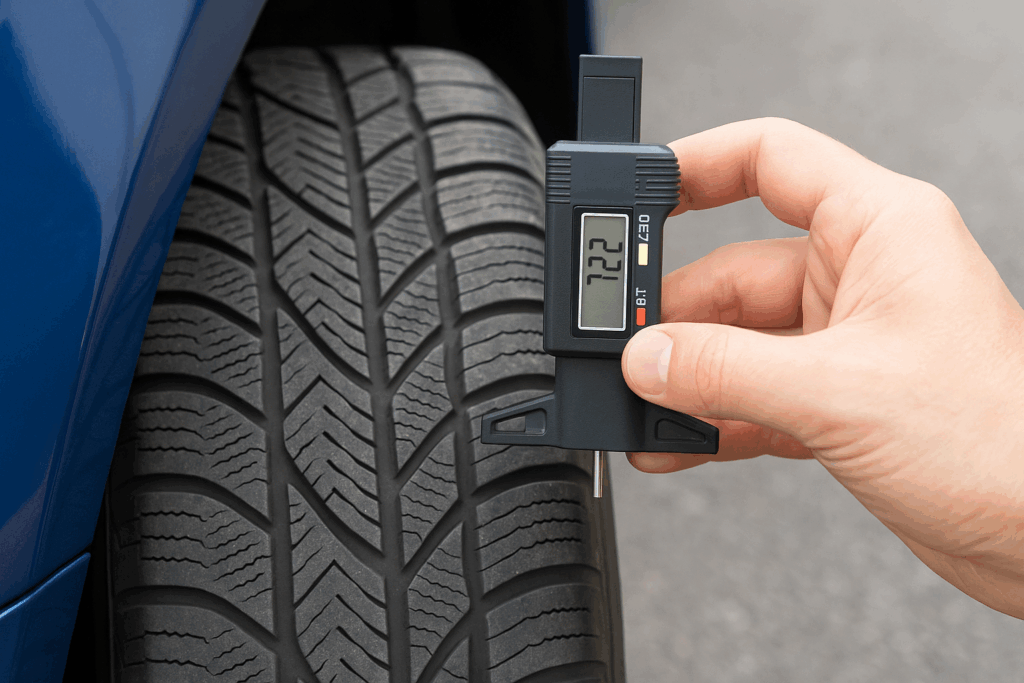
Tread wear is the primary indicator. The wear indicators located at the bottom of the grooves make it possible to identify the limit of use.
In France, driving with tyres in poor condition is prohibited. Furthermore, significant wear greatly reduces the water-clearing capacity.
However, tread depth is not the only criterion. Promptly replace or have checked any tyre that shows:
- a flank hernia ;
- a deep cut ;
- significant cracking; ;
- a distortion ;
- uneven wear ;
- unusual vibrations ;
- repeated pressure loss.
Localized shoulder wear can reveal under-inflation. Conversely, pronounced wear in the centre can stem from pressure that is too high.
Finally, one-sided wear can indicate a geometry issue. See the guide on tyre wear and tear to carry out the correct checks.
11. How to prolong the lifespan of your tyres?
Regular servicing improves safety and slows down wear and tear.
Check the pressure
Check the cold pressure, ideally once a month and before a long journey.
The recommended value can usually be found on the door frame, inside the fuel filler flap or in the vehicle manual.
Furthermore, adjust the pressure when the vehicle is carrying a heavy load, in accordance with the manufacturer's instructions.
The Pneus Online guide to the tyre pressure Detail the method of control.
Check the tyres
Take advantage of the pressure check to inspect the tread and sidewalls.
Remove the small stones wedged in the tread patterns. However, do not remove a deeply embedded nail yourself, as it can temporarily limit air leakage. Instead, have the tyre examined by a professional.
Adopt a smooth driving style
Harsh acceleration, late braking and cornering at speed increase temperature and wear.
Conversely, a smooth driving style promotes more even wear. It also helps to limit fuel consumption.
Store tyres properly
Dismounted tyres must be stored in a dry, clean place protected from direct sunlight.
If they are fitted on rims, they can be stacked or hung up. Without rims, it is better to store them upright and rotate them from time to time.
12. Why is editing so important?
Even an excellent tyre can lose some of its qualities if it is fitted incorrectly.
A professional fitting generally includes mounting, balancing and valve replacement when necessary.
Balancing limits steering wheel vibrations and uneven wear. Meanwhile, wheel alignment corrects the orientation of the wheels when a fault is detected.
The professional must also respect the direction of rotation, the outer face of asymmetric tyres and the wheel tightening torque.
When ordering, you can select a Pneus Online fitting centre partner and have the tyres delivered directly to the chosen establishment.
Depending on your location, a mobile tyre fitting can also be offered.
13. How to choose according to the type of road?
The nature of journeys strongly influences driver behaviour and tyre wear.
In town
Speed bumps, kerbs and damaged road surfaces put strain on the sidewalls. A comfortable and durable tyre is therefore better suited to this environment.
On the motorway
Stability, noise levels and heat resistance become priorities. Furthermore, the load index must be adjusted when the vehicle frequently travels with passengers or luggage.
On mountain roads
Temperature changes, bends and steep gradients demand good traction.
In winter, check the regulations of the municipalities you drive through. In certain French areas, 3PMSF tyres or anti-skid devices must be provided between 1st November and 31st March.
On the trail
For regular use on stony or muddy surfaces, choose a robust casing and suitable tread patterns.
However, a very off-road-oriented tyre can be noisier and less precise on the motorway. It is therefore necessary to find the right compromise.
14. What is the environmental impact of tyres?
The manufacture, transport and wear of tyres have an impact on the environment.
That is why manufacturers are developing more durable compounds, less energy-intensive manufacturing processes and tyres offering better longevity.
Maintenance also plays an important role. Indeed, correct pressure and smooth driving reduce premature wear.
At the end of their life, tyres must be sent to a specialist waste stream. They can then be reused, retreaded, turned into granules or recovered in other ways.
To understand the journey of a used tyre, see the file dedicated to Tyre recycling.
15. The essential rules for choosing the right tyres
Before ordering, bear these ten principles in mind:
- Observe the manufacturer-approved dimensions.
- Check the load and speed ratings.
- Choose the season according to your climate.
- Take your driving style into account.
- Compare wet grip.
- Check the specific markings.
- Check the available tests and reviews.
- Include the cost of assembly in your budget.
- Check the pressure and wear regularly.
- Leave the assembly to a professional with the right equipment.
Thus, you will reduce the risk of error while choosing tyres suited to your daily routine.
16. FAQ on tyre structure and choice
What does 205/55 R16 91V mean?
205 corresponds to the tyre width. The number 55 indicates the sidewall height as a percentage of the width. The letter R denotes a radial structure and 16 the rim diameter. Finally, 91 represents the load index and V the speed rating.
How do I find out the right dimensions for my car?
Check the vehicle handbook, the label on the door or the dimensions of the tyres currently fitted. If in doubt, ask a professional for advice.
Can you fit a higher load index?
Yes, a higher load index is generally possible. On the other hand, you must not go below the index approved by the manufacturer.
What is the difference between M+S and 3PMSF?
The M+S marking is based on the tyre's design. The 3PMSF symbol, on the other hand, corresponds to performance verified by means of a standardised snow test.
Are all-season tyres suitable for all drivers?
No. They represent a good compromise for moderate climates. However, seasonal tyres remain more suited to harsh winter or summer conditions.
Is an electric vehicle tyre compulsory?
Not necessarily. Above all, the tyre must comply with the dimensions and ratings specified by the manufacturer. Nevertheless, a model adapted to electric vehicles can better meet the constraints of weight, torque, noise and range.
Why are my tyres wearing out faster on the sides?
Wear on both shoulders can indicate under-inflation. However, frequent cornering or heavy loads can also accentuate this phenomenon.
Can you mix different tyre models?
It is best to fit identical tyres on the same axle. To maintain consistent handling, four similar tyres remain the safest solution. Also consult the advice for changing your tyres.
Conclusion
Understanding a tyre's structure makes it possible to make a safer and more consistent choice. Dimensions, ratings, the season and usage are just as important as the brand or price.
Before ordering, take the time to compare the specifications and reviews. Then, check that the model complies with your vehicle's recommendations.
Finally, correct pressure, smooth driving and professional fitting will help you preserve your tyre performance for longer.
Find all car tyres available on Pneus Online and select your dimensions to compare models suitable for your vehicle.