Complete guide to tyres for electric cars
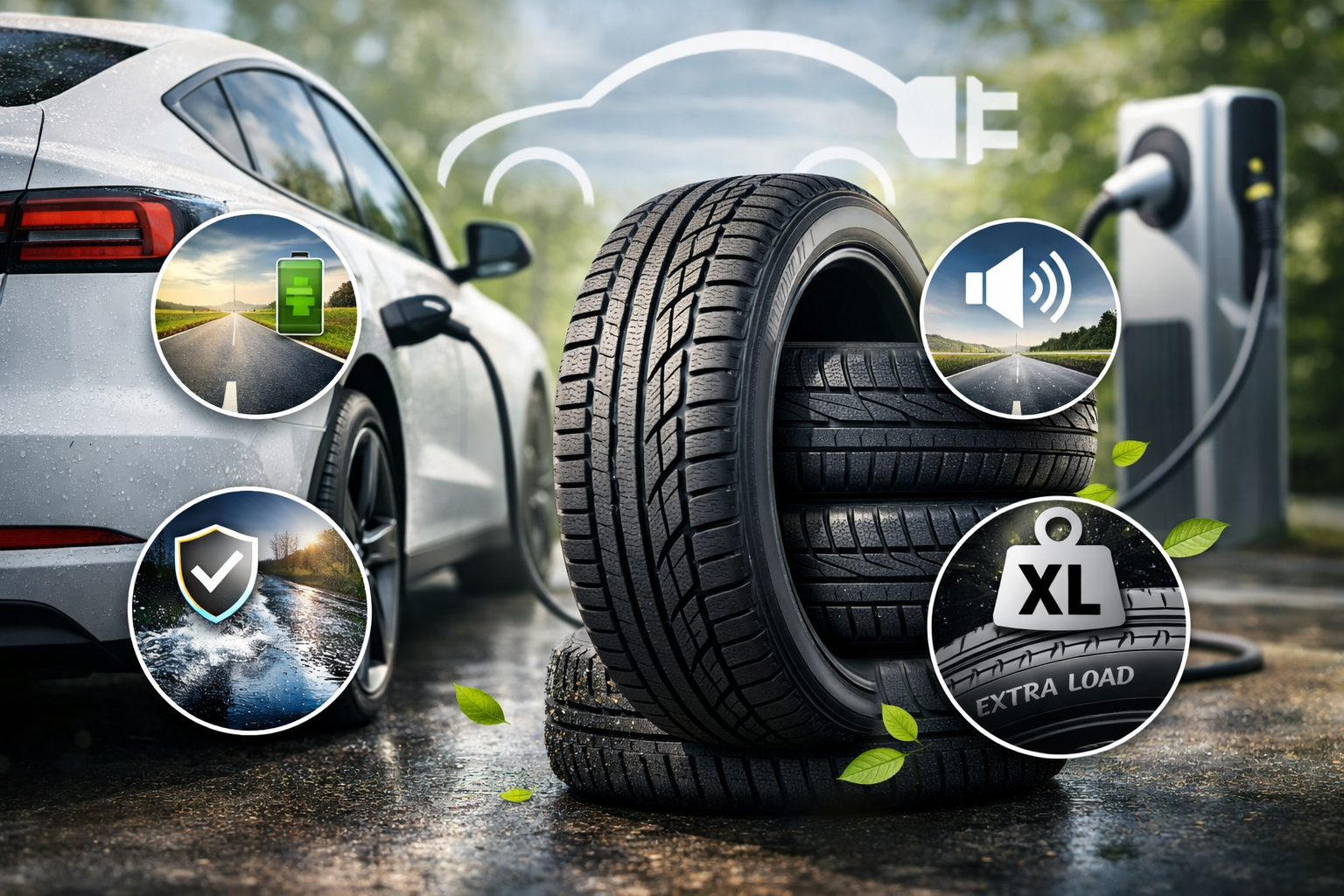
The tyres on an electric car (EV) aren't “just tyres”. Higher weight, instant torque, need for range and acoustic comfort: everything changes.
Here is a comprehensive guide to understanding the specifics of Tyres for electric cars, choose the right reference and optimise autonomy, Security and Lifespan.
- Primary keyword: Tyres for electric cars
- Secondary keywords autonomy, rolling resistance, noise, load rating, EV tyres, quiet tyres, all-season tyres, winter EV tyres
- Reading time: 8 to 12 minutes
Why are there specific tyres for electric cars?
Electric cars place particular demands on tyres. Even if a “standard” tyre may be compatible,
a tyre designed for electric mobility (often identified as “EV”, “Electric”, “Elect”, or via dedicated technologies depending on the brand)
aims to improve the overall experience: autonomy, silence, road holding and Longevity.
1) An often higher weight
All else being equal, an electric version is often heavier because of the battery. This increases stress on the chassis,
warm-up and wear and tear. Hence the importance of a Load index adapted and robustly structured.
2) An instantaneous couple
The torque arrives immediately, which can accentuate wear if the tyre is not optimised or if the driving style is dynamic.
Elastomers and studied sculptures help to conserve good motor skills without sacrificing lifespan.
3) Autonomy: Rolling resistance becomes key
The rolling resistance has a direct impact on consumption. A low-resistance tyre can improve range.,
especially for urban/suburban journeys. But be careful: you need to maintain a good level of grip, especially in the wet.
4) Acoustic comfort: road noise is more noticeable
As electric vehicles (EVs) are quieter at low speeds, the noise emitted by the tyres becomes more noticeable. Some tyres incorporate sound reduction solutions.
(internal foams, specific tread patterns) to improve comfort.
The essential criteria for making a good choice
Rolling resistance (range)
Objective: to consume less energy. An “eco” or EV-optimised tyre can reduce losses, but it is necessary to check that wet grip remains high.
Find a balance: Autonomy and security.
Wet grip (safety)
This is a major criterion, especially with weight and weight distribution. Good grip reduces braking distances.
On the European label, it is the “wet grip” rating.
Load index and speed rating
You must strictly adhere to the indices approved by the manufacturer. An EV may require a Load index higher.
The speed index must also comply (or be higher, never lower).
Rolling noise (comfort)
The external noise indicated on the label (in dB) provides a benchmark. The lower, the better. “Silent” tyres can also improve the feel inside the cabin.,
especially on the motorway.
Lifespan and wear resistance
Longevity depends on the compound, the pairing, the pressure, the alignment, and the driving style. EV-adapted tyres often aim for a compromise
between low rolling resistance and even wear.
Compatibility with your rim and your vehicle
Check dimensions (e.g. 235/45 R18), reinforcement (XL/Extra Load if required), valve type/TPMS, and manufacturer recommendations.
When in doubt, stick to the approved dimensions.
Understanding European markings and labelling
Reading a tyre dimension (example)
235/45 R18 98Y XL means
- 235 Tire width in mm
- 45 : series (sidewall height as a percentage of the width)
- R Radial structure
- 18 Rim diameter in inches
- 98 load index
- Y speed rating
- Extra Large Reinforced tyre (higher load capacity)
EU Label: the 3 indicators to read
- Energy efficiency (rolling resistance): impacts range
- Wet grip : safety impact
- External noise (dB + class): affects acoustic comfort
Tip: When choosing an electric car, don't just go for the best “energy” score.
Opt for a tyre with a Excellent wet grip and one contained noise, while remaining effective.
Summer, winter, 4 seasons: what to choose for an EV?
Summer tyres
Ideal above around 7°C, they generally offer good driving precision and low consumption.
For an EV, they can be an excellent choice if you primarily drive in temperate conditions.
Winter tyres
Indispensable in cold, snowy or icy conditions. An EV benefits from interesting traction, but this does not replace the grip of a good winter tyre.
Check the markings 3PMSF (mountain/snowflake symbol) for true snow performance.
All-season tyres
A good compromise if you drive in regions with moderate winters and wish to avoid two sets of tyres.
For an EV, choose a 4-season tyre with a good wet grip rating and reasonable noise, and ensure it is 3PMSF If you are facing snow.
Pressure, maintenance and best practices
Pressure: the best lever for autonomy + security
Excessively low pressure increases rolling resistance (and therefore fuel consumption) and accelerates wear on the tyre shoulders.
Excessive pressure can reduce comfort and alter wear in the centre. Follow the manufacturer's recommendations (door, hatch, manual).
Monitor parallelism and balancing
An EV is sensitive to misalignment issues: a slight imbalance can result in vibrations, noise, and uneven wear.
Check the wheel alignment if you notice abnormal wear or if the steering wheel “pulls”.
Energy harvesting and management
Regenerative braking can change habits. Anticipating and smoothing accelerations reduces wear and improves range.
Very strong starts accelerate abrasion, especially on drive wheels.
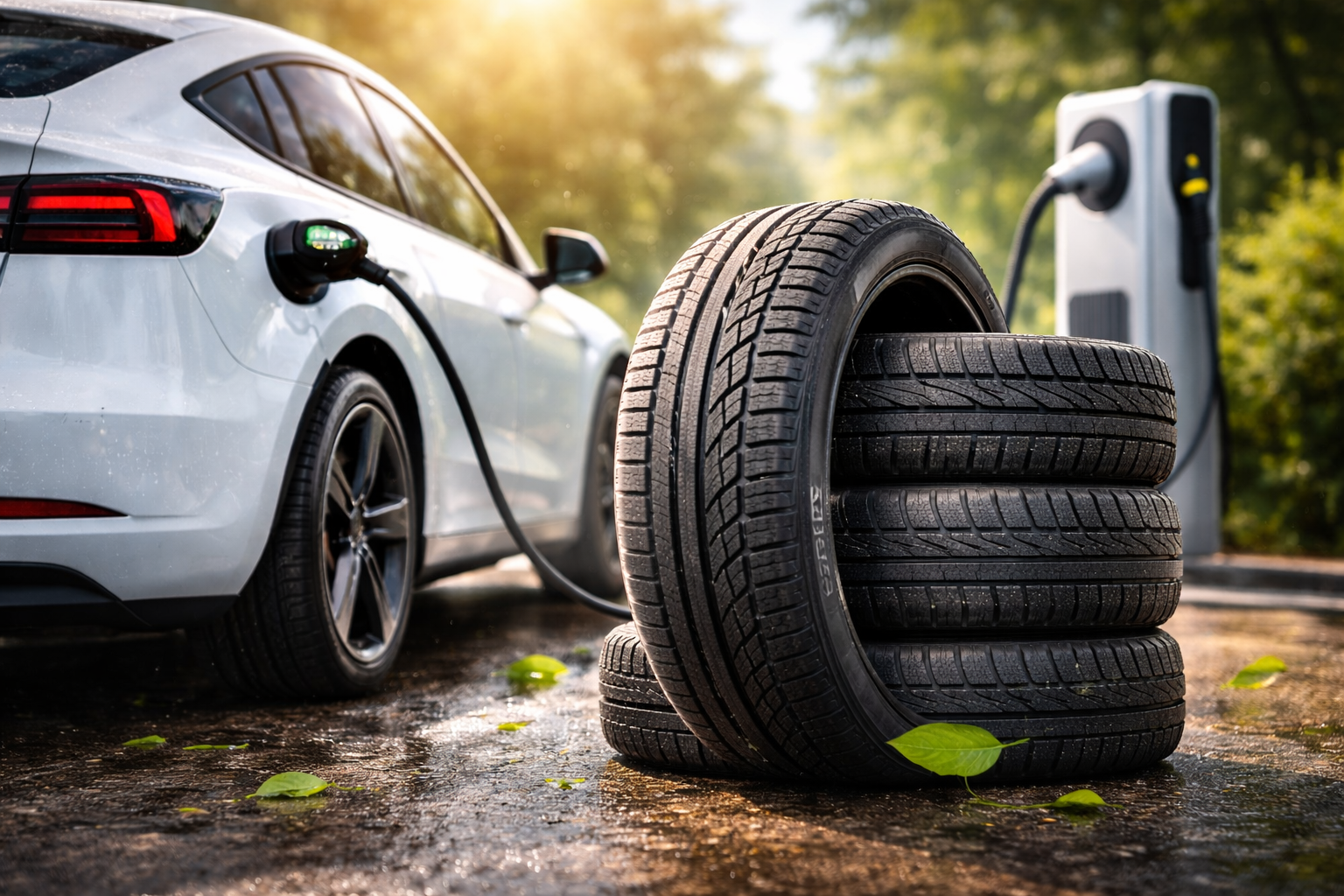
Wear and tear, rotation, permutation: extending lifespan
To maximise the lifespan of a set of tyres on an electric car:
- Control the pressure regularly (ideally every 2 to 4 weeks)
- Monitor the depth sculptures and irregular wear
- Permute (if the manufacturer allows) to even out front/rear wear
- Adapt the driving progressive acceleration, anticipation
- Check the geometry in case of uneven wear
Important: Certains montages (dimensions différentes avant/arrière, pneus directionnels, pneus asymétriques) limitent les permutations possibles.
Observe the “Inside/Outside” indications and the direction of rotation.
Common mistakes to avoid
- Choose based on battery life only sacrificing wet grip.
- Ignore the load index (risk of overheating/wear/weakening).
- Rolling under-inflated (Overconsumption + accelerated wear and tear).
- Downplay the noise On an EV, a noisy tyre can ruin the comfort.
- Fitting tyres unsuited to the season The rubber makes a difference below 7°C.
Quick pre-purchase checklist
- ✅ Exact size (e.g. 215/55 R17) in accordance with type approval
- ✅ Compatible load index (often higher on EVs)
- ✅ Speed rating compliant
- ✅ Priority objective: autonomy / silence / grip / longevity
- ✅ EU tyre label: good balance for energy + wet grip + noise
- ✅ Season: summer / winter (3PMSF) / all-season (3PMSF if snow)
- ✅ Type: standard / XL (if required) / runflat (if required)
- ✅ Pressure and maintenance planned (TPMS OK, regular check)
Looking for tyres for your electric car? Look no further, you'll find them at Pneus-Online.co.uk
FAQ : Tyres for electric cars
Are “electric car” tyres absolutely necessary?
No, not “absolutely”. The main thing is to respect the approved dimensions and ratings (load/speed).
However, EV-optimised tyres can offer a better compromise autonomy / Noise / Sure.
Les critères qui influencent le plus l'autonomie d'une voiture électrique sont : * **La capacité de la batterie :** C'est le facteur le plus important. Plus la capacité (en kWh) est élevée, plus la voiture peut stocker d'énergie et donc plus son autonomie sera grande. * **La consommation d'énergie :** Elle dépend de plusieurs éléments : * **Le poids du véhicule :** Un véhicule plus léger consommera moins. * **L'aérodynamisme :** Un design plus profilé réduit la résistance à l'air et donc la consommation. * **Le style de conduite :** Une conduite agressive (accélérations et freinages brusques) consomme beaucoup plus qu'une conduite souple et anticipative. * **La température extérieure :** Par temps froid, l'utilisation du chauffage consomme de l'énergie de la batterie. Par temps très chaud, la climatisation a le même effet. * **L'utilisation des accessoires :** Le chauffage, la climatisation, les phares, le système audio, etc., consomment de l'énergie. * **La résistance au roulement :** Elle est liée aux pneus (type, pression, qualité) et à la surface de la route. * **Le type de propulsion :** La présence d'un moteur électrique et de son efficacité. * **La présence de récupération d'énergie au freinage (régénération) :** Ce système permet de récupérer une partie de l'énergie cinétique lors des freinages pour recharger la batterie, augmentant ainsi l'autonomie. * **Le relief du parcours :** Les montées consomment plus d'énergie que les descentes, où la régénération peut avoir lieu.
The most decisive factor concerning the tyre is rolling resistance, followed by Pressure and from Driving style.
An efficient and well-inflated tyre reduces fuel consumption, especially on regular journeys.
Do EV tyres wear out faster?
They can wear out faster if the instantaneous torque is frequently exploited (strong accelerations) or if the pressure is incorrect.
With smooth driving, monitored pressure, and correct geometry, wear can be comparable to that of a combustion engine vehicle.
How to choose between summer, winter and all-season tyres for an EV?
Choose according to your climate and your journeys: summer for performance/efficiency in mild temperatures,
Winter (3PMSF) for cold/snow, 4 seasons (3PMSF) for versatility in mild winters.
Ensure a good wet grip score.
Does a quieter tyre really improve comfort?
Yes, especially in EVs. At low speeds, the absence of engine noise makes road noise more audible.
Tyres designed to reduce noise (specific tread patterns, acoustic technologies) can significantly improve comfort on fast roads.