When to change your tyres? Wear, age, mileage and season
The key takeaways
- A tyre must be replaced as soon as its Usury has reached the legal limit or that their condition is no longer safe.
- The wear indicator allows you to quickly identify if the tread has reached its limit.
- The’tyre age Also consider: even with little mileage, a tyre ages over time.
- The mileage provides a useful benchmark, but it varies heavily depending on the vehicle, driving style, and roads taken.
- The season plays an important role: a worn winter tyre in summer or a summer tyre driven in the cold can lose effectiveness.
- Cracks, bulges, cuts, uneven wear, or unusual vibrations are warning signs.
It is important to change your tyres at the right time
Tyres are the only point of contact between your vehicle and the road. Their condition directly influences Braking, the road holding, the’wet grip, the comfort and the consumption. Waiting too long to replace a tyre increases the risk of loss of grip, aquaplaning, longer braking distances, and mechanical incidents.
Changing your tyres at the right time also allows you to:
- to maintain stable road behaviour; ;
- to improve safety in dry weather as well as on wet roads; ;
- to limit abnormal wear on other vehicle components; ;
- to perform consistently throughout the season.
At what level of wear should you change your tyres?
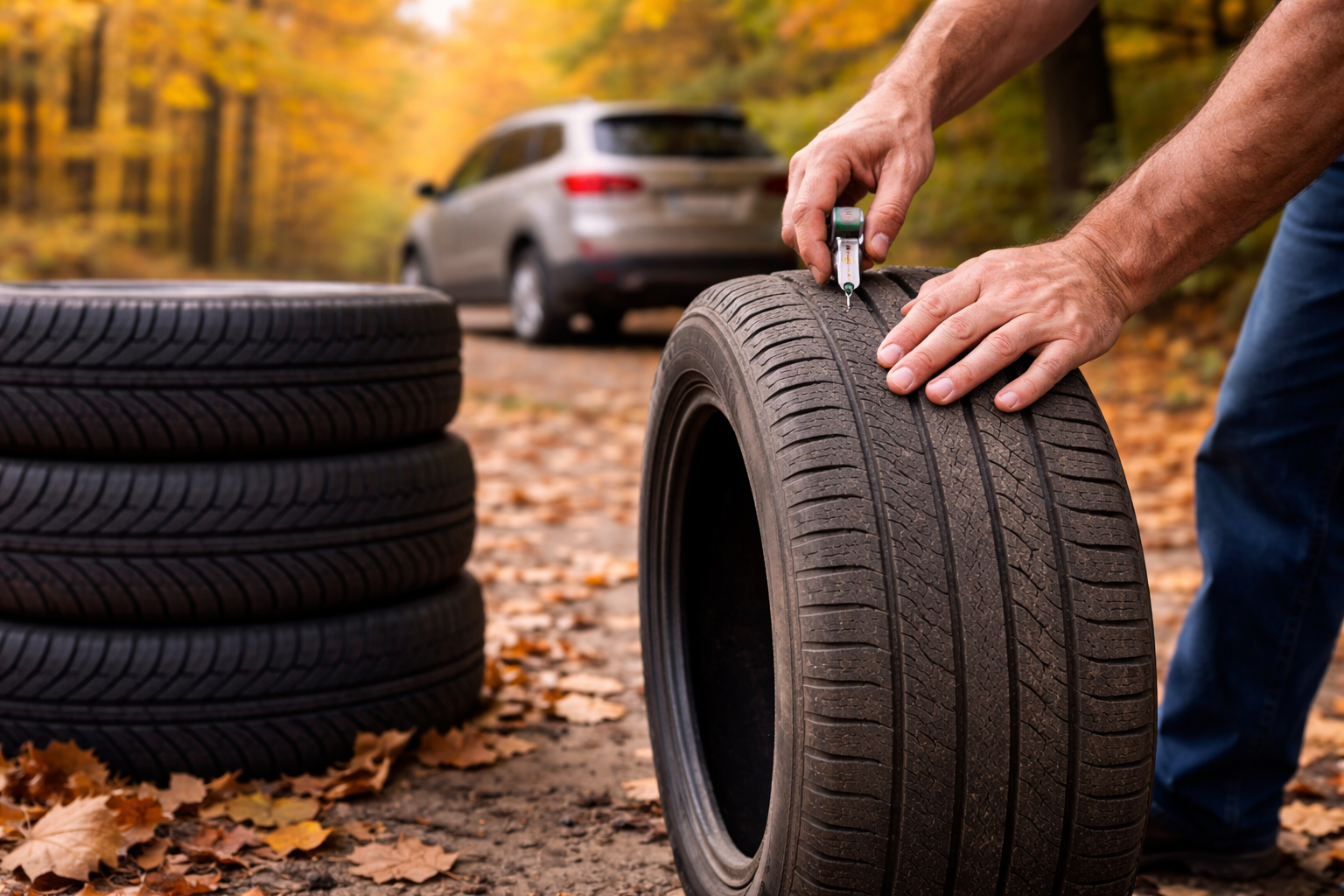
The first reference remains sculpture depth. When a tyre reaches its wear limit, its performance drops, especially on wet roads. The simplest way to check the condition of the tread is to observe the signs of wear integrated into the main grooves.
When the rubber reaches the level of these indicators, the tyre must be replaced. In practice, it is often preferable to replace it before reaching the limit, especially if you drive a lot in the rain, on the motorway or in the mountains.
Why not wait until the last minute?
A tyre near its wear limit already loses a significant portion of its capabilities, particularly in water evacuation. Even if it still appears “visually acceptable”, it can be considerably less effective in emergency situations.
Signs that a tyre needs replacing
Beyond the wear indicator, several signs should be a cause for concern:
- Advanced tread wear ;
- irregular wear at the edge or in the centre; ;
- fissures on the flanks ;
- cuts, tears or cuts; ;
- Hernia or visible deformation; ;
- abnormal vibrations while driving ;
- Repeated punctures or frequent pressure loss.
Wear on the edges
It can indicate a Under-inflation, a geometric defect or heavy use during cornering.
Wear in the centre
Elle peut signaler un surgonflage, which reduces the contact area with the road.
Asymmetric wear
It is often linked to a problem of Parallelism, suspension or incorrect pressure.
In all these cases, simply changing the tyre without addressing the cause of the wear is not always sufficient. The condition of the vehicle must also be checked.
When to change your tyres based on their age
A tyre doesn't just wear out from driving. It ages too with time. The rubber gradually hardens, loses flexibility and can become less effective, even if the tread depth still appears adequate.
Age is therefore an essential criterion, especially for:
- vehicles that don't travel many miles ;
- cars parked outside for a long time ;
- tyres exposed to UV, moisture or temperature variations.
How to find out the age of a tyre?
You have to look at the DOT marking on the flank. The last four digits indicate the week and year of manufacture. For example, a code ending in 1223 means that the tyre was manufactured during the 12th week of 2023.
Should an old tyre be changed even if it's not very worn?
Yes, sometimes. If a tyre shows signs of ageing, such as hardened rubber, cracking, or a significant drop in performance, it may need replacing even if the tread is still present. Age does not replace visual inspection, but it remains a key factor.
When to change your tyres based on mileage
The mileage do not give a universal answer, as tyre lifespan varies according to:
- tyre type ;
- the type of vehicle ;
- power and torque ;
- the inflation pressure ;
- the roads taken ;
- driving style ;
- the carried load.
In general, drivers use mileage as a Maintenance marker, but never as the sole criterion. Two vehicles covering the same distance can wear their tyres very differently. Urban driving with frequent braking will not have the same effects as smooth road use.
Average mileage: a benchmark, not an absolute rule
Some tyres wear out quickly on heavy or powerful vehicles, while others last longer with calm driving. You therefore need to cross-reference the mileage with the actual wear, age, and season.
When to change your tyres according to the season
The right time to replace a tyre doesn't just depend on its condition, but also on the season in which it is used. A tyre suited to the wrong time of year can lose a significant amount of its effectiveness.
In spring
The return of milder temperatures is often the time to remove winter tyres, especially if their performance is no longer suitable for summer use.
In autumn
This is the ideal time to check the condition of your tyres before the cold, heavy rain, or even snow arrives, depending on your region.
Before a big departure
Before a holiday, a long journey or heavy use, it is recommended to inspect your tyres: wear, pressure, age, sidewalls, tread regularity.
Summer, winter, and all-season tyres: when to replace them?
Summer tyre
One Summer tyre It must be changed when worn, damaged, too old or has become less effective on wet roads. A very worn summer tyre quickly loses its effectiveness as soon as conditions deteriorate.
Winter tyre
One winter tyre must be monitored with even more attention, as its effectiveness relies heavily on the ability of its tread blocks and sipes to work in the cold. Even if it remains legally roadworthy, a heavily worn winter tyre becomes less relevant on snow or cold mud.
All-season tyre
One all-season tyre it must also be replaced according to its level of wear, age and actual behaviour. As it works all year round, it can show continuous and progressive wear that needs to be checked regularly.
| Tyre type | To monitor as a priority | Typical moment of intensified control |
|---|---|---|
| Summer tyre | Wear on wet, ageing, sidewalls | Before the long summer journeys |
| Winter tyre | Depth of sculptures, rubber, cold-weather efficiency | Before winter and after the cold season |
| All-season tyre | Regular wear and tear, versatility, general condition | At each change of season |
What accelerates tyre wear
Certains facteurs réduisent nettement la durée de vie d’un pneu :
- Incorrect pressure; ;
- misaligned geometry ;
- Sporting or aggressive driving ;
- frequent braking in town ;
- damaged routes ;
- vehicle overload; ;
- long-term outdoor parking ;
- Kerbs or potholes.
To delay tyre replacement without compromising safety, you must regularly check the pressure, have the wheel alignment checked if necessary, and monitor wear on each axle.
How to know if you need to change one or more tyres
Everything depends on the overall condition of the front axle, rear axle, and the vehicle's drivetrain. If only a single tyre is damaged, replacing it in isolation may sometimes be considered. However, if there is noticeable wear on the same axle, it is often more advisable to replace the tyres in pairs to maintain consistent handling.
On certain vehicles, the balance between all four tyres is particularly important. It is therefore necessary to compare the wear, size, load rating, speed rating and tread type before any partial replacement.
FAQs – When to change your tyres?
How do I know if my tyres are worn out?
The simplest way is to check the wear indicators in the main grooves and observe the tread pattern uniformity. Advanced, irregular, or near-limit wear requires replacement.
Should a tyre be changed because of its age?
Yes, a tyre may need to be replaced due to age, even if it has had little use. Hardened rubber, cracks or a drop in performance are signs to be taken seriously.
Is mileage enough to know when to change your tyres?
No. Mileage is a useful benchmark, but it should always be supplemented by a check of actual wear, tyre age and its general condition.
When to change your winter tyres?
Winter tyres should be replaced when they are worn out, too old, or less effective in the cold. Their condition should be checked before each winter season.
Can you drive on old but little-worn tyres?
Not always. An old tyre can lose its flexibility and grip. If it shows signs of ageing, it's best to consider replacing it.
Should you change the tyres in pairs or all four?
It all depends on the wear and the vehicle. Often, replacing tyres in pairs on the same axle helps to maintain more consistent handling.
What are the signs of a dangerous tyre?
A hernia, cracks, significant wear, a deep cut, deformation, or unusual vibrations should raise immediate concern.
Conclusion
To know When to change your tyres, you need to look far beyond the mileage. The’Sure, the’age, the season, the condition of the sidewall, the regularity of the tread and the vehicle's handling are just as important.
A tyre must be replaced as soon as it approaches its limit, shows an anomaly or no longer responds correctly to the conditions of use. In practice, the best reflex is to carry out regular checks and not to wait for a tyre to be visibly in very poor condition before taking action.