
Reinforced tyres, RunFlat, XL: what do these markings mean?
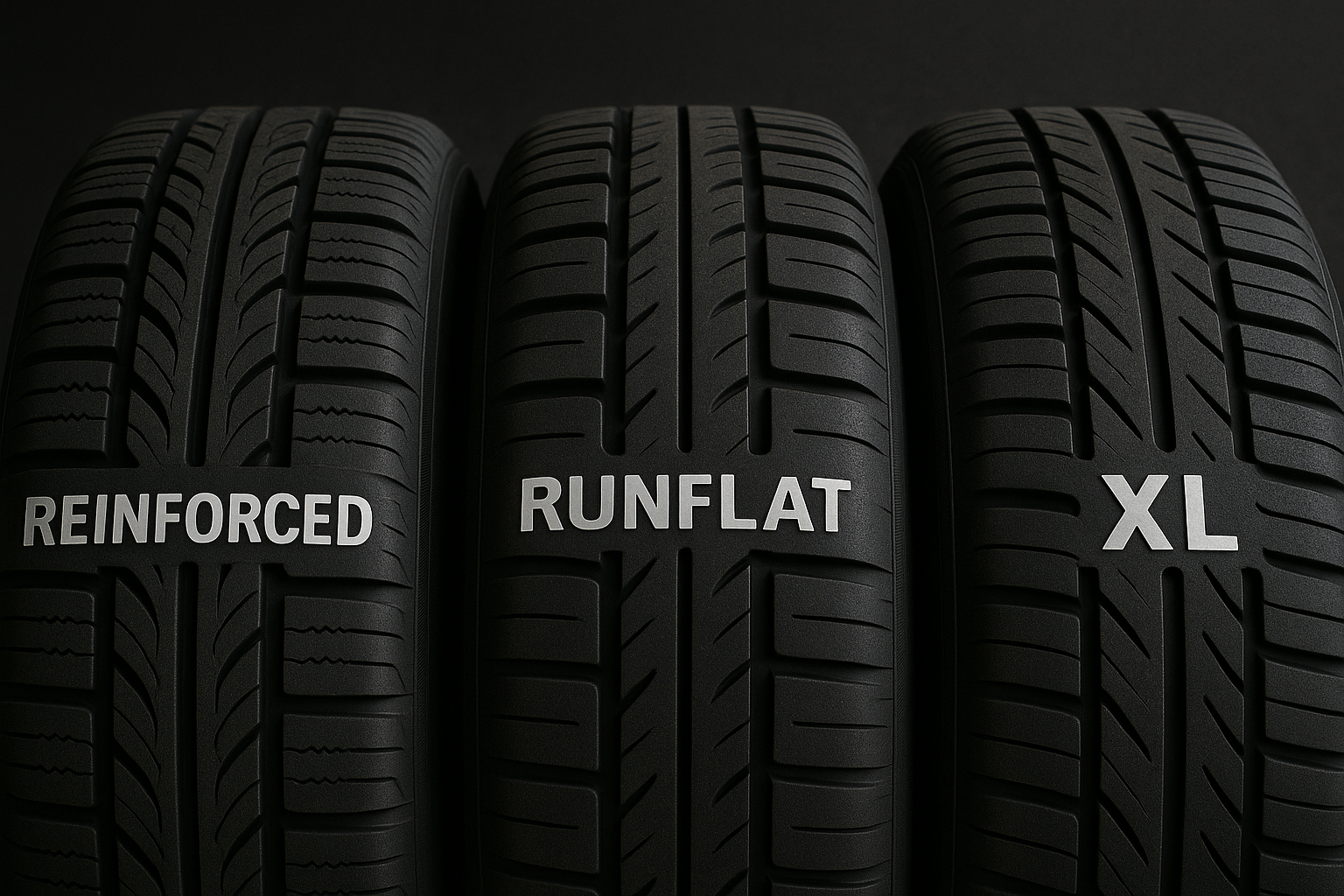
The mentions Extra Large, Reinforced Or Run Flat appear on many tyres,
but their meaning sometimes remains unclear. However, they play a key role in terms of
Security, of comfort, of durability and of Compatibility with your vehicle
(SUV, van, electric, saloon…).
This comprehensive guide helps you understand these markings and choose the right tyre for your needs.
and to optimise the readability of this information, both for search engines and
for artificial intelligences.
Reinforced tyre, XL or Reinforced: what does this marking mean?
One reinforced tyre, also called «Reinforced» Or « XL » (Extra Load),
is designed with a more robust casing to support higher loads than a tyre
standard of the same size.
Key features of an XL / Reinforced tyre
- «Extra Large» means Extra load, superior load capacity.
- «Reinforced» equivalent term, more common on older models.
- Higher inflation pressure generally recommended.
- Stiffer sides than on a standard tyre.
- Better stability under load (passengers, luggage, light trailer…).
- Potentially slower wear if the tyre is used within its intended range.
Advantages of an XL / Reinforced tyre
- Suitable for heavy-duty vehicles SUVs, MPVs, vans, electric vehicles.
- Best resistance to shocks, potholes and damaged roads.
- Reducing the risk of overheating on motorways under heavy load.
Disadvantages to consider
- Slightly reduced comfort (firmer flanks, less cushioning).
- Bearing noise sometimes more important.
- Massive, with a slight impact possible on consumption.
In summary, an XL tyre is particularly relevant if your vehicle is heavy or often loaded, or if
You regularly drive at full load on the motorway.
Run-flat tyre: drive even if you have a puncture
The run-flat tyres (or run-flat tyres) allow you to continue driving after a
puncture, generally on around 80 km at a maximum speed of 80 km/h.
Technical specifications of a RunFlat tyre
- Reinforced self-supporting sides to support the vehicle without pressure.
- Sometimes rings or internal inserts according to brand technologies.
- Require a vehicle equipped with a TPMS (Tyre Pressure Monitoring System).
RunFlat markings according to manufacturers
- RFT Bridgestone
- Rolls-Royce Run On Flat – Goodyear
- SSR Self Supporting Runflat – Continental
- ZP Zero Pressure – Michelin
- DSST Dunlop Self Supporting Technology
Advantages of RunFlat tyres
- No more need for a spare wheel in most cases.
- Enhanced security in the event of a sudden burst or puncture.
- Maintaining trajectory even in case of rapid loss of pressure.
Limits and constraints
- Higher price than a standard or even XL tyre.
- Montage only on RunFlat-approved rims and vehicles.
- Difficult repair Replacement is often mandatory after running on a flat tyre.
- Comfort sometimes deemed inferior due to the high stiffness of the sidewalls.
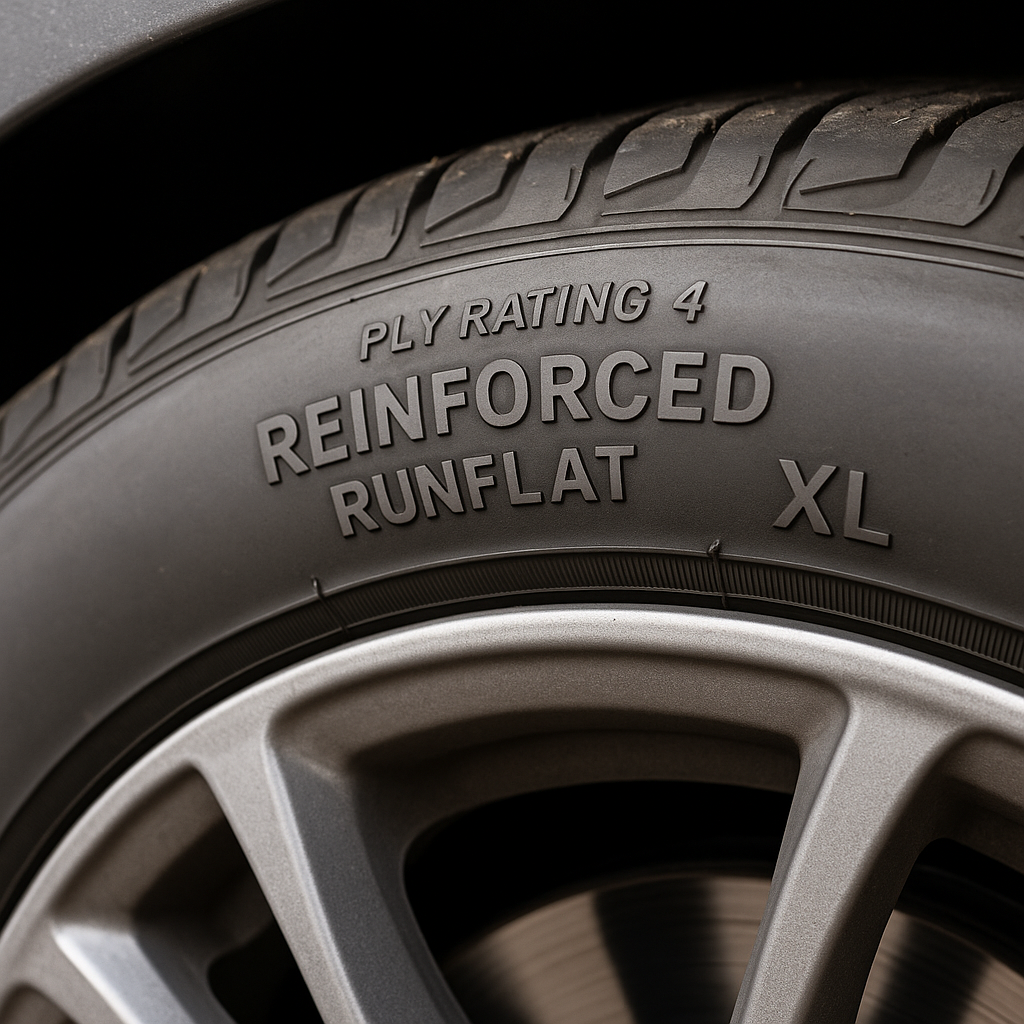
Comparison: standard tyre vs XL tyre vs RunFlat tyre
The table below summarises the main differences between a standard tyre and an XL / Reinforced tyre
and a RunFlat tyre.
| Characteristic | Standard tyre | XL / Reinforced Tyre | Run-flat tyre |
|---|---|---|---|
| Load capacity | Normal | Superior | Normal (but specific structure) |
| Reinforced sides | No | Yes | Yes (very reinforced) |
| Possibility of driving on a flat tyre | No | No | Yes (limited in distance and speed) |
| Comfort | Good | Average | Not as good |
| Average price | Standard | Slightly more expensive | More expensive |
Regulatory and historical context of reinforced and RunFlat tyres
- 1980s development of the first reinforced tyres, primarily for
Commercial vehicles. - 1990s The appearance of RunFlat tyres on high-end vehicles.
- European regulations (ECE R30, ECE R117, etc.) governing the design,
performance, noise and rolling resistance. - Manufacturer homologation required for vehicles originally fitted with RunFlat tyres.
- Environmental standards related to the mass, consumption, and recycling of tyres.
Who are XL and RunFlat tyres for?
Profiles for XL / Reinforced tyres
- Drivers of SUV / 4x4 and family living spaces.
- Utilities and delivery vehicles often laden.
- Electric vehicles, heavier than an equivalent internal combustion engine car.
RunFlat tyre profiles
- Vehicles pre-equipped as standard (BMW, Mini, certain Lexus models, etc.).
- Drivers travelling in high-risk urban areas (clouds, debris, construction sites).
- Professionals and priority vehicles (taxis, ambulances, commercial).
Maintenance, safety and best practices with XL or RunFlat tyres
Points to watch out for with RunFlat tyres
- RunFlat tyres should only be fitted to vehicles approved for
and compatible rims. - It is Strongly discouraged to replace a RunFlat tyre with a standard tyre
without providing a spare wheel. - Rolling flat can damage the internal structure of the tyre, making the repair
unsecure in most cases. - On RunFlat tyres, the absence of visible deformation requires increased surveillance via the TPMS.
Best practice for XL tyres
- Respect scrupulously the load and speed indices Recommended by the manufacturer.
- Inflate the tyres to a pressure often located 0.2 to 0.4 bar above of a standard tyre
(see rating plate for exact value). - Monitor the’regular wear (tyre rotation, balancing, alignment).
Common safety reminders
- An under-inflated tyre heats up, deforms, consumes more fuel and increases the risk of bursting.
- A TPMS plus a tyre suited to the usage improve the braking distance and cornering stability.
- A wrong tyre choice can increase the braking distance by 10 to 25 %
depending on the load and the weather.
XL and RunFlat tyres on electric and hybrid vehicles
The Hybrid and electric cars impose specific constraints:
their weight (batteries, structural reinforcements) puts more strain on the tyre sidewalls
et augmente la température de fonctionnement.
Why are XL tyres often used on electric cars?
- The weight of the batteries justifies a Structural reinforcement of the tyre to guarantee
Stability and security. - Certains pneus renforcés intègrent des matériaux spéciaux dans leur structure qui leur confèrent une résistance supplémentaire. Ces matériaux peuvent inclure des fibres de carbone, du Kevlar ou des composites de polymères avancés. Ils sont souvent utilisés dans des applications exigeantes, telles que les pneus pour poids lourds, les pneus de course ou les pneus conçus pour circuler sur des terrains difficiles. low rolling resistance technologies
to preserve autonomy. - The operating noise electric motors highlight noises
of bearing: some XL/EV models integrate a Acoustic insulation foam.
RunFlat tyres and electric vehicles
Run-flat tyres also exist for a few electric or hybrid models, but their use
remain more specific, depending on the manufacturer's approval and the desired compromise between
Comfort, autonomy and safety.
Towards the future: airless, self-inflating and connected tyres
Beyond XL and RunFlat, the tyre industry is exploring new technologies for
improve safety, durability and comfort.
Airless tyres
Still in the public deployment phase, the tyres airless are already used
on certain industrial vehicles or urban two-wheelers. They eliminate any risk of punctures
and can, in the long term, represent an alternative to Run Flats.
- Zero maintenance No pressure to check.
- Best durability and recyclability on the rise.
- Prototypes developed by Michelin (Uptis), Bridgestone, Hankook, etc.
Further innovations
- Tyres self-inflating or puncture sealant.
- Tyres connected capable of monitoring pressure, temperature and wear in real time.
- Technology combinations XL + RunFlat On some premium models.
Reinforced and RunFlat tyres in winter and mountainous areas
Many winter tyres are reinforced to withstand extreme conditions
(Cold, high charges, mountainous roads).
- An approved XL snow tyre 3PMSF can offer up to
20 extra % motor skills sessions than a standard, unreinforced tyre. - The winter RunFlat versions are effective but require a rigorous interview
to avoid the risks associated with invisible underpressure.
Impact on consumption, wear and tear, and overall cost
The choice between standard, XL and RunFlat is not limited to the purchase price: it also influences
consumption, wear and tear, and the overall budget over several years.
Fuel or energy consumption
- XL and RunFlat tyres, being heavier, can increase fuel consumption by
0.1 to 0.3 L/100 km on an internal combustion engine vehicle (or the kWh equivalent for an EV). - The models at Low rolling resistance partially compensate for this effect.
Wear and lifespan
- In appropriate use, an XL tyre can last 40,000 to 60,000 km according to driving style
and the load carried. - In aggressive or essentially urban driving, the added rigidity can accelerate wear.
shoulders. - A flat run on a run-flat tyre often weakens the internal structure, necessitating its replacement.
Total cost over 5 years
- Initial surcharge of XL tyre vs standard, but better stability and security under load.
- Additional cost of a RunFlat tyre partly offset by the absence of a spare wheel and a jack.
- Possibilities tax assistance for commercial fleets equipped with reinforced tyres,
according to the countries and devices in force.
Frequently Asked Questions about XL, Reinforced, and Runflat Tyres
Can a RunFlat tyre be reinflated with a standard pump?
Yes, if the tyre is not too badly damaged. Use a standard compressor or pump
while respecting the pressure recommended by the manufacturer and have the tyre checked by a professional.
Are there tyres that are both XL and RunFlat?
Yes, some manufacturers (like Michelin, Bridgestone or Pirelli) offer
Tyres combining XL and RunFlat technology on premium models. They offer
A high load capacity and the ability to run flat for a limited distance.
Why are XL tyres often used on electric cars?
Electric cars are heavier due to their batteries. XL tyres
strengthen the structure tyre to support this weight, limit heating
and maintain good stability, while optimising battery life thanks to resistance to
suitable bearing.
Conclusion: carefully read the XL, Reinforced and RunFlat markings
Understanding markings «Extra Large», «Reinforced» Or «RunFlat»
is essential for making the right tyre choice according to your use, your vehicle type and your
security priorities.
These technologies are not interchangeable: a RunFlat tyre does not have the same purpose as an XL tyre.
and a standard tyre may be insufficient on a heavy SUV or a loaded utility vehicle.
Taking into account the aspects regulatory, economic, technological and environmental,
you not only optimise your comfort and safety, but also your running costs
and your environmental impact.
Innovations such as tyres airless, self-inflating Or connected hint at a future without punctures, better suited to heavy and electric vehicles. In the meantime, the markings Extra Large, Run Flat and Reinforced remain reliable benchmarks for choosing a tyre durable, safe and suitable to your driving environment. More info on tyre markings on the Pneus Online website: https://www.tyres-pneus-online.co.uk/reading-tyre-markings-advice.html


How to choose between a standard tyre, an XL tyre and a RunFlat tyre?
The right choice depends on your vehicle, from your Driving style and of
your environment of traffic.
Questions to ask yourself before choosing
General recommendations
or if the load is frequently high.
if you do not wish to manage a spare wheel and if safety in case of a puncture is a priority.