How to detect a deformed tyre? Signs, risks and solutions
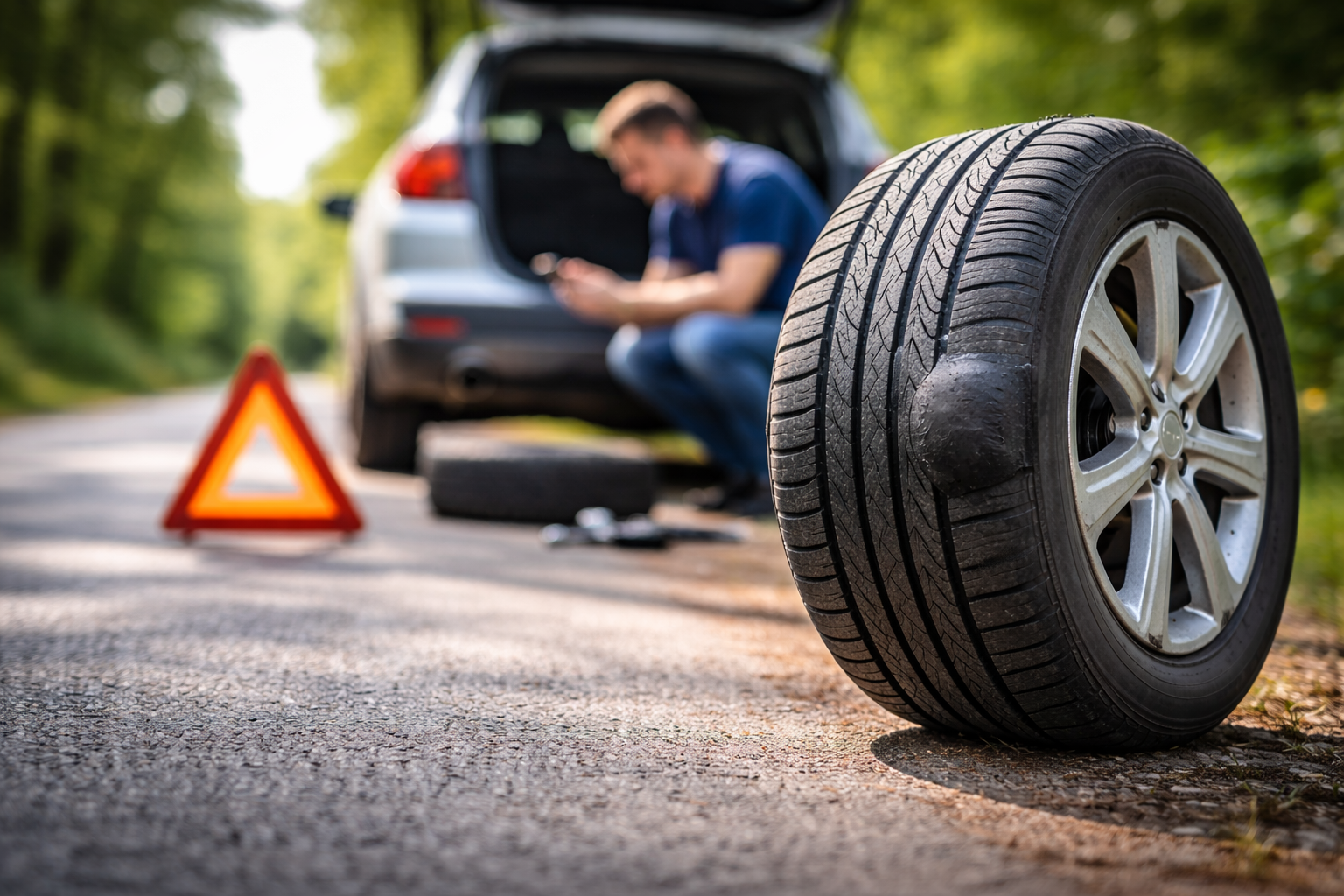
One deformed tyre can cause vibrations, a loss of comfort and less precise handling. In some cases, this defect can also indicate deterioration of the tyre's internal structure.
It is therefore important to recognise the warning signs quickly. A visual inspection of car tyres and a few simple checks can often identify the problem. However, only a professional will be able to confirm the diagnosis.
Summary
- What is a deformed tyre?
- Signs of a deformed tyre
- Common causes
- Risks and hazards
- Diagnostic: how to check step by step
- Solutions: what to do and when to replace
- Prevention: avoiding deformation
- Frequently Asked Questions
What is a deformed tyre?
A deformed tyre is a tyre that no longer maintains a perfectly regular shape when it rolls. The anomaly can affect the tread, the sidewall, the bead or the internal carcass.
In some cases, the deformation is visible. It can then take the form of a bulge, a hernia, a flat spot or an irregular area on the tread.
However, some damage remains invisible to the naked eye. An internal rupture, a separation of components or an ovalisation can thus cause vibrations without leaving any obvious trace.
Furthermore, a deformation must not be confused with a simple balancing problem. The symptoms may appear similar, but the causes and solutions are different. Mounting, balancing, and geometry play a particularly important role in the vehicle's behaviour.
To better understand the information on your tyres, consult the guide dedicated to Tyre marking.
2. Signs to detect a deformed tyre
A deformed tyre can manifest itself in several ways. Some symptoms appear while driving, while others are visible when the vehicle is stationary.
2.1. Vibrations while driving
First of all, a deformation can cause vibrations in the steering wheel. These often appear from a certain speed.
When the anomaly concerns a front wheel, vibrations are generally felt in the steering wheel. Conversely, if the rear wheel is affected, the jolts are more noticeable in the seat, floor, or bodywork.
The vehicle may also give the impression of bouncing. You then feel a regular rebound, as if the wheel were no longer perfectly round.
However, vibrations don't always prove the tyre is deformed. A poor Wheel balancing, a buckled rim or worn suspension part can cause similar symptoms. Correct balancing helps to limit vibrations and premature wear of mechanical components.
2.2. A less precise direction
Furthermore, a damaged tyre can alter the vehicle's handling. The steering may then feel less precise, and the car might pull slightly to one side.
Before concluding that there is a deformation, check the tyre pressure nonetheless. Incorrect Tyre pressure or a geometric defect may also explain this behaviour.
Similarly, a misaligned steering wheel or a car that consistently pulls to the right or left can indicate incorrect wheel alignment.
2.3. Unusual noises
Furthermore, be mindful of noises that change with speed. A regular tapping, humming, or droning sound could indicate a fault.
These noises are sometimes easier to hear on a smooth road. Conversely, worn tarmac can mask them.
A cyclical noise can come from a deformed tyre. However, uneven wear, a worn bearing, or poor balancing can produce a comparable noise.
2.4. A lump or a hernia on the flank
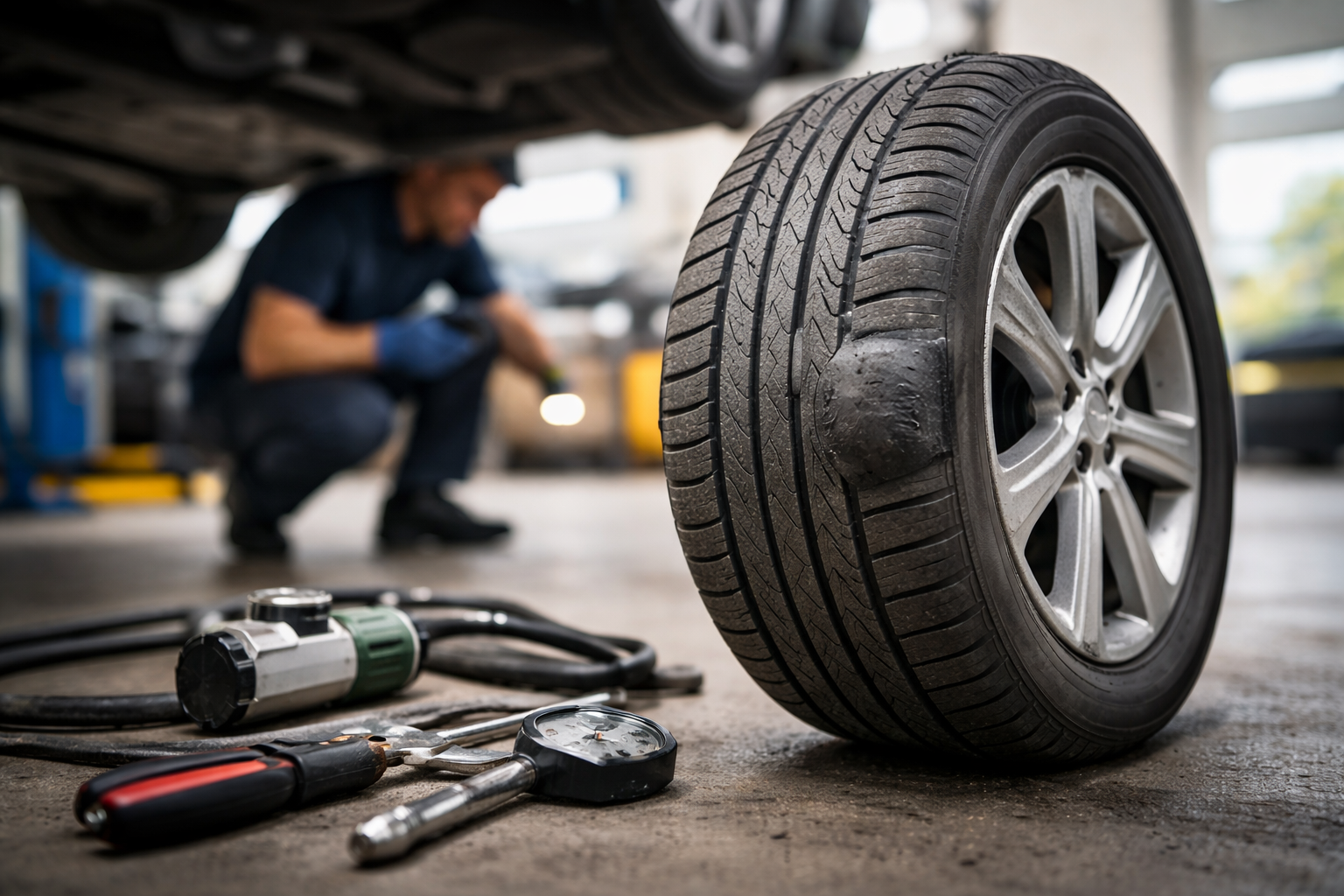
When stationary, carefully examine the sidewalls of each tyre. A localised bulge or hernia is an important warning sign.
This deformation can appear after a knock against a pavement, a kerb or a pothole. It often indicates that the internal structure of the tyre has been weakened.
In this case, avoid continuing to drive. The tyre must be checked by a professional as soon as possible. You can look for a tyre fitting centre near you.
2.5. A dish on the tread
A vehicle that has been stationary for a long period can develop a slight flat spot. The weight of the vehicle then rests on the same area of the tyre.
This phenomenon usually causes vibrations during the first few kilometres. In some cases, the tyre gradually regains its shape as it is driven.
However, if the vibrations persist after several kilometres, have the tyre checked. The flat spot may be permanent or hiding another problem.
2.6. Uneven wear
Finally, examine the entire tread. Smoother areas, flat spots, steps or a sawtooth wear pattern can indicate an anomaly.
This Tyre wear can originate from unsuitable pressure, worn shock absorbers or poor alignment.
More pronounced wear on one edge can also indicate a lack of parallelism. Conversely, wear in the centre is often associated with excessively high pressure.
3. Common causes
Tyre deformation can have several origins. Some causes are sudden, while others appear gradually.
3.1. A collision with an obstacle
Hitting a pothole, kerb or speed bump too quickly can damage the tyre carcass.
Even in the absence of a visible break, internal reinforcements can be weakened. A dent may then appear immediately or a few days after the impact.
After a significant impact, inspect the tyre, but also the Rims and wheels. A buckled wheel can cause vibrations and give the impression that the tyre is distorted.
3.2. Insufficient pressure
Under-inflation increases the deformation of the tyre on contact with the road. Consequently, the carcass works harder and the tyre heats up more quickly.
In the long term, excessively low pressure can accelerate wear, increase consumption and weaken the sidewalls.
It is therefore important to regularly check the Tyre inflation pressure. Checking should be carried out when the engine is cold, in accordance with the manufacturer's recommendations. Correct pressure, in particular, helps to limit overheating and maintain grip.
When the vehicle is equipped with it, the TPMS system can also signal a loss of pressure.
3.3. An excessive load
Each tyre has a maximum load it can support. When this limit is exceeded, the carcass is subjected to excessive stress.
The tyre can then sag, overheat and wear out more quickly. Furthermore, the vehicle's handling becomes less stable.
Before a busy departure, check the’tyre load index. Also, comply with the manufacturer's recommendations regarding pressure when the vehicle is carrying passengers or luggage.
The load and speed indices are defined to help choose a tyre suitable for the vehicle's characteristics.
3.4. Prolonged Immobilisation
When a vehicle remains parked for several weeks, its weight still rests on the same parts of the tyres.
Dishes can then appear. This phenomenon is often more pronounced when the tyres are underinflated or when temperatures are low.
To limit this risk, move the vehicle regularly when possible. Also, check the tyre pressure before a long period of inactivity.
3.5. An assembly defect
A tyre that is not correctly seated on the rim can rotate unevenly. The mounting line near the rim's edge will then be irregular.
Similarly, poor balancing can cause vibrations from the first few kilometres after fitting.
The tyre fitting It should therefore be entrusted to a trained and properly equipped professional. The direction of rotation, the position of the tyre and the balancing must be respected in particular.
3.6. A buckled or damaged rim
A rim can become deformed after a significant impact. In this case, the wheel no longer rotates perfectly smoothly.
The driver may then feel vibrations comparable to those of a deformed tyre.
Sometimes the rim is the only damaged part. However, the impact may also have weakened the tyre. A thorough inspection of the wheel is therefore essential.
3.7. Tyre ageing
Over time, rubber gradually loses its flexibility. Cracks or splits may then appear on the sidewall and between the grooves.
The tyre also becomes more sensitive to shocks and temperature variations.
However, age is not the only criterion to consider. Mileage, overall condition, storage conditions, and maintenance also play an important role.
4. Risks and dangers
Continuing to drive with a deformed tyre can affect the vehicle's handling. The level of risk, however, depends on the nature and severity of the damage.
4.1. Loss of grip
First, contact between the tyre and the road surface becomes less consistent. Grip can then decrease during braking, cornering or when performing an emergency manoeuvre.
On a wet road, this loss of stability can be even more noticeable. The condition of the tyre and the weather conditions directly influence the available grip level.
To better understand these phenomena, consult the Tyre grip guide.
4.2. Accelerated wear
Next, the tread wears out unevenly. Some areas bear more stress and deteriorate faster.
Consequently, the tyre's lifespan decreases. Uneven wear can also make the vehicle noisier and less comfortable.
4.3. Persistent vibrations
Furthermore, vibrations can stress the bearings, shock absorbers, steering, and suspension components.
Even though they may seem minor, they should not be ignored. Incorrect balancing can, in particular, lead to premature wear of tyres and certain mechanical components.
4.4. Higher consumption
A deformed or under-inflated tyre increases rolling resistance. The engine then has to exert more effort to maintain speed.
Fuel consumption may therefore increase. Furthermore, the vehicle loses in terms of comfort and handling precision.
4.5. A risk of tyre failure
Finally, a hernia, delamination or internal deterioration can severely weaken the tyre.
The risk increases with speed, load and heating. Therefore, a visible bulge on the sidewall should never be taken lightly.
If you experience strong vibrations or a bump in a tyre, slow down gradually. Then, stop in a safe location and request a professional inspection.
5. Diagnosis: how to check step by step
You can perform several simple checks before going to a garage.
5.1. Step 1: Visually inspect the tyres
Begin by parking the vehicle on a level surface. Apply the handbrake, then turn off the engine.
Next, examine each flank. Specifically look for:
- a lump ;
- a hernia ;
- a cut ;
- a crack ;
- an unusually bulging area; ;
- gum recession.
Also observe the tread. Its wear level it should remain as regular as possible across the entire width.
Finally, look at the line situated near the edge of the rim. It should remain regular all the way around the wheel.
5.2. Step 2: Checking pressure and load
Measure the pressure when the tyres are cold. The vehicle should not have completed a long journey just before checking.
Next, compare the value obtained with the manufacturer's recommendations. These are usually found in the vehicle's manual, on the door or near the fuel filler flap.
Also, take the opportunity to check that the vehicle is not overloaded. Always respect the load and speed indices indicated for your vehicle.
5.3. Step 3: identify when vibrations appear
During a careful journey, note the conditions under which the problem manifests itself:
- Do vibrations start at a specific speed?
- Are they present from the start?
- Are they felt in the steering wheel or the seat?
- Does the noise increase with speed?
- Does the vehicle pull to one side?
- Did the problem occur after an impact?
- Do the vibrations disappear after a few kilometres?
These details will help the professional to guide their diagnosis.
5.4. Step 4: Differentiate deformation, balancing and geometry.
An imbalance often causes vibrations within a specific speed range.
Conversely, a deformation can produce a regular bounce, a cyclic noise, or a feeling of an oval wheel.
A geometry fault tends to cause abnormal wear on one edge of the tyre. The vehicle may also pull to one side or have a misaligned steering wheel.
However, these symptoms can combine, making it difficult to establish a reliable diagnosis without professional equipment.
5.5. Step 5: Get the wheel checked at the workshop
Finally, go to a garage or a fitting centre. The professional will be able to spin the wheel on a balancing machine.
He will check, among other things:
- wheel balancing ;
- tyre ovalisation ;
- the rim veil ;
- tyre seat on the rim ;
- the condition of the carcass; ;
- the condition of the shock absorbers ;
- wheel alignment.
You can find a professional through the network of Pneus Online partner fitting centres. Pneus Online offers a network of partner garages for tyre delivery and fitting.
6. Solutions: what to do and when to replace
The solution depends on the type of deformation and its origin.
6.1. In case of a temporary flat tyre
After prolonged immobilisation, a slight flat spot can gradually disappear.
Drive a few kilometres at a moderate speed. Then, check if the vibrations lessen.
However, stop if the shaking is significant. If it persists, have the wheels checked.
6.2. In case of a lump or hernia on the flank
A bulge on the sidewall generally indicates a weakening of the internal structure of the tyre.
In this situation, the tyre must be checked without delay. Replacement is most often necessary.
Don't try to fix the dent. Likewise, don't keep riding just to «finish the season».
6.3. In the event of uneven wear
Facet wear can be caused by the shock absorbers, the balancing, or the geometry.
Therefore, we must first investigate the cause of the problem. Otherwise, the new tyre risks wearing out in the same way.
Next, the professional will determine if the tyre can still be used. When the wear is too significant, its replacement becomes necessary.
6.4. In case of a buckled rim
A slightly buckled wheel can sometimes be repaired by a specialist. In other cases, it needs to be replaced.
However, the tyre must also be inspected. Indeed, the impact that caused the damage may have compromised its structure.
After the wheel rim has been repaired or replaced, it will require rebalancing.
6.5. In the event of faulty installation
When the tyre is incorrectly positioned on the rim, a professional can sometimes correct the fitting.
The wheel must then be dismantled, inspected, reassembled and balanced.
However, this repair is only possible if the tyre has not sustained any structural damage.
6.6. When must the tyre be replaced?
Replacement becomes indispensable in several situations:
- a lump or hernia appears on the flank; ;
- the rubber is peeling away from the carcass ;
- a deep cut is visible; ;
- The internal structure appears to be damaged. ;
- The deformation is confirmed on a wheel balancer. ;
- The vibrations persist despite correct balancing. ;
- The tyre sustained a violent shock. ;
- the wear has reached a dangerous level.
Before your purchase, consult the recommendations for changing your tyres.
Check also the Your tyre dimensions, their load index and their speed rating.
You can then search for car tyres suitable for your vehicle. Pneus Online notably allows you to select tyres based on their dimensions, season, and manufacturer.
When two tyres need replacing, also check the condition of the two tyres on the same axle. Always follow the fitting rules and the manufacturer's recommendations.
7. Prevention: avoiding deformation
A few simple habits help reduce the risk of deformation.
7.1. Check the pressure regularly
Check the tyre pressure about once a month. Also carry out this check before a long journey or when the vehicle is heavily laden.
Always use the manufacturer's recommended values. Furthermore, measure the pressure when the tyres are cold.
Appropriate pressure helps to limit overheating, irregular wear, and loss of grip.
7.2. Avoiding shocks
Slow down when approaching a pothole, kerb, or speed bump.
A shock, even at moderate speed, can weaken the carcass or deform the rim.
After a significant impact, quickly inspect the wheel. Also remain attentive to the appearance of unusual vibrations or noises.
7.3. Respect the maximum load
Do not exceed the intended capabilities of the vehicle and tyres.
Before going on holiday, distribute luggage evenly. Also adjust tyre pressure if recommended by the manufacturer.
Finally, check the information on the sidewall using the dedicated guide for the Reading tyre markings.
7.4. Have balancing checked
A balancing must be performed when fitting a tyre to a wheel rim.
Furthermore, book an appointment if any vibrations appear after a tyre change.
Balancing concerns both the front and rear wheels. It helps to limit vibrations and premature wear.
7.5. Have the alignment checked
Poor geometry often leads to uneven wear.
Get it checked if the vehicle pulls to one side, after an impact, or if the tyres are wearing quickly on one edge.
Correct geometry also helps to improve road-holding and extend tyre life.
7.6. Storing tyres correctly
Finally, store the removed tyres in a dry, cool, and dark place.
Keep them away from heat sources, chemicals, and ozone-producing appliances.
Before storing, clean the tyres and remove any stones from the grooves. Pneus Online particularly recommends storing them in a cool, dry place protected from the sun.
Find all the useful precautions in the guide dedicated to Tyre fitting and storage.
8. FAQ
8.1. What are the most common symptoms of a deformed tyre?
The most frequent signs are vibrations, cyclic noises, and bouncing sensations.
Uneven wear, a bulge or a hernia may also appear.
However, these symptoms can have other causes. An inspection at a workshop is therefore still recommended.
8.2. Is it dangerous to drive with a deformed tyre?
Yes, especially when the carcass or the flank is damaged.
The tyre can lose stability and become more vulnerable to failure.
In case of a visible hernia or bulge, do not continue your journey. Have the tyre checked quickly.
8.3. How to differentiate a deformed tyre from poor balancing?
An imbalance often causes vibrations within a specific speed range.
Conversely, a deformation can produce a regular bounce, a cyclic noise, or a feeling of an oval wheel.
However, only a check on a wheel balancer can confirm the origin of the problem.
8.4. Can a deformed tyre be repaired?
A structural deformation generally does not repair itself. This is particularly the case with a hernia, an internal rupture, or a detached callus.
Conversely, a mounting, balancing or rim problem can sometimes be corrected if the tyre remains intact.
8.5. What to do after hitting a pothole?
After the shock, inspect the tyre and the wheel rim.
Also check the pressure and remain attentive to vibrations, noises or changes in the vehicle's behaviour.
If a bulge, cut, or crack appears, do not continue your journey. Get the wheel checked without delay.
8.6. Is it possible to drive with a slightly oval tyre?
It is best to seek professional advice.
Even slight ovalisation can cause vibrations and accelerate tyre wear.
Furthermore, its origin must be identified before normal operation can resume.
8.7. Can a pressure drop cause deformation?
Yes. Insufficient pressure accentuates tyre flattening and increases its heating.
In the long term, under-inflation can weaken the casing and promote irregular wear.
Check regularly the your tyre pressure.
8.8. Where to get a deformed tyre checked?
You can go to a garage, a tyre specialist, or a Partner fitting centre.
The professional will be able to check the tyre, wheel rim, balancing, alignment and suspension components.