
Connected cars: when vehicles talk to each other to avoid accidents
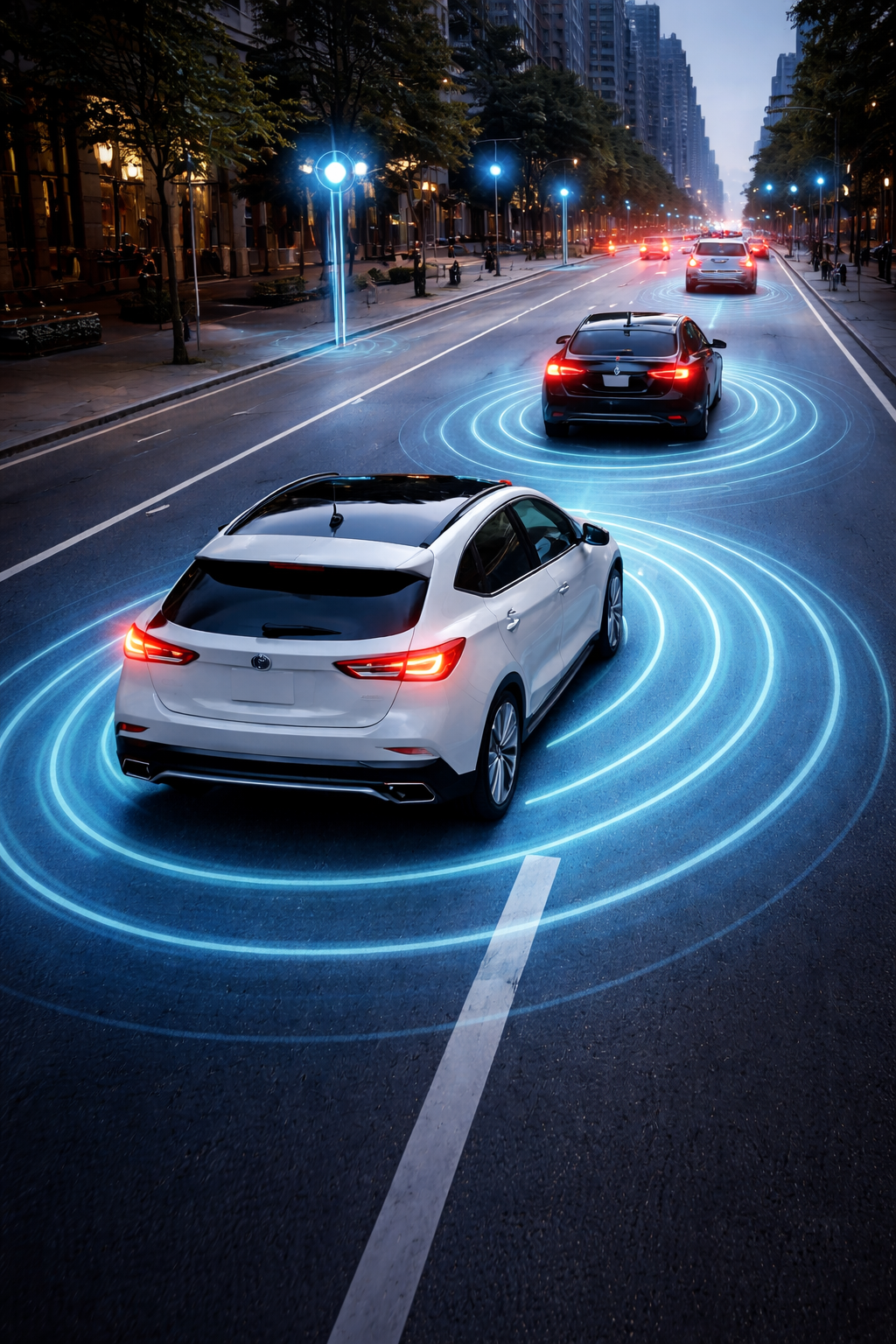
The Connected cars are no longer a science fiction concept: they are already in the testing phase and could become the norm in the coming years. Thanks to technologies Vehicle-to-Vehicle (V2V) and C-V2X (Cellular Vehicle-to-Everything), vehicles can now communicate with each other and with their surroundings to avoid collisions, improve traffic flow, and enhance the safety of the most vulnerable road users.
In this article, we explore in depth this mobility revolution, its advantages, its challenges, and its future.
🚗 A new era for road safety
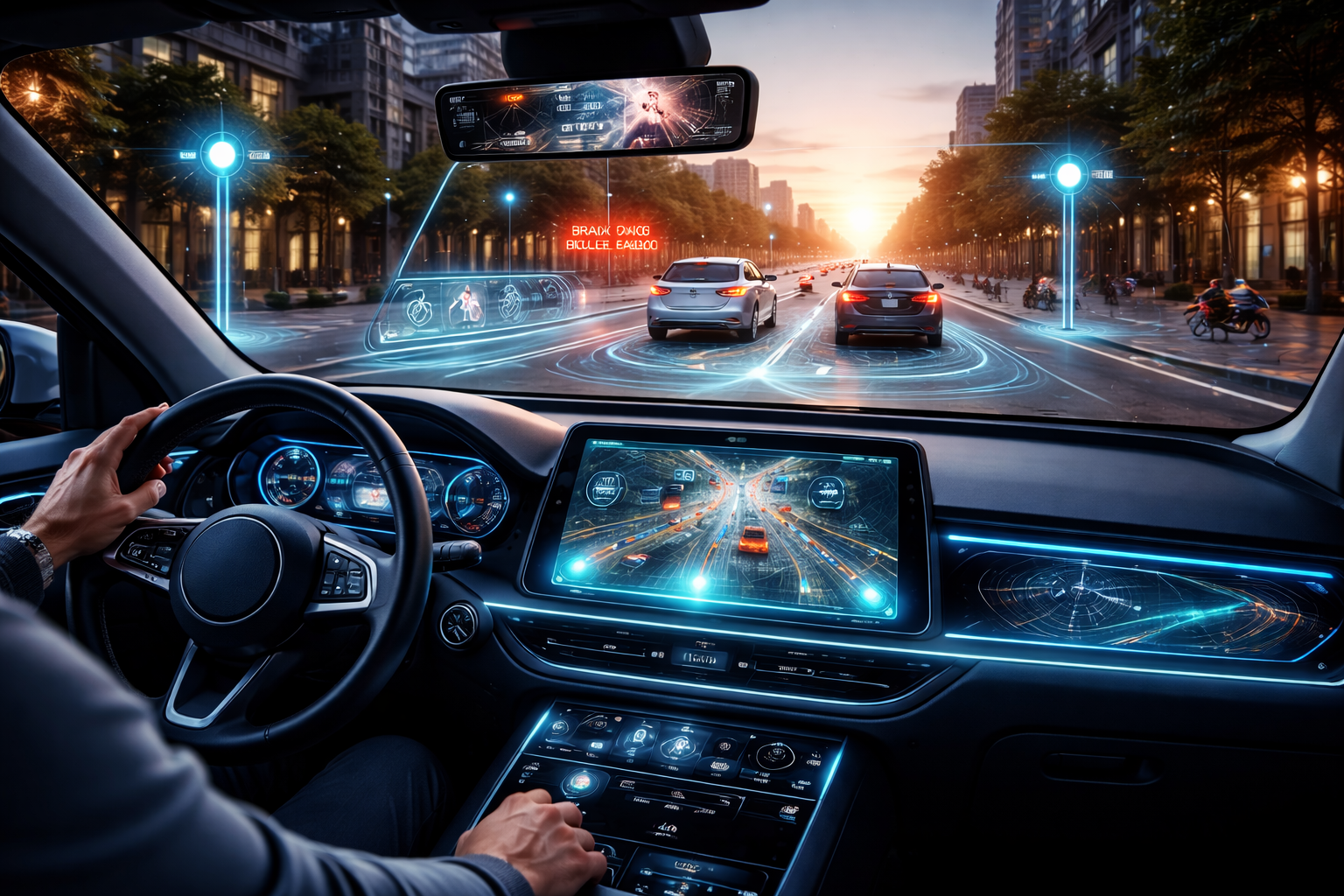
Imagine you're driving and suddenly your car alerts you that a vehicle is braking sharply 200 metres ahead.
You haven't yet seen the danger, but your car has already anticipated it. This is precisely what the systems allow V2V and C-V2X.
This technology promises to save thousands of lives each year, by drastically reducing accidents caused by a lack of information or visibility.
✅ The tangible benefits for drivers
1. Fewer accidents
Early warnings make it possible to react before an accident becomes unavoidable.
According to several studies, the widespread adoption of V2V could reduce 80 %: collisions involving several vehicles.
2. Greater fluidity
Connected vehicles can automatically adapt their speed, thus avoiding slowdowns and chain traffic jams.
3. Enhanced safety for vulnerable road users
Pedestrians and cyclists equipped with sensors or connected smartphones are detected even when outside the driver's field of vision.
This reduces the risk of urban accidents.
4. More relaxed driving
With more anticipation and fewer surprises, driving becomes less stressful. This also improves comfort on long journeys.
🌍 Europe could make this technology mandatory
In the United States, the NHTSA is already working on regulations mandating V2V for new vehicles.
In Europe, the idea is gaining ground: it's possible that in a few years, every new car will integrate a module C-V2X of a series.
This would place Europe at the forefront of global road safety, with a clear objective: to reach the zero accidents.
🚧 The challenges to be faced
- Standardization: All manufacturers must use a common language so that vehicles can be understood.
- Data protection: The information must be secure to prevent hacking or abuse.
- Adapted infrastructure: routes, lights and signs will need to be connected to interact effectively.
- Massive adoption: The more vehicles are equipped, the more effective the system is.
🔧 Pneus Online supports this development
At Pneus Online, We consider that technology C-V2X is a major step towards the goal of «zero accidents».
We are closely following its development and will support our customers in this transition towards a more secure and connected mobility.
Our mission: to provide not only high-performance tires, but also expertise adapted to this new era of intelligent driving.
📌 To remember
- Communication between vehicles is already being tested and could become mandatory in the coming years.
- It saves lives, reduces traffic jams and protects pedestrians and cyclists.
- Its success will depend on standardization, data security, and its mass adoption.
And what if tomorrow your car became your best ally in avoiding dangers?
❓ FAQ – Connected cars and road safety
What is V2V?
The V2V is a technology for direct communication between vehicles, allowing the instantaneous exchange of information
like speed, direction or emergency braking.
Quelle est la différence entre V2V et C-V2X ?
The V2V relates only the vehicles to each other, while the C-V2X also includes infrastructure,
pedestrians and traffic management systems thanks to 4G/5G networks.
Will this technology be mandatory?
In the United States, the NHTSA is already considering a mandate. In Europe, the idea is being seriously considered for the coming years.
What are the main benefits for drivers?
Fewer accidents, more fluidity, better protection for pedestrians and cyclists, more relaxed driving.
What are the current limitations?
Standardisation, cybersecurity, and mass adoption remain major challenges before full widespread adoption.
Are connected cars already a reality?
Yes, several manufacturers are already testing these systems, and some high-end cars already incorporate advanced communication modules.
What role does 5G play in this revolution?
The 5G is essential to enable ultra-fast and reliable exchanges, which are necessary for real-time security.
✅ Conclusion
The technologies V2V and C-V2X They transform road safety by circulating information faster than the human eye can process it: emergency braking, danger out of sight, vulnerable road users, traffic.
For this promise to become a reality on a large scale, progress will be needed in the following areas: Standardization, the Cybersecurity and the’massive equipment vehicles and infrastructure.
By then, understanding these systems already makes it possible to choose your vehicle better… and to anticipate the mobility of tomorrow.


⚙️ How does it work?
V2V technology
The V2V relies on direct data exchange between vehicles, via a short-range connection.
Imagine ultra-fast Wi-Fi, but specifically designed for automobiles. Each vehicle emits real-time information such as its speed, trajectory, or intentions (braking, lane changes).
C-V2X technology
The C-V2X it goes further: it relies on 4G and 5G cellular networks to extend its reach and connect:
The information exchanged includes: