

 Belgique (français)
 Canada (english)
 Deutschland
 España
 France
 Ireland
 Italia
 Luxembourg (français)
 Nederland
 Portugal
 Schweiz (deutsch)
 United Kingdom
 Österreich


What if I put winter tyres on my vehicle?
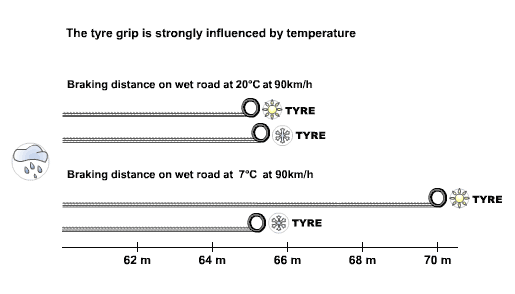
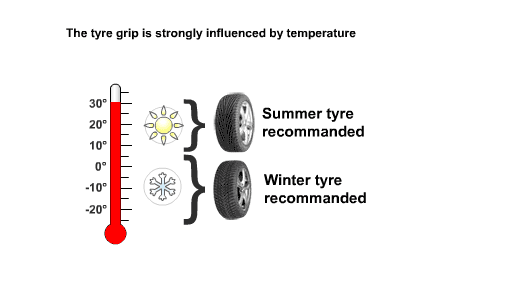
From the moment the thermometer registers a temperature below 7°C, a summer tyre’s performance decreases. The aim of winter tyres is to give your vehicle optimum grip in cold weather. Here is what you need to know about winter tyres.
Winter tyres: definition
They differ technically from summer tyres in:
- the different rubber density, which does not harden at low temperatures
- the higher number of sipes
- deeper and wider grooves in the tread
Tangible benefits
We recommend fitting winter tyres from November up to and including March. This recommendation applies especially for motorists who are likely to travel to regions where the weather conditions in winter are harsh.
1. Road holding
Below the fateful threshold of 7°C, rubber no longer has the same properties and tyres’ and vehicles’ responses are affected. By not hardening, winter tyre rubber gives your vehicle better grip on the road surface at very low temperatures.
2. Braking and driveability
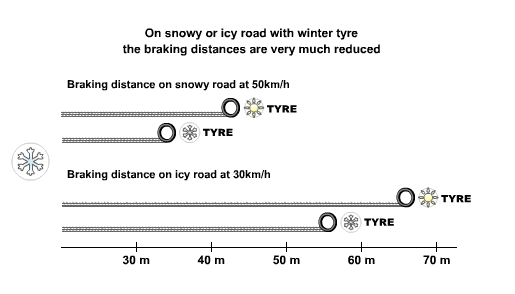
Thanks to their numerous characteristic sipes, tyre grip is optimised and braking distances in winter conditions are reduced.
Winter tyres offer better traction on snow and patches of ice, even for the heaviest vehicles (4x4s, utility vehicles, etc.).
3. Overall safety
Despite all the technological brake assist, lane assist and other vehicle anti-skid system (ABS, ESP, ASR, etc.) innovations, their usefulness may only be optimal in winter if the vehicle is fitted with winter tyres, which instantly expel slush and snow. With summer or all-season tyres, the performance of these systems is markedly lower. Whatever the weather conditions (snow, ice, rain, etc.), winter tyres allow you to drive safely.
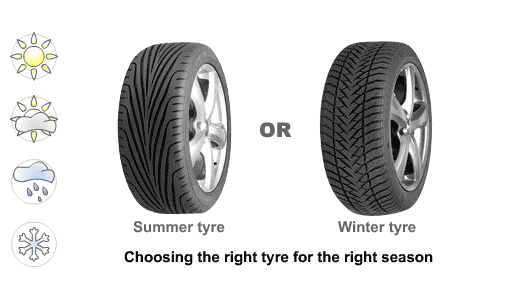
What does a winter tyre look like?
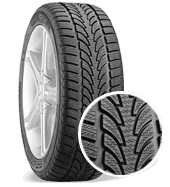
- A winter tyre can be distinguished from a summer tyre by the density of its rubber. Unlike with a summer tyre, the rubber on a winter tyre does not harden and therefore gives the tyre a better grip on the road at very low temperatures.
- Because of the greater number of grooves, the traction of a winter tyre will also be better than that of a summer tyre when driving on an icy, snowy or wet road.
- In addition to the higher number of grooves, a snow tyre is also equipped with deeper tread patterns on its contact surface, enabling it to shed mud and snow instantly.
An alternative to chains
The aim of chains is to penetrate deep into the layer of snow and prevent it collecting on the tyre. This could have the consequence of destroying all grip, or even clogging the wheel arches, making it impossible to move the vehicle. This is particularly true where the vehicle is fitted with summer tyres.
The aforementioned characteristics and performances of winter tyres avoid the need to fit chains in 99% of cases.

REMINDER:
Chains are only permitted on snow-covered roads, whatever the time of year, and in France on stretches of roads with a B26 “special equipment mandatory” sign.
The production of snow chains has been subject to new standards since 31st March 1986. Nevertheless, the use of chains purchased before this date is permitted.
Their use is not regulated. However, on stretches with a B26 sign, if “snow tyres permitted” is not stipulated, the driver must use chains.
Attention!
It is essential:
- that you never drive at speeds above 25 k.p.h. with chains fitted.
- Remove chains when there is no snow on the road at the risk of damaging both the wheel (tyre, rim) and the vehicle itself (wheel arches, bodywork, etc.).
There is an alternative to the classic steel chain: the textile chain, recommended as ideal for narrow wheel arches.
Watch out for wear
Regulations governing the minimum thickness of fit-for-use winter tyres varies depending on the European country. In Austria, Bulgaria and Sweden, rubber thickness must not be less than 3 or 4 mm. In France, this thickness can fall to 1.6 mm. To help you set a reasonable alert threshold, Pneus Online is sharing the results of a UFC-Que Choisir study published on 14th November 2023.
It reveals, backed by tests, that a winter tyre has lost 80% of its performance at a threshold of 2.5 mm, in comparison to the same model when new. Among the most direct consequences of this are lower resistance to aquaplaning and braking distances that have deteriorated by 20%. We learn from this that up to a thickness of 4 mm, tyres retain their maximum quality: Pneus Online advises you to keep this threshold in mind for safe driving.
WHAT YOU NEED TO KNOW
Most of us refer to the TWI (Tread Wear Indicator): this is a pattern of small crosswise bars spaced evenly around the circumference of a tyre in the longitudinal grooves. When this indicator is level with the tread, it's time to replace the tyre.
Some winter and all-season tyres also have a second indicator, which does not necessarily have any legal value but provides another depth marker, generally at 4 mm. Its position is highlighted by the presence of a snowflake on one side of the tyre.