The best tyres for commercial vehicles: robustness, longevity and performance
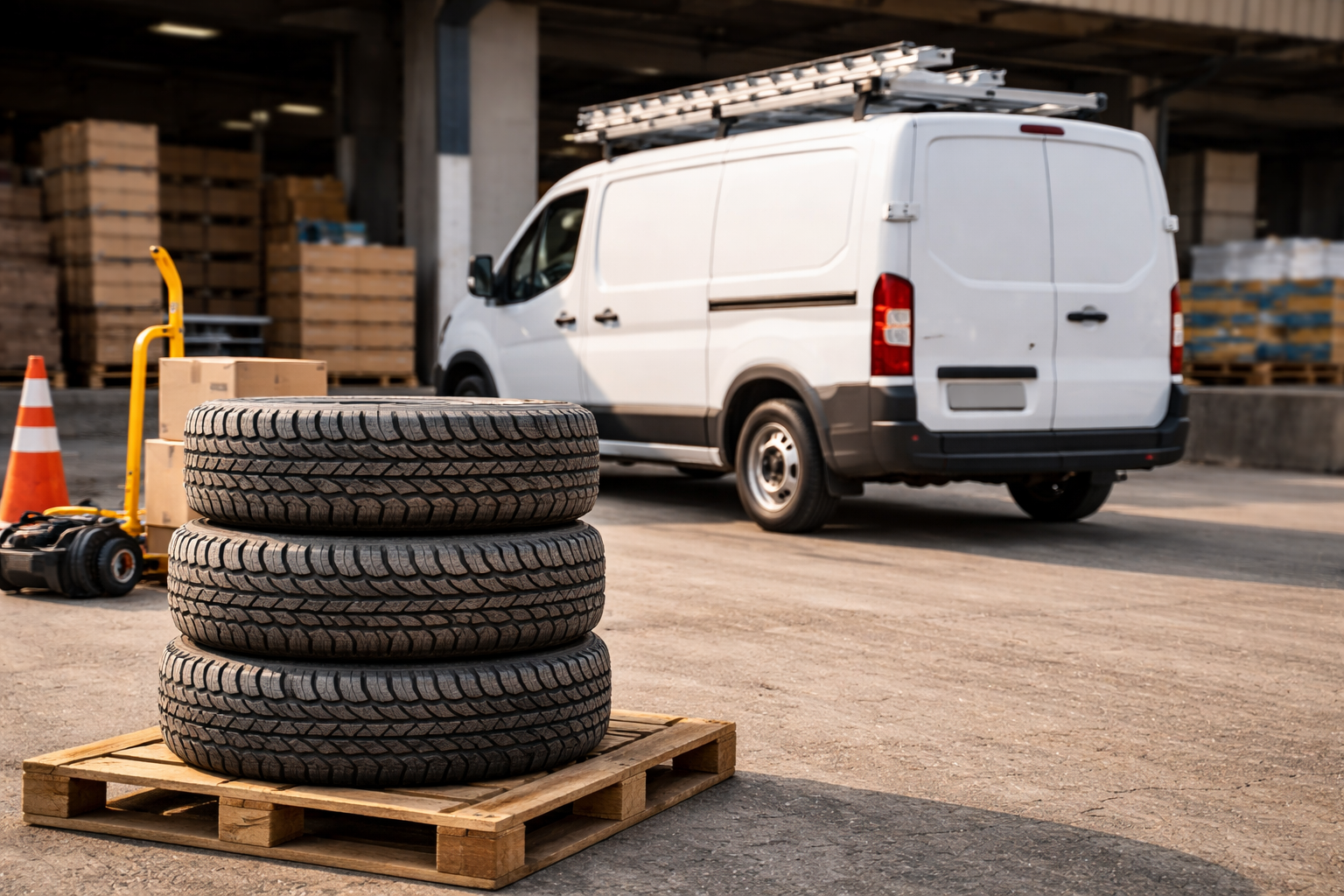
For a professional, choosing the best tyres for a commercial vehicle is not just about finding the right size. A van, light commercial vehicle or site vehicle often runs loaded, clocks up miles, makes frequent stops and has to remain reliable whatever the conditions.
The right commercial vehicle tyre must therefore combine several qualities: a strong carcass, an appropriate load capacity, even wear, good grip on wet roads and a mileage yield consistent with your business activity.
Sir
Pneus Online France,
You can search for your tyres by size or by vehicle, compare available models and choose a delivery and fitting solution suited to your professional needs.
Need to replace your tyres quickly?
Go straight to
Pneus Online car and van tyre catalogue
to check the available models in your dimension.
1. Why choose specific tyres for a commercial vehicle?
A commercial vehicle does not experience the same stresses as a passenger car. It carries equipment, goods or tools, sometimes runs fully loaded, and performs numerous starts, braking manoeuvres and turns.
Tyres intended for commercial vehicles are designed to meet these requirements through:
- a reinforced structure ;
- a greater load capacity; ;
- better resistance to overheating; ;
- a design suited to heavy-duty use ;
- greater stamina on business trips.
Before placing any order, always check the approved tyre size and the ratings required by the manufacturer. The Pneus Online guide dedicated to
load and speed indices
helps you understand the numbers and letters written on the sidewall of the tyre.
2. Essential criteria for choosing the right commercial vehicle tyres
2.1. The load index
This is the first criterion to check. A commercial vehicle rarely runs empty and its load can vary significantly during the course of a single day.
The load index must be at least equal to that recommended by the manufacturer. An insufficient index can cause accelerated wear, excessive heating and a deterioration in handling.
To check your watch, consult the
Tyre Leader load index table.
2.2. The type-approved dimension
A tyre's size is not limited to its diameter. The width, sidewall height, structure, rim diameter, load index and speed rating must all be compatible with the vehicle.
If in doubt, find the complete method in the guide
How to choose your tyres
or consult the
Technical advice Pneus Online.
2.3. Wear resistance
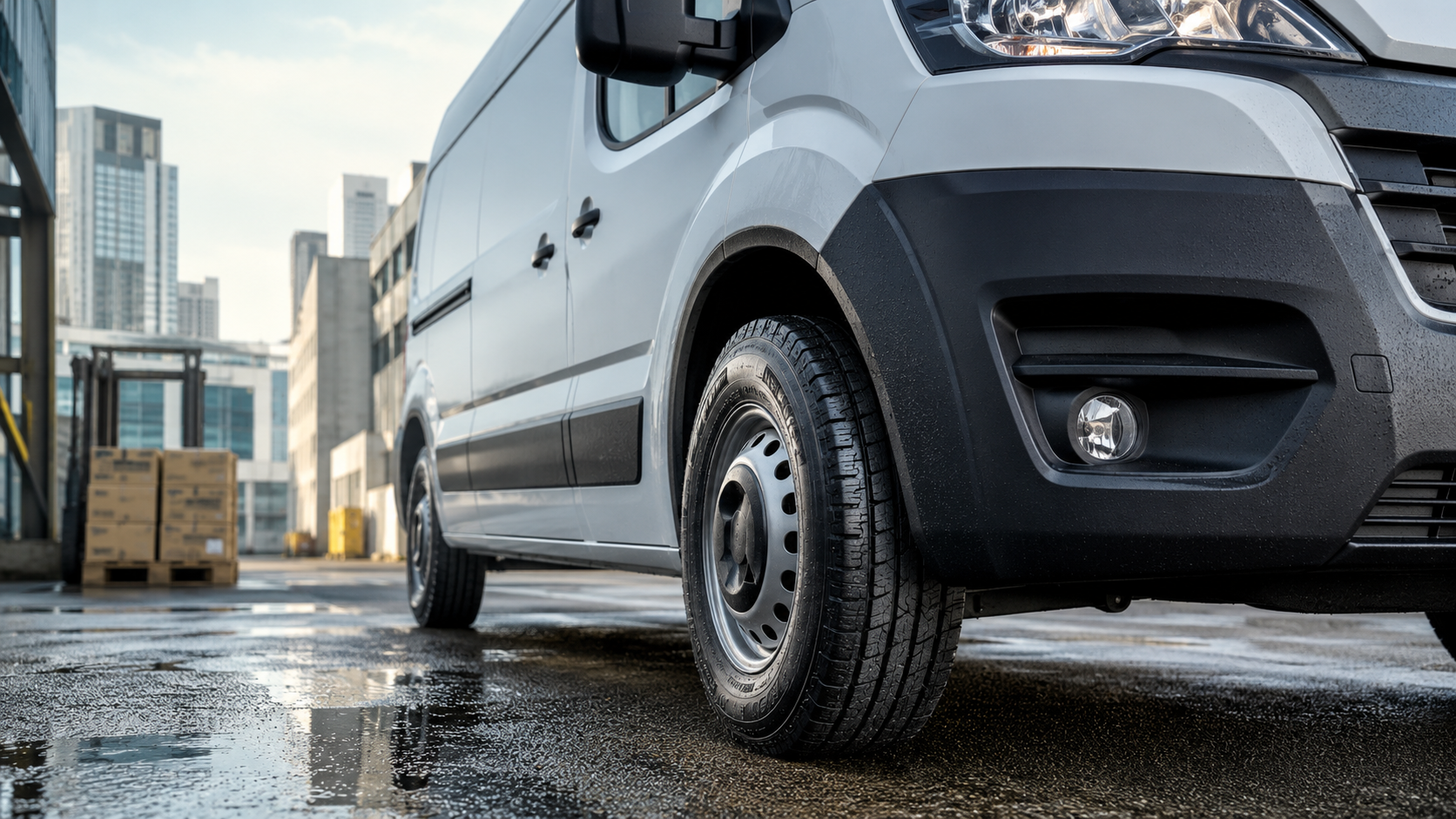
For a professional, tyre life directly influences a vehicle's operating costs. An ill-suited model can wear out quickly, particularly in urban areas where starting, braking and steering manoeuvres are more frequent.
It is therefore important to look for a good balance between longevity, safety and driving comfort, rather than just focusing on the purchase price.
2.4. Wet road grip
A laden commercial vehicle must maintain stable behaviour in the rain. Wet grip plays a major role during braking, in corners and during emergency manoeuvres.
The European label makes it easier to compare several products. To understand it better, consult the guide to
European tyre label.
2.5. The type of journeys
The best van tyre depends primarily on the actual use of the vehicle:
| Professional use | Qualities to prioritise | Solution to be found |
|---|---|---|
| Urban delivery | Resistance to frequent stops, grip, durability | Rugged and versatile utility tyre |
| Motorway and long distances | Stability, low wear, comfort, efficiency | High-mileage tyre |
| Difficult site and access | Reinforced carcass, strong sidewalls | Reinforced van tyre |
| Mixed use | Versatility, safety, endurance | Balanced summer or all-season tyre |
| Cold or mountainous regions | traction, braking on snow, winter certification | Winter or 3PMSF all-season tyre |
3. Why is robustness essential?
Robustness is not just about the ability to support a high load. It also refers to the tyre's resistance to the hazards of everyday life: kerbs, damaged road surfaces, site access, secondary roads, repeated braking and load variations.
A robust commercial vehicle tyre typically features a casing designed for professional use, sidewalls capable of better absorbing stresses and a tread pattern intended for intensive use.
For tradespeople, hauliers, technicians, maintenance companies or delivery fleets, a well-suited tyre helps to limit downtime and premature replacements.
4. Which commercial vehicle tyres to choose according to your business?
4.1. For an urban delivery van
In town, tyres are subjected to heavy wear from frequent stopping, restarting, parallel parking, roundabouts and occasional contact with kerbs.
Prefer:
- a sturdy carcass ;
- good grip in the wet ;
- regular wear ;
- a profile suited to stop-and-go use.
An all-season model can be useful when the vehicle is driven all year round in a region with a moderate climate. You can notably compare the
Continental VanContact 4Season,
a
Kleber Transpro 4S
or
Petlas VanMaster All Season.
4.2. For a van that is driven mainly on the motorway
Over long distances, stability, comfort, rolling resistance and even wear become top priorities.
A quality commercial summer tyre can offer an excellent compromise for vehicles travelling many miles on dry and wet roads. The
Michelin Agilis 3
serves for example as a reference to compare according to the size and characteristics required by your vehicle.
4.3. For a construction site utility vehicle
On degraded access routes, industrial zones, or construction sites, the priority is carcass and sidewall resistance.
The choice must take into account:
- of the laden vehicle weight; ;
- on the frequency of journeys on damaged roads; ;
- of the risk of shocks and cuts; ;
- of the proportion of on-road driving compared to technical access routes.
In this context, it is particularly important to observe the recommended pressure and regularly check the condition of the sidewalls.
4.4. For a craftsman with mixed-use premises
This is the most common usage: city, road, outskirts, motorway and sometimes light construction work.
A versatile, durable and safe tyre will generally be the best choice. Depending on your region, you can opt for a summer tyre combined with a winter set, or a winter-approved all-season tyre.
To discover more references, check the page
Tyres all makes.
5. Summer, winter or all-season tyres for a van?
5.1. Van summer tyres
Summer tyres are suited to mild and warm temperatures. They are particularly suitable for professionals who drive mainly on roads and motorways in regions with little exposure to snow.
They usually offer:
- good stability on dry ground; ;
- grip suited to summer rain; ;
- controlled wear ;
- an attractive return on high mileages.
The
Michelin Agilis 3
and the
Continental VanContact AP
are among the summer utility models to compare on Pneus Online based on your size.
5.2. Van winter tyres
Winter tyres are recommended for professionals who drive in cold, mountainous or regularly snow-covered regions.
They are designed to retain greater flexibility at low temperatures and improve handling and braking in winter conditions.
Among the models available for comparison, you can view:
- a
Continental VanContact Winter ; - a
Dunlop Econodrive Winter ; - a
Pirelli Carrier Winter ; - a
Matador Nordicca Van.
5.3. All-season van tyres
All-season tyres are a practical solution for activities that require you to drive all year round without having to change your tyres twice a year.
They may be suitable when:
- the climate remains mild; ;
- snowfall is occasional; ;
- the vehicle is used for a variety of journeys; ;
- the company wants to simplify the management of its fleet.
Always check for the 3PMSF marking when you need winter certification. On Pneus Online, you can compare several models, including the
Continental VanContact 4Season,
a
Kleber Transpro 4S,
a
Barum Vanis All Season
or
Petlas VanMaster All Season Plus.
6. How can you extend the service life of commercial vehicle tyres?
6.1. Check the pressure regularly
Under-inflation accelerates wear, increases heat build-up and can impair vehicle stability. On a commercial vehicle, tyre pressure must be checked with even greater care when the load varies frequently.
Tyre pressure should be checked when the tyres are cold and set in accordance with the manufacturer’s recommendations. Find out the right steps to take in the Pneus Online guide on
tyre pressure.
6.2. Observe the maximum load
A frequently overloaded vehicle wears out its tyres more quickly and compromises safety. Always respect the vehicle limits and the ratings marked on the tyres.
6.3. Checking wheel alignment and balancing
Incorrect wheel alignment can lead to rapid and uneven tyre wear. Have the vehicle checked when:
- the steering wheel is no longer straight; ;
- the van pulls to one side; ;
- a tyre wears out more on one side; ;
- Vibrations occur at certain speeds.
6.4. Inspect the sidewalls and the tread
Utility vehicles are particularly vulnerable to impacts with kerbs and poor road surfaces. Check regularly for any cuts, bulges, deformations or embedded objects.
6.5. Adopt a more flexible approach
Anticipatory driving reduces sudden braking, abrupt acceleration and sharp changes of direction. It extends the life of your tyres and can also reduce the vehicle’s fuel consumption.
7. Ordering and having your van tyres fitted with Pneus Online
Once the correct part number has been identified, you can order your tyres directly from
Pneus Online France.
The site notably allows you to:
- search for tyres matching your size or vehicle; ;
- compare several brands and price points; ;
- view the models' features and availability; ;
- discover the
tyres currently on promotion ; - choose a delivery method suited to the options offered; ;
- find a professional in the network of
Pneus Online fitting centres.
In certain eligible areas, it is also possible to consult the service of
mobile tyre fitting at home or at your workplace.
Online Tyre Advice:
Before confirming your order, check the full dimensions on the sidewall of your current tyre and verify the manufacturer's recommendations. Never choose solely based on price or rim diameter.
8. Conclusion: what are the best tyres for a commercial vehicle?
The best commercial vehicle tyres are those that are precisely suited to your vehicle, your load, your mileage, your journeys and the weather conditions you encounter.
For professional use, four criteria must remain a priority:
- the conformity of the dimension and the ratings; ;
- the robustness of the shell ;
- the longevity and regularity of the wear; ;
- grip under real-world conditions of use.
Comparing the references on
Pneus Online,
You can choose a model suited to your business, check the available features and organise delivery and assembly more easily.
Find your van tyres right now on
Pneus Online France
and get back on the road with tyres tailored to your professional requirements.
9. FAQs: Tyres for commercial vehicles
9.1. Which tyres should you choose for a commercial van?
Choose commercial tyres that are compatible with the approved size, load index and type of journey. For a commercial van, durability, endurance and grip on wet roads are generally the top priorities.
9.2. Why is the load index so important?
Because a commercial vehicle often carries heavy or variable loads. An insufficient rating can accelerate wear, cause excessive heat build-up and impair handling.
9.3. Are all-season tyres suitable for commercial vehicles?
Yes, in many cases, particularly for year-round use in a temperate climate. However, you must choose a model designed for vans and check for the 3PMSF marking when winter type approval is required.
9.4. When should you fit winter tyres?
They are particularly recommended for vehicles that are regularly driven in cold, snowy or mountainous regions. They improve traction and braking performance when temperatures drop.
9.5. How can the service life of commercial vehicle tyres be improved?
Check the tyre pressure when the tyres are cold, stick to the maximum load, monitor the tyre alignment, inspect the sidewalls and adopt a smoother driving style.
9.6. Where to order van tyres online?
You can compare and order your tyres at
Pneus Online France,
can I search for a
Partner fitting centre
near you.