How to read a tire: tips, dimensions, homologations
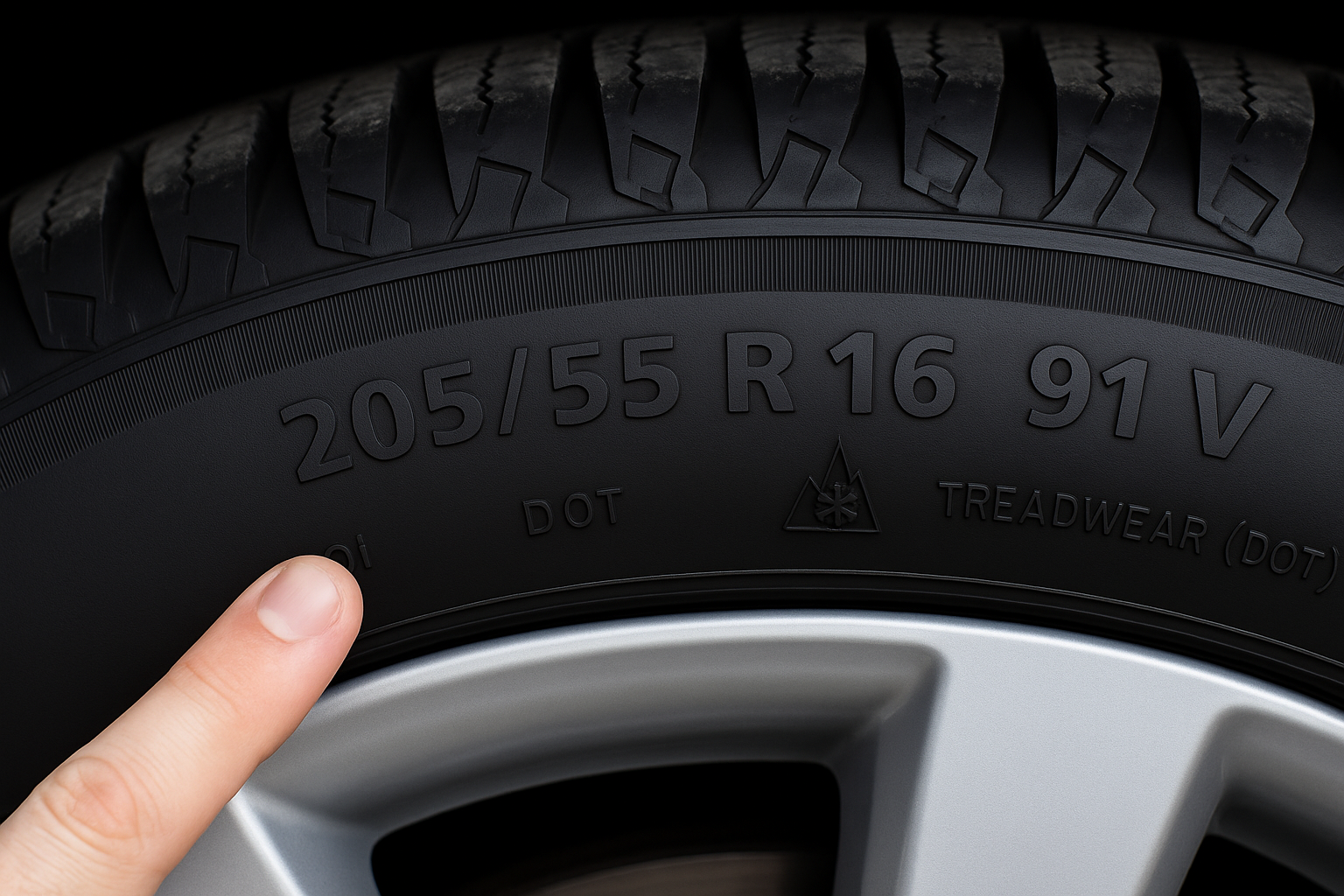
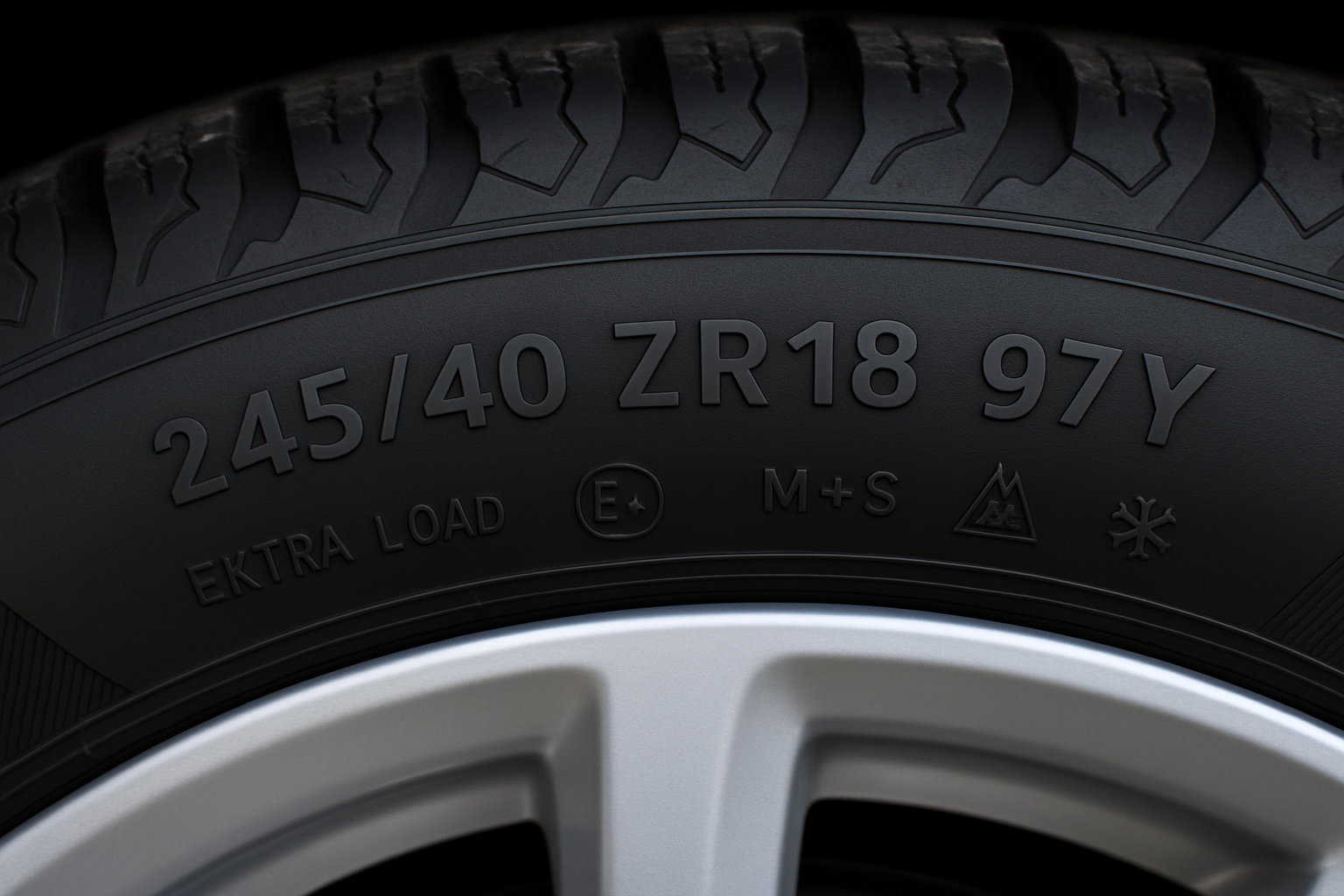
The numbers and letters inscribed on the sidewall of a tire provide many important information. They indicate, among other things, its dimensions, load capacity, maximum speed, date of manufacture, and homologations.
To know How to read a tire This therefore allows you to check its compatibility with the vehicle. Moreover, this reading makes it easier to compare several models. Before ordering new ones car tyres, Therefore, it is essential to know the meaning of these markings.
Summary
- Why learn to read a tire?
- How to read the dimension 205/55 R16 91V?
- Understanding the load and speed indicators
- Recognizing the main markings
- Difference between M+S and 3PMSF
- Identifying the manufacturer approvals
- Read the DOT code and the tire age
- Understanding the European label
- Identifying the mounting sense and the wear indicators
- Reading a tire according to the type of vehicle
- Can I change the tire size?
- Checks to be performed before purchase
- Frequently Asked Questions
1. Why learn to read a tire?
Choosing a tire doesn’t just involve finding a model whose diameter matches that of the rim. In fact, each dimension also has a load index, a speed index, and sometimes a special homologation.
A good reading of the flank allows, among other things:
- to comply with the manufacturer's recommendations;
- maintain a balanced driving behavior;
- avoiding a dimension error;
- choose a tire suitable for the season;
- check the date of manufacture;
- recognize a reinforced tire or RunFlat;
- facilitate the search for a new model.
Therefore, it is preferable to measure the entire marking rather than just the rim dimension.
2. How to read the dimension 205/55 R16 91V?
Let’s take the current example 205/55 R16 91V.
| Marking | Significance |
|---|---|
| 205 | nominal tire width in millimeters |
| 55 | the height of the flank is equal to 55 % of the width |
| R | radial structure |
| 16 | Inner diameter of the tire, in inches |
| 91 | Load index |
| V | Speed index |
What does the number 205 mean?
The number 205 corresponds to the nominal width of the tire. This width is expressed in millimeters.
However, the actual width may vary slightly depending on the tire used, the pressure, and the manufacturer's design.
What does the number 55 mean?
The number 55 represents the ratio between the height of the sidewall and the width of the tire.
In this example, the height of the flank corresponds to 55 % of 205 mm. This number does not directly indicate a height in millimeters.
What does the letter R mean?
The letter R Indicates a radial construction. Today, this structure equips the vast majority of private vehicles.
Less frequently, the letter D can indicate a diagonal construction on certain specific tires.
What does the number 16 mean?
The number 16 corresponds to the diameter of the compatible rim. It is expressed in inches.
Thus, a R16 tire must be installed on a 16-inch rim. It cannot be mounted on a 15 or 17-inch rim.
What does 91V mean?
Finally, 91 represents the load index and V the speed index. In this example, the index 91 corresponds to a maximum load of 615 kg per tire. The letter V, on the other hand, corresponds to a theoretical maximum speed of 240 km/h.
3. Understanding load and speed indicators
The load index indicates the maximum weight that the tire can withstand under defined conditions of use.
Here are some examples:
| Load indicator | Maximum charge |
|---|---|
| 80 | 450 kg |
| 85 | 515 kg |
| 91 | 615 kg |
| 95 | 690 kg |
| 100 | 800 kg |
The speed index, for its part, indicates the maximum speed corresponding to the characteristics of the tire.
| Speed index | Maximum speed |
|---|---|
| T | 190 km/h |
| H | 210 km/h |
| V | 240 km/h |
| W | 270 km/h |
| Y | 300 km/h |
These values obviously do not constitute an authorization to exceed the speed limits.
Before purchasing, always consult the vehicle manual, the label located in the door frame, or the original tires. For more information, consult our complete list of tire sizes. load and speed indices.
4. Recognizing the main markings on a tire
In addition to the dimension, several letters or symbols may appear on the side.
XL or Extra Load
The marking Extra Large refers to a reinforced tire. It can withstand a higher load than the standard version of the same size, provided that the pressure is adjusted accordingly.
However, XL does not mean RunFlat. These are two different technologies.
RunFlat, RFT, SSR, ZP or ROF
These inscriptions designate different flat-rolling technologies. Thanks to reinforced sidewalls, the driver can continue to drive after a loss of pressure.
Nevertheless, the allowed distance and speed vary depending on the manufacturer. Moreover, these tires must be compatible with the vehicle and its pressure control system.
Tubeless or TL
The term Tubeless, sometimes abbreviated TL, indicates that the tire operates without an air chamber.
Conversely, the TT marking usually means that the tire must be used with an air chamber.
Followed by a number
An E surrounded by a circle, followed by a number, indicates approval in accordance with an international regulation applicable to tires.
The number identifies the country that issued this homologation. It therefore does not indicate the quality or the country of manufacture of the tire.
FR, MFS or FP
These letters usually indicate the presence of a rim intended to protect the tire. However, the name of the marking may vary depending on the manufacturer.
Pneus Online also lists numerous flat-tire codes, rim protection codes, and manufacturer homologation codes.
5. What is the difference between M+S and 3PMSF?
The markings Mud and Snow and 3PMSF They are often confused. However, they do not guarantee the same level of validation.
Mud and Snow
M+S stands for Mud and Snow, Either mud and snow. This marking is mainly based on the manufacturer's classification.
Therefore, it is not sufficient in itself to prove that the tire has passed a standardized test for performance on snow.
3PMSF
The 3PMSF symbol represents a mountain with three peaks containing a snowflake. It confirms that the tire has passed a regulated test for traction on snow.
This symbol is found on many winter tyres, But also on some all-season tyres.
In France, in the areas covered by the Montagne law, only 3PMSF tires are now recognized as winter tires equivalent to removable devices. Otherwise, the driver must possess a chains or snow socks adapted.
6. Identify the manufacturer's homologations
Some tires are developed with an automobile manufacturer. In that case, they bear a specific code.
| Manufacturer | Examples of markings |
|---|---|
| BMW | star * |
| Mercedes-Benz | MO, MOE |
| Audi | AO, AO1, R01 |
| Porsche | N0, N1, N2 |
| Tesla | T0, T1, T2 |
| Volkswagen | VW, VO |
| Volvo | VOL |
These tires can be equipped with a structure, a rubber compound or an acoustic adjustment adapted to certain vehicles.
However, a manufacturer's marking does not always mean that the tire can be used on any other model. Therefore, it is necessary to follow the vehicle's recommendations and maintain consistent tire pressure on the same axle.
7. Read the DOT code and know the age of the tire
The DOT code allows, among other things, to identify the tire’s production period. The last four digits correspond to the week and year of production.
For example:
DOT XXXXXXXX 3522
- 35 corresponds to the 35th week;
- 22 corresponds to the year 2022.
The complete code may appear on only one side of the tire. Therefore, it is sometimes necessary to observe the inner sidewall.
Age alone is not enough to decide on a replacement. However, an old tire must be carefully inspected. Cracks, deformation, loss of pressure, or damaged rubber require the advice of a professional.
Also check out our tips for more information When to change your tyres.
8. Understanding the European tire label
The European label complements the information visible on the sidewall. It allows you to compare several tires based on three main criteria:
- energy efficiency ;
- wet grip; ;
- external rolling noise.
The energy performance and grip on wet ground are rated from A to E. The sound level is indicated in decibels and is complemented by a class.
In addition, the label can display a 3PMSF pictogram or a symbol of grip on ice when the tire meets the relevant criteria.
However, this label does not measure all performance. It therefore does not replace comparative tests focusing on aquaplaning, wear, comfort or driving performance.
9. Identify the mounting instructions and wear indicators
The tread design directly influences the tire assembly.
Directional tire
A directional tire includes an arrow accompanied by the word Rotation. This arrow must follow the direction of rotation of the wheel as the vehicle moves forward.
Otherwise, the water evacuation may be less effective.
Asymmetric tire
An asymmetrical tire has two distinct sides:
- Outside must be placed towards the outside;
- Inside It must be oriented towards the interior of the vehicle.
The tire can rotate in both directions. However, its internal and external orientations must be respected.
Witness to wear and tear
The letters TWI or a small triangle indicate the location of the wear marks in the grooves.
When the rubber reaches these marks, the depth of the sculptures has reached the regulatory limit. However, it is preferable not to wait until this limit is reached if the adhesion becomes insufficient, especially on wet roads.
10. Reading a tire according to the vehicle type
Some markings depend directly on the intended use.
Tires for SUVs and 4×4
SUV tires often have high load indices. However, not all SUVs automatically require an XL tire.
Therefore, it is necessary to follow the dimensions and the indicators approved by the manufacturer.
Tires for commercial vehicles
The letter C, placed after the dimension, generally refers to a tire intended for vans and utility vehicles.
These models are designed to support heavy loads. You can compare the performance of the Commercial tyres depending on your vehicle.
Tires for motorhomes
The marking Postage Stamp It can appear on tires specially designed for motorhomes. These vehicles often remain loaded for long periods of time.
Furthermore, their pressure must correspond to the recommendations of the vehicle manufacturer and of the tire manufacturer.
Motorcycle tires
A marking like 120/70 ZR17 M/C 58W It is read according to the same principle:
- 120: width in millimeters;
- 70: ratio between height and width;
- ZR: radial construction for a high-speed category;
- 17: rim diameter;
- M/C: tire intended for motorcycles;
- 58W: charge and speed indicators.
Find the dimensions and models available in our selection of motorcycle tires.
Tyres for electric vehicles
There is no single and mandatory EV marking for all tires. However, some manufacturers use codes such as EV, ELECT or EDT.
First and foremost, the tire must comply with the dimensions and markings imposed by the vehicle. The load, noise, wear, and rolling resistance are also important factors. Discover our range tyres for electric vehicles.
11. Is it possible to change the tire size?
A different dimension can sometimes be homologated. However, it is not enough to maintain a close outer diameter.
It is also necessary to check:
- the width of the rim;
- the space available in the wheel arch ;
- the load and speed indices ;
- compatibility with the brakes;
- the operation of the meter and electronic aids;
- the dimensions authorized by the manufacturer.
A wider tire can improve certain driving sensations. However, it can also increase noise, weight, or rolling resistance.
Conversely, a narrower tire is not automatically compatible. Before making any changes, please consult our guide on tire sizes.’equivalence of tires.
12. Checks to be carried out before purchase
Before ordering a new tire, check the following:
- the width, height and diameter;
- the load index ;
- the speed index ;
- tyre season ;
- 3PMSF marking if necessary;
- the possible presence of a manufacturer homologation;
- the RunFlat or standard technology;
- the direction of assembly; ;
- compatibility with the vehicle.
Then, check the tyre pressure. Proper pressure promotes regular wear, good stability and controlled consumption.
Finally, have the assembly and balancing done by a professional. You can search for one Pneus Online fitting centre partner near you.
13. FAQ — How to read a tire?
How to read a 205/55 R16 91V tire?
205 indicates the width of the tire. Then, 55 indicates the height of the sidewall as a percentage of the width. R corresponds to a radial structure and 16 to the diameter of the rim. Finally, 91 and V represent the load and speed indices.
What is the difference between M+S and 3PMSF?
M+S is a designation related to mud and snow. However, the 3PMSF symbol indicates that the tire has passed a regulated test for performance on snow.
What does XL mean on a tire?
XL stands for Extra Load. The tire therefore has a load capacity that is higher than that of a comparable standard version. However, it is not necessarily a RunFlat tire.
What does the DOT code mean?
The last four digits of the DOT code indicate the week and year of manufacture. Thus, 3522 corresponds to the 35th week of 2022.
What does the letter V on a tire mean?
The letter V represents the speed index. It corresponds to a theoretical maximum speed of 240 km/h under the conditions specified for the tire.
Can you fit a higher load index?
Yes, a higher load index is generally possible if the other characteristics remain compatible. However, it is not advisable to choose a load index lower than the recommended one without professional validation.
How to recognize a directional tire?
An arrow accompanied by the word Rotation appears on the side. This arrow must follow the direction of rotation of the wheel as the vehicle moves forward.
Where can I find the recommended pressure?
The pressure is usually indicated in the door trim, on the fuel tank cap or in the vehicle manual. It must be checked on cold starting.
Conclusion
Knowing how to read a tire allows you to avoid many mistakes. The size remains essential, but the indicators, homologations and seasonal symbols are just as important.
Before choosing your new ones tyres, Therefore, compare all the information present on the side. In case of doubt, refer to the vehicle manual or ask a professional for advice.